🧪 Chemistry · Organic 🔥 Day 1
0/5 topics mastered

Organic Chemistry

GOC · Hydrocarbons · Functional Groups · Biomolecules & Polymers

⚗
Purification & Characterisation
Purification methods · Lassaigne's test · quantitative estimation · formula determination

1. Purification Methods

MethodPrincipleTypical use
CrystallisationDifferential solubility in hot vs cold solventSugar, aspirin, amino acids
SublimationSolid → vapour → solid, bypassing the liquid phaseCamphor, naphthalene, iodine, NH₄Cl, benzoic acid
DistillationSeparation by boiling pointSimple (wide bp gap), fractional (close bp), steam (immiscible + thermolabile), vacuum (high bp + thermolabile)
Solvent extractionPartition between two immiscible solventsExtracting a solute into ether; many small extractions beat one large
ChromatographyDifferential migration over a stationary phaseColumn, TLC, paper, gas (GLC)

For TLC/paper chromatography the retardation factor is \(R_f = \dfrac{\text{distance moved by solute}}{\text{distance moved by solvent front}}\), always between 0 and 1. A higher \(R_f\) means the compound is less adsorbed by the stationary phase.

2. Qualitative Analysis — Lassaigne's Sodium Fusion Test

Fusing the compound with sodium converts covalent N, S and halogens into ionic forms (NaCN, Na₂S, NaX) detectable in the water extract (SFE):

ElementReagentObservation
NitrogenFeSO₄, then conc. H₂SO₄Prussian blue
SulphurSodium nitroprussideViolet colour
ChlorineAgNO₃ (after dil. HNO₃)White ppt (AgCl), soluble in dil. NH₃
BromineAgNO₃Pale-yellow ppt (AgBr), soluble in conc. NH₃
IodineAgNO₃Yellow ppt (AgI), insoluble in NH₃

3. Quantitative Analysis

  • Carbon & hydrogen: Liebig combustion over CuO; CO₂ absorbed in KOH, H₂O in anhydrous CaCl₂.
  • Nitrogen: Dumas method (measure N₂ volume) or Kjeldahl method (back-titrate the liberated NH₃). Kjeldahl fails for N in aromatic rings, nitro, azo and N–N / N–O compounds.
  • Halogens & sulphur: Carius method — halogen precipitated as AgX, sulphur as BaSO₄.
💡 Exam tip: if both N and S are present, fusion gives NaSCN and the nitrogen Prussian-blue test can fail — boil the extract with excess sodium before testing for nitrogen.
⚠ Common trap: a lower \(R_f\) means the compound is more strongly adsorbed on the stationary phase (it moved less), not less.
⚗
Purification — Formulas
Percentage composition & formula determination
% Carbon
$$ \%\,\text{C} = \frac{12}{44}\times\frac{m(\text{CO}_2)}{m}\times100 $$
From combustion; \(m\) = mass of compound
%
% Hydrogen
$$ \%\,\text{H} = \frac{2}{18}\times\frac{m(\text{H}_2\text{O})}{m}\times100 $$
Note denominator 18, not 2
%
% Nitrogen (Dumas)
$$ \%\,\text{N} = \frac{28\,V_{\text{N}_2}}{22400\,m}\times100 $$
\(V\) in mL at STP
%
% Nitrogen (Kjeldahl)
$$ \%\,\text{N} = \frac{1.4\,M\,V}{m} $$
\(M,V\) of the acid used by NH₃
%
% Chlorine (Carius)
$$ \%\,\text{Cl} = \frac{35.5}{143.5}\times\frac{m(\text{AgCl})}{m}\times100 $$
Sulphur: use 32/233 with BaSO₄
%
Retardation factor
$$ R_f = \frac{\text{solute distance}}{\text{solvent-front distance}} $$
Between 0 and 1
—
⚗
Purification — Solved Examples
NEET · JEE Main level
Example 1 Easy NEET pattern
Combustion of 0.20 g of a compound gives 0.44 g CO₂ and 0.18 g H₂O. Find % C, % H and % O.
  1. \(\%\,\text{C} = \dfrac{12}{44}\times\dfrac{0.44}{0.20}\times100 = 60\%\)
  2. \(\%\,\text{H} = \dfrac{2}{18}\times\dfrac{0.18}{0.20}\times100 = 10\%\)
  3. \(\%\,\text{O} = 100 - 60 - 10 = 30\%\)
✓ C 60% · H 10% · O 30%
Example 2 Medium NEET pattern
A compound is C 40%, H 6.67%, O 53.33%; molecular mass 180. Find the empirical and molecular formulas.
  1. Mole ratios: C = 40/12 = 3.33, H = 6.67/1 = 6.67, O = 53.33/16 = 3.33
  2. Divide by smallest → C 1, H 2, O 1 → empirical CH₂O (EFM 30)
  3. \(n = \dfrac{180}{30} = 6\) → molecular formula C₆H₁₂O₆
✓ Empirical CH₂O; molecular C₆H₁₂O₆ (glucose)
Example 3 Hard JEE Main pattern
In a Carius estimation, 0.20 g of a chlorine-containing compound gives 0.287 g AgCl. Find % Cl.
  1. \(\%\,\text{Cl} = \dfrac{35.5}{143.5}\times\dfrac{0.287}{0.20}\times100\)
  2. \(= \dfrac{35.5 \times 0.287}{143.5 \times 0.20}\times100 = 35.5\%\)
✓ % Cl = 35.5%
⚗
Purification — Quick Quiz
tap an option to reveal the answer
Question 1
In TLC, a compound with \(R_f = 0.2\) versus one with \(R_f = 0.8\): which is more strongly adsorbed on the stationary phase?
A low \(R_f\) means the compound moved little relative to the solvent front — it was more strongly retained (adsorbed) by the stationary phase.
Question 2
A silver halide from the Lassaigne test is a yellow precipitate insoluble in ammonium hydroxide. The halogen is:
AgCl is white (soluble in dil. NH₃), AgBr pale-yellow (soluble in conc. NH₃), AgI yellow and insoluble in NH₃ → iodine.
Question 3
Kjeldahl's method cannot reliably estimate nitrogen in:
Ring nitrogen (pyridine), nitro, azo and N–N / N–O compounds do not convert to ammonium sulphate under Kjeldahl digestion; use the Dumas method instead.
🧬
General Organic Chemistry (GOC)
Electronic effects · Intermediates · Isomerism · IUPAC

Electronic Effects

Four effects govern electron distribution and reactivity in organic molecules:

Inductive Effect (–I / +I)

Through-σ-bonds electron withdrawal (–I: F, Cl, NO₂, CN) or donation (+I: alkyl, O⁻, COO⁻). Decreases rapidly with distance — negligible beyond 3 bonds.

Order –I: F > Cl > Br > I > OH > OR > NH₂ > C₆H₅ > H

Order +I: C(CH₃)₃ > CH(CH₃)₂ > C₂H₅ > CH₃ > H

Resonance (Mesomeric) Effect (–R / +R)

Through-π-system delocalization. –R groups withdraw (NO₂, CN, CHO, COOH, COR), +R groups donate (OH, OR, NH₂, NR₂, halogens via lone pairs).

Conditions: atoms must be coplanar, conjugated system required. Resonance structures differ only in electron positions — not atom positions.

Hyperconjugation (Baker–Nathan)

σ(C–H) electrons of an α-C overlap with adjacent empty/π orbital. Stabilises carbocations, free radicals, alkenes.

Stability ∝ number of α-H: (CH₃)₃C⁺ (9H) > (CH₃)₂CH⁺ (6H) > CH₃CH₂⁺ (3H)

Alkene stability: more substituted = more hyperconjugation = more stable.

Electromeric Effect (E)

Complete, instantaneous π-electron transfer to one atom under reagent attack. Temporary (unlike resonance). +E towards attacking electrophile; –E towards attacking nucleophile.
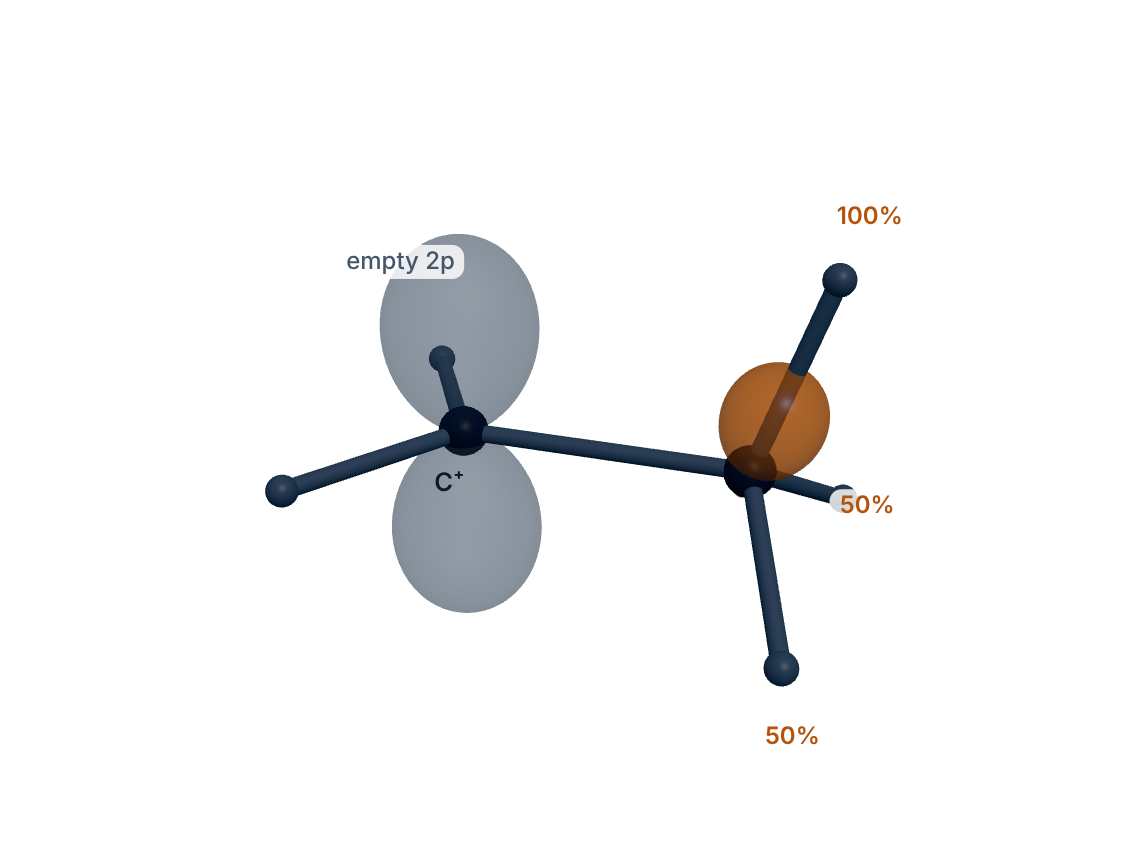
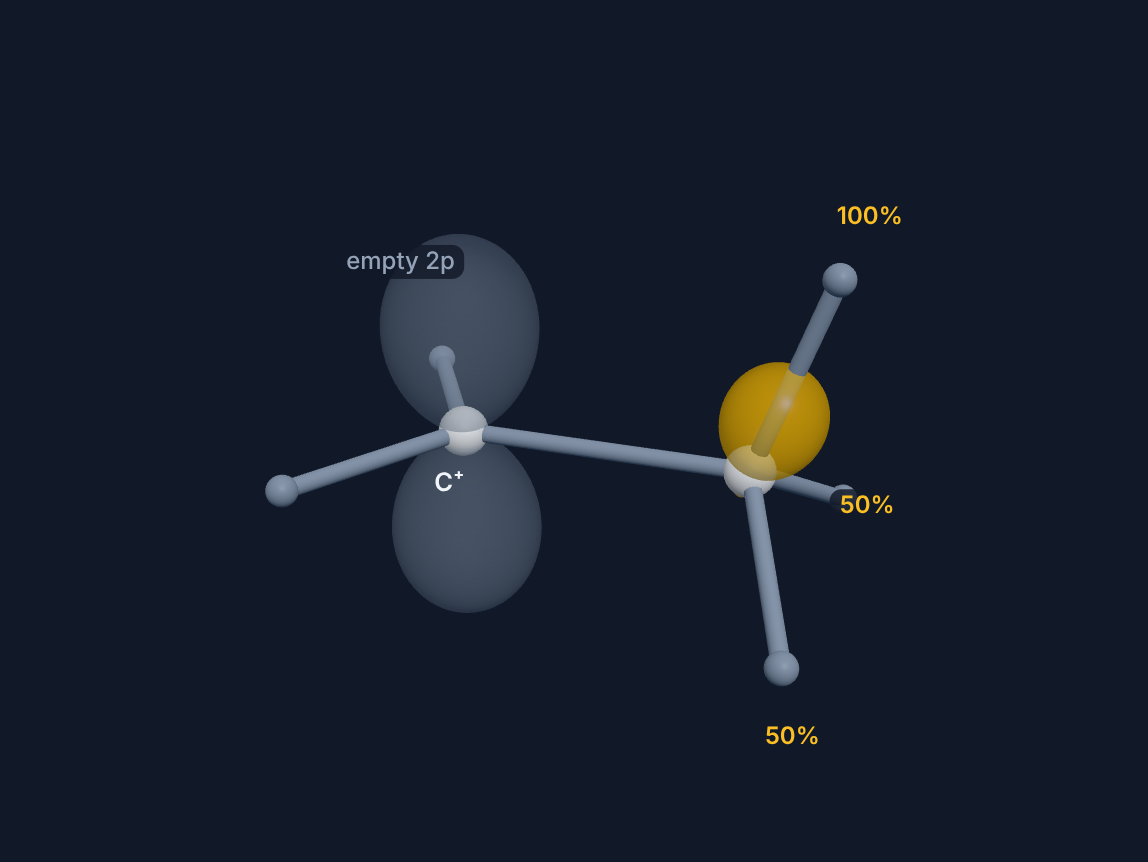
Hyperconjugation in 3D — In a carbocation the C⁺ is sp² and its 2p orbital is empty. In the ethyl cation a C–H bond of the next carbon lined up with that 2p overlaps it, and its electrons spread into it: this is hyperconjugation. The overlap goes as cos θ, with θ the angle between the C–H bond and the 2p: lined up, one C–H overlaps fully (100%) and the other two half as much (50%); turn the CH₃ by 90° and that C–H lies in the node (0%) while the other two swing to 87%. The three together give the same total at any angle, so what counts is the number of α-H: 3 in CH₃CH₂⁺, 6 in (CH₃)₂CH⁺ and 9 in (CH₃)₃C⁺, which is why 3° > 2° > 1°. Sizes are not to scale.

Reaction Intermediates

IntermediateStructureHybridisationGeometryStability order
Carbocation (R⁺)C with empty orbitalsp²Planar3° > 2° > 1° > CH₃⁺; allylic ≈ benzylic >> 2°; vinyl/phenyl: most unstable
Carbanion (R⁻)C with lone pairsp³Pyramidal3° < 2° < 1° < CH₃⁻ (induction); sp > sp² > sp³ (s-character holds e⁻ closer)
Free radical (R•)C with unpaired e⁻sp² / sp³Planar/pyramidal3° > 2° > 1° > CH₃• (hyperconj./induction)
Carbene (:C)Neutral C, 2 non-bonding e⁻sp²Singlet (paired) or triplet (unpaired)Singlet more reactive; triplet more stable
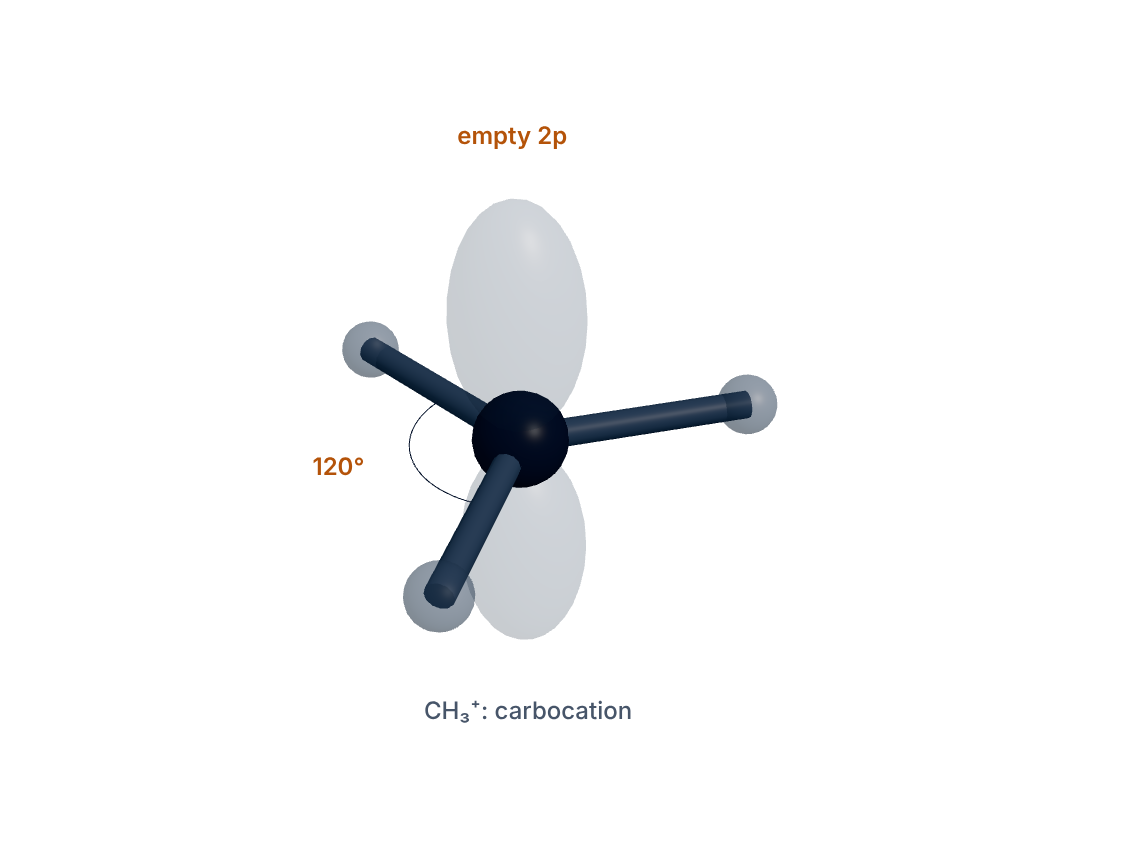
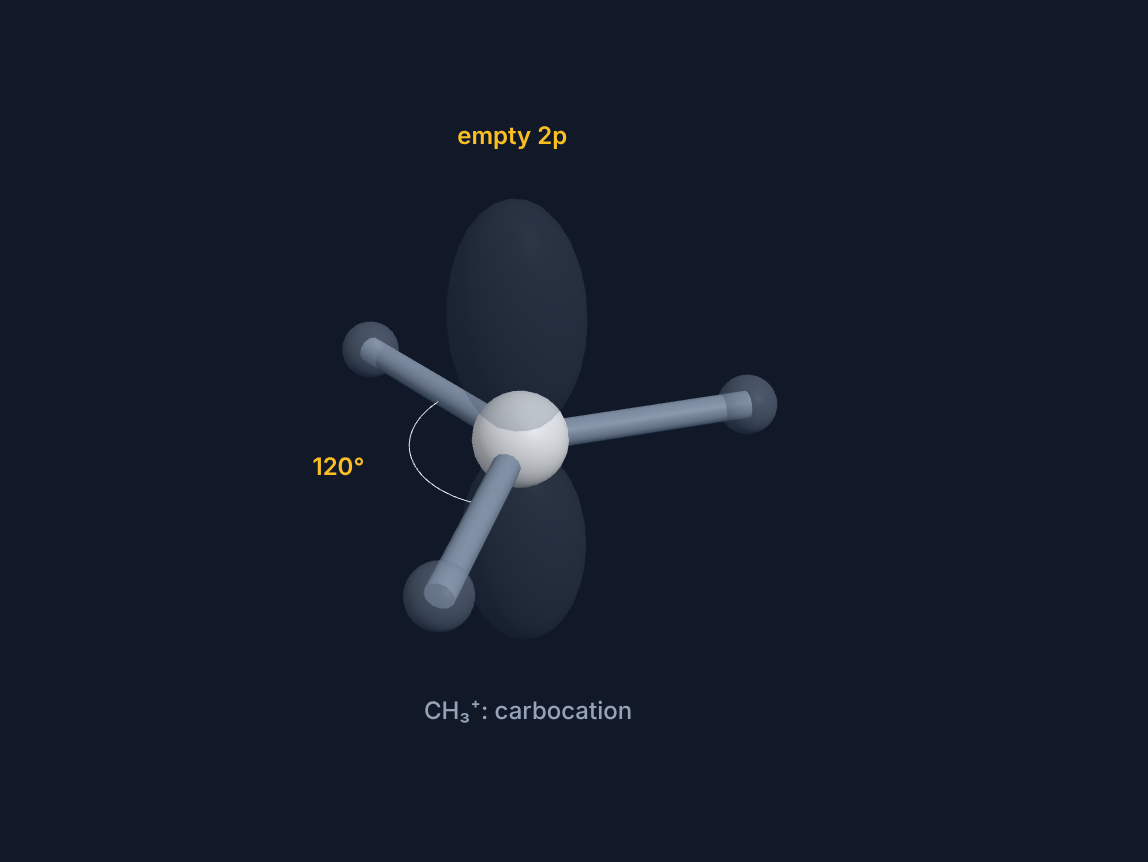
Reaction intermediates in 3D — In the carbocation CH₃⁺ the carbon is sp²: its three bonds lie in one plane, 120° apart, and the unhybridised 2p orbital, at right angles to that plane, is empty, so C⁺ has only six electrons round it. In the carbanion CH₃⁻ the carbon is sp³: a lone pair fills the fourth corner of the tetrahedron, so the three bonds make a pyramid (109.5° at the ideal angle) and C⁻ has eight electrons. The methyl radical CH₃• is planar like the cation, with its odd electron in the 2p and seven electrons round C; radicals with bulkier or more electronegative groups can be slightly pyramidal. A carbene, CH₂, has only two bonds and six electrons round C. In singlet CH₂ the carbon is sp², its two non-bonding electrons are paired in the third sp² orbital and the 2p is empty. In triplet CH₂ the same two electrons are unpaired, one in the sp² orbital and one in the 2p, with parallel spins. Both carbenes are drawn at the ideal sp² angle, 120°; the measured H–C–H angles are about 102° (singlet) and 134° (triplet). Orbitals are schematic and sizes are not to scale.

Types of Organic Reactions

TypeBond broken/formedExample
Substitution (S)One bond replaced by anotherSN1, SN2, electrophilic aromatic (EAS)
Addition (A)π-bond broken, two σ-bonds formedAlkene + HBr, Diels-Alder
Elimination (E)Two σ-bonds broken, π-bond formedE1, E2 (dehydrohalogenation)
RearrangementSkeleton rearranges1,2-hydride/methyl shift in carbocations
Oxidation-ReductionChange in O or H countOzonolysis, LiAlH₄ reduction

Homolytic vs. Heterolytic Fission

Homolytic Cleavage

Each atom takes one electron → free radicals. Favoured by non-polar bonds, UV light, high temperature, peroxides.

A:B → A• + B•

Heterolytic Cleavage

One atom takes both electrons → ions (carbocation + carbanion). Favoured by polar bonds, polar solvents, Lewis acids.

A:B → A⁺ + :B⁻ (or A:⁻ + B⁺)

Acidity & Basicity in Organic Chemistry

Acidity of O–H / N–H

Higher s-character → more acidic (sp C–H > sp² C–H > sp³ C–H). Electron-withdrawing groups increase acidity; EWG stabilise conjugate base.

Acid strength: RCOOH > C₆H₅OH > HOH > ROH > RC≡CH > RNH₂ > RH

Basicity of Amines

Lone pair availability: 3° > 2° > 1° > NH₃ in gas phase. In water: 2° > 1° > 3° > NH₃ (solvation). Aniline weakest (lone pair in resonance with ring).

Base strength (aq): (CH₃)₂NH > CH₃NH₂ > (CH₃)₃N > NH₃ > C₆H₅NH₂

Isomerism

TypeSub-typeBasis
Structural (Constitutional)Chain isomerismDifferent carbon skeleton
Position isomerismDifferent position of substituent/function group
Functional group isomerismDifferent functional groups (alcohol vs. ether)
StereoisomerismGeometric (cis/trans)Restricted rotation; different groups on each C of double bond
Optical (R/S)Non-superimposable mirror images (enantiomers); chiral centre
ConformationalRotation about C–C σ-bond (staggered vs. eclipsed)
TautomerismKeto–enol, lactam–lactim (proton shift)
💡Chiral centre: C attached to 4 different groups. Enantiomers: mirror images, equal & opposite optical rotation. Diastereomers: stereoisomers that are not mirror images. Meso compounds: chiral centres cancel — internally symmetric, optically inactive.
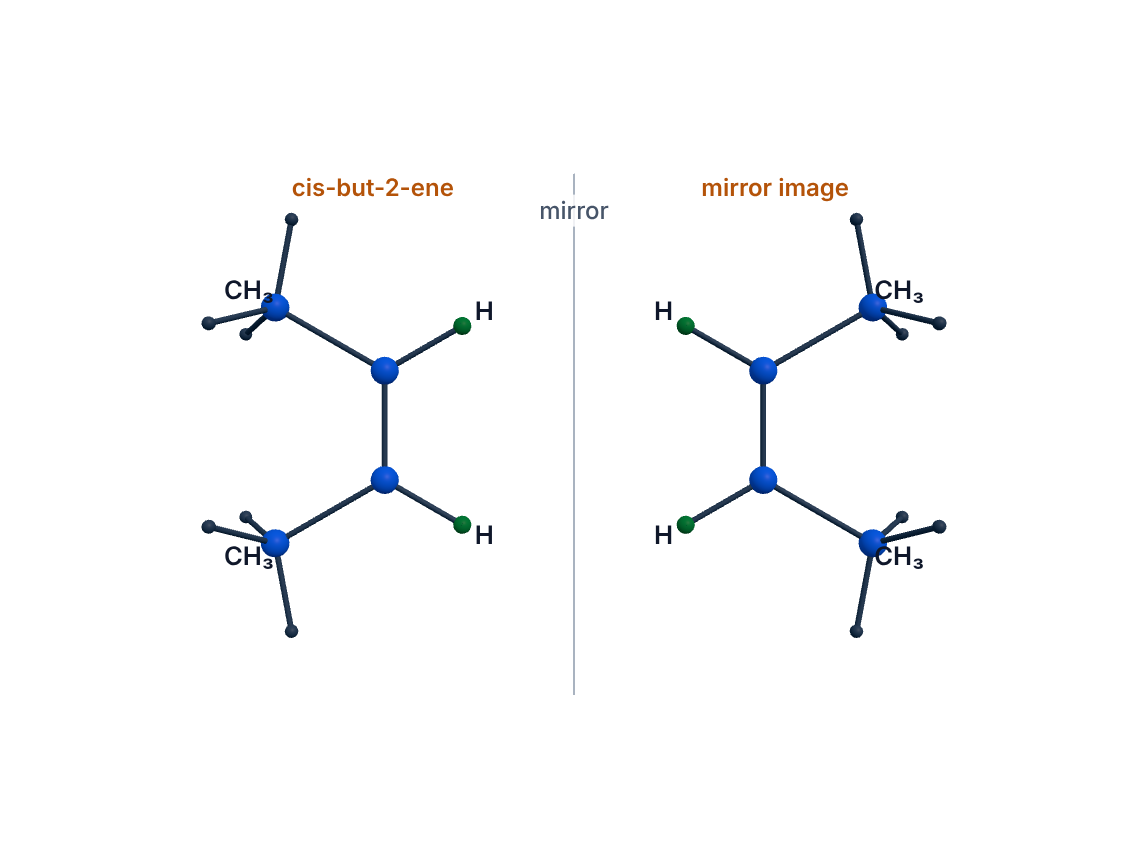
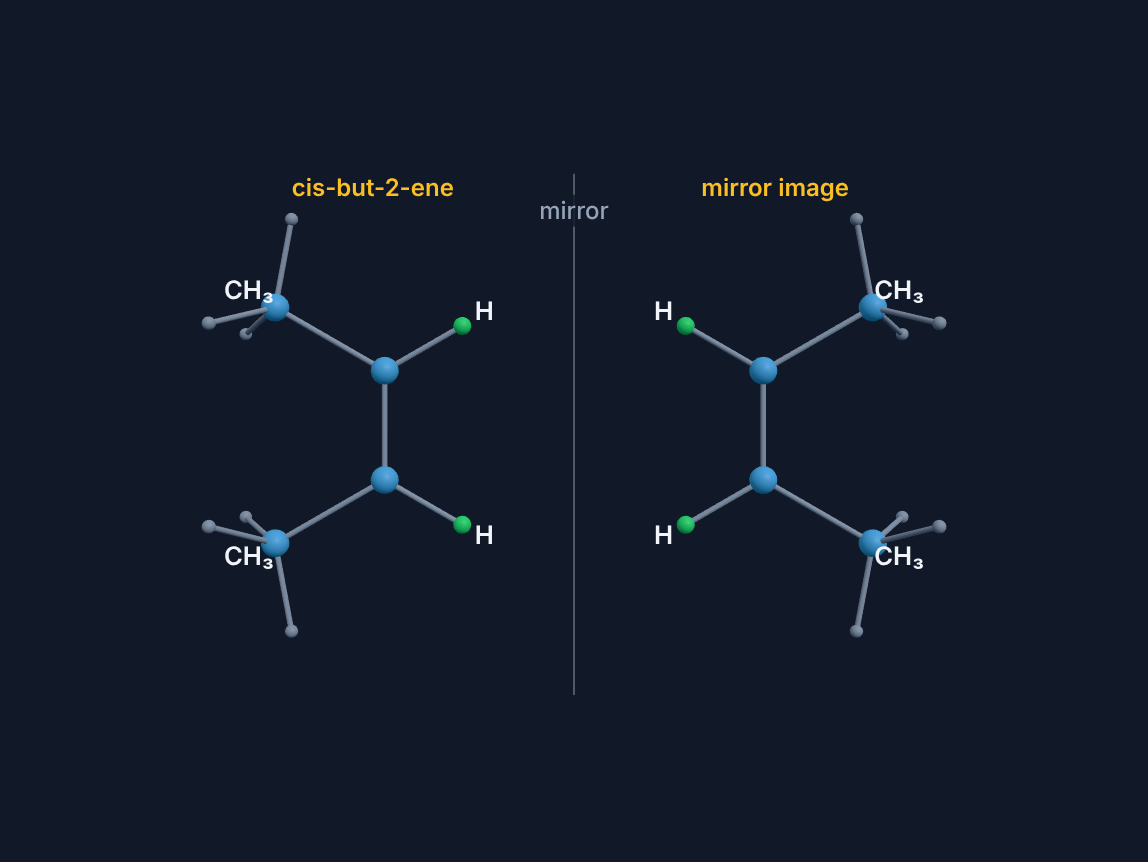
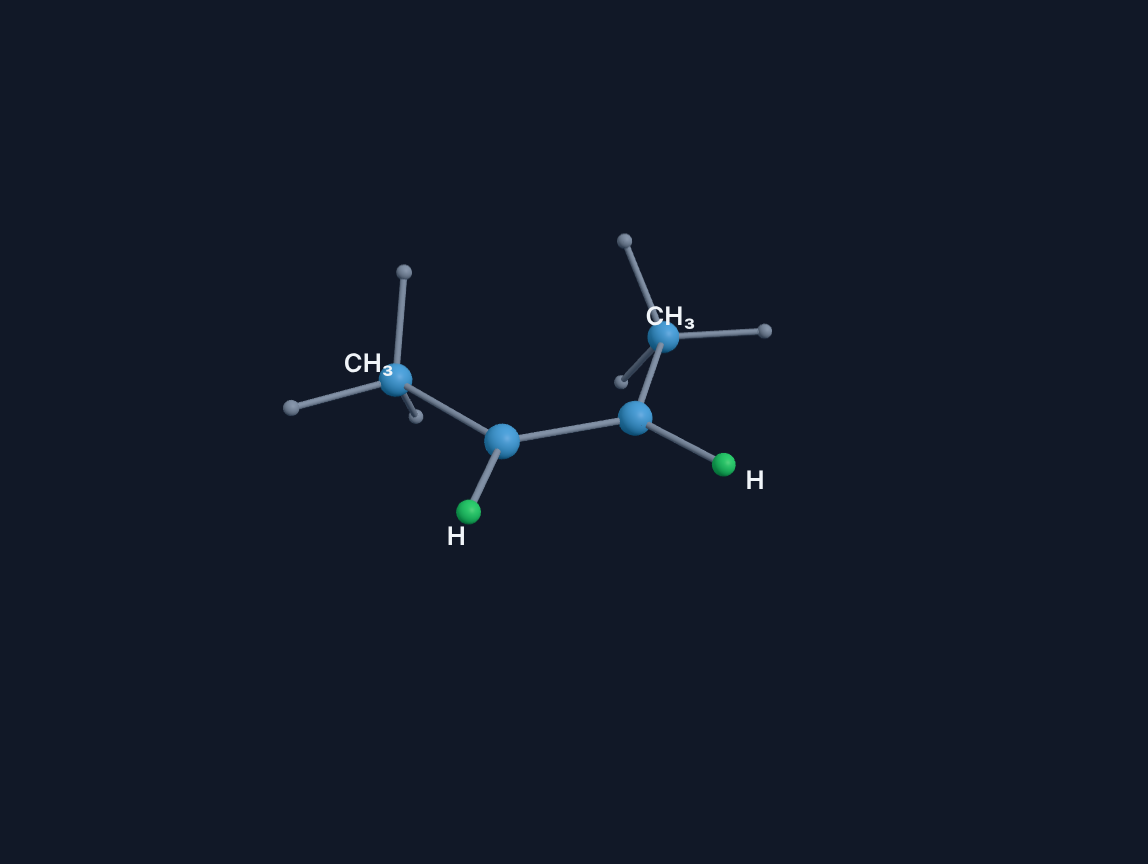
Geometric isomerism and restricted rotation in 3D — In but-2-ene, CH₃–CH=CH–CH₃, the two ends cannot turn about the C=C double bond (133 pm) without breaking its π bond: twisting one end by 90° costs about 262 kJ/mol (ChemPRIME’s calculation for cis-but-2-ene), so cis- and trans-but-2-ene do not interconvert at room temperature and can be separated. In cis-but-2-ene both methyl groups lie on the same side of the double bond (C–C=C–C dihedral 0°); in trans-but-2-ene they lie on opposite sides (dihedral 180°). The C–C single bonds are 154 pm. Geometric isomerism needs both restricted rotation and two different groups on each double-bonded carbon. Each isomer is shown beside its mirror image: a turn lays the image on the original, so neither is chiral (both are optically inactive).
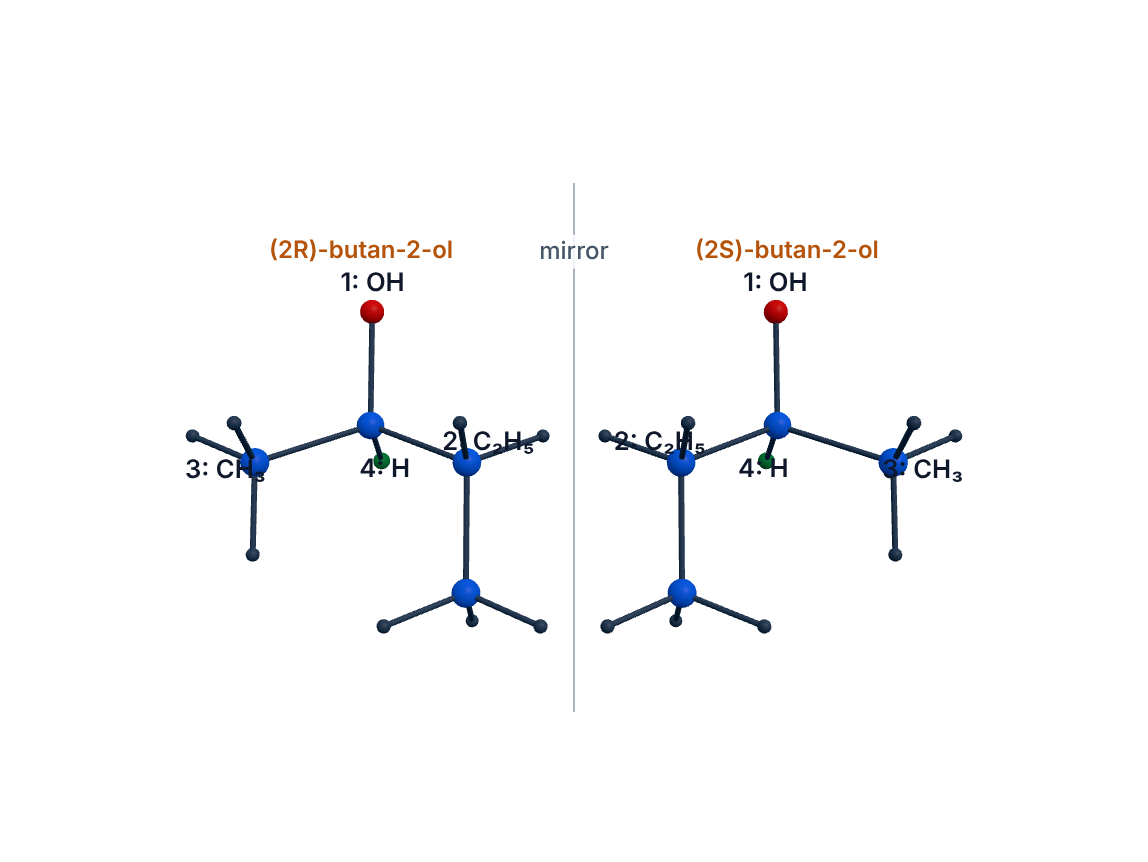
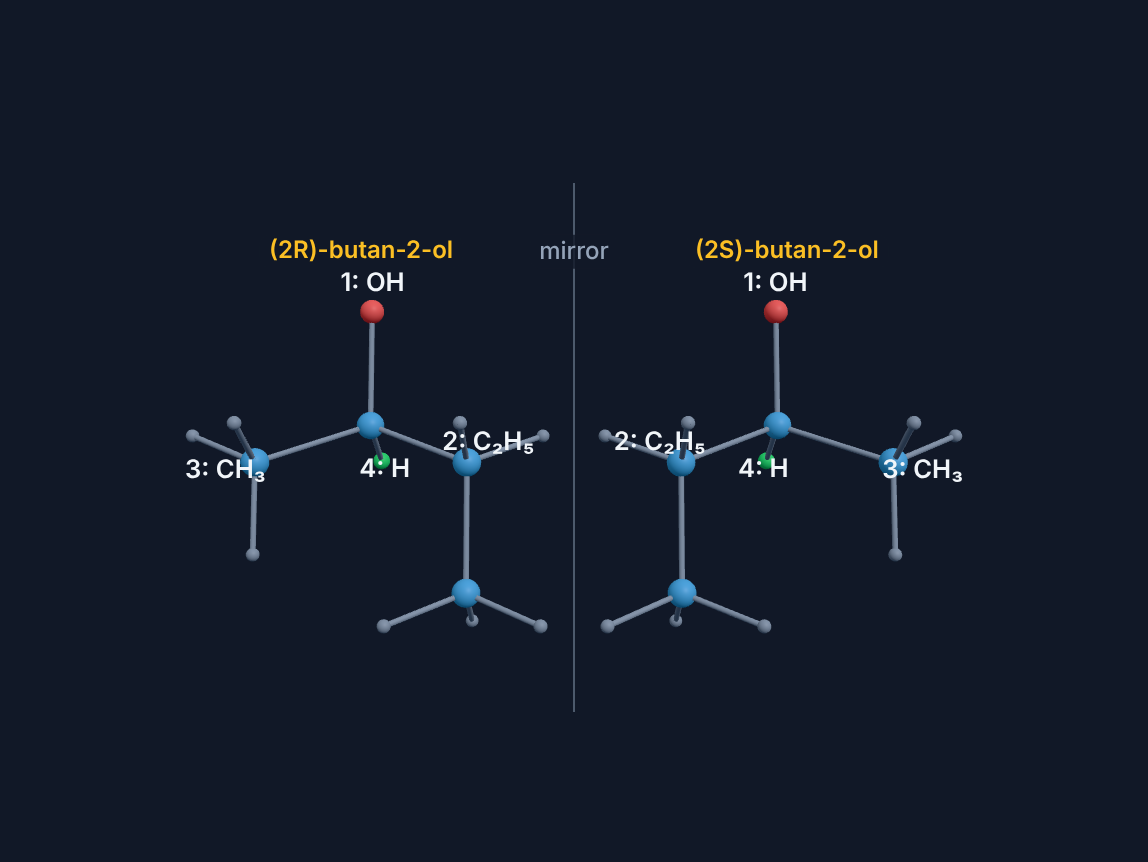
Chirality and CIP R/S assignment in 3D — In butan-2-ol, CH₃–CH(OH)–CH₂–CH₃, C2 is a chiral centre: it carries four different groups, –OH, –C₂H₅, –CH₃ and –H. The Cahn–Ingold–Prelog (CIP) rules rank them by atomic number at the first point of difference: priority 1 is –OH (oxygen, Z = 8); priority 2 is ethyl, whose carbon carries (C, H, H); priority 3 is methyl, whose carbon carries only (H, H, H); priority 4 is –H. Seen with the lowest priority (H) pointing away, 1 → 2 → 3 runs clockwise in (2R)-butan-2-ol and anticlockwise in its mirror image, (2S)-butan-2-ol. The two are non-superimposable mirror images (enantiomers): the best turn lays the image’s C–H and C–OH bonds on the original’s, but then its methyl sits where the ethyl was and its ethyl where the methyl was. R and S describe the arrangement only; whether a compound turns plane-polarised light to the right (+) or the left (−) has to be measured.
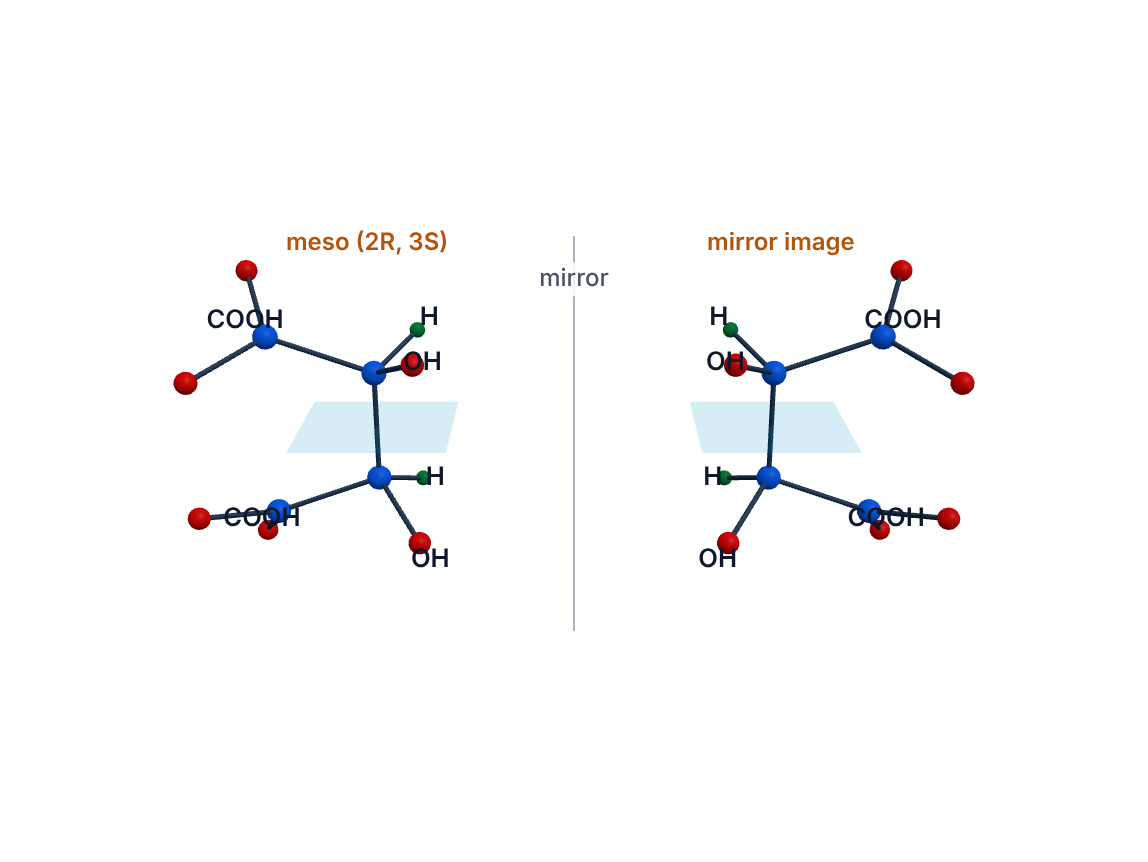
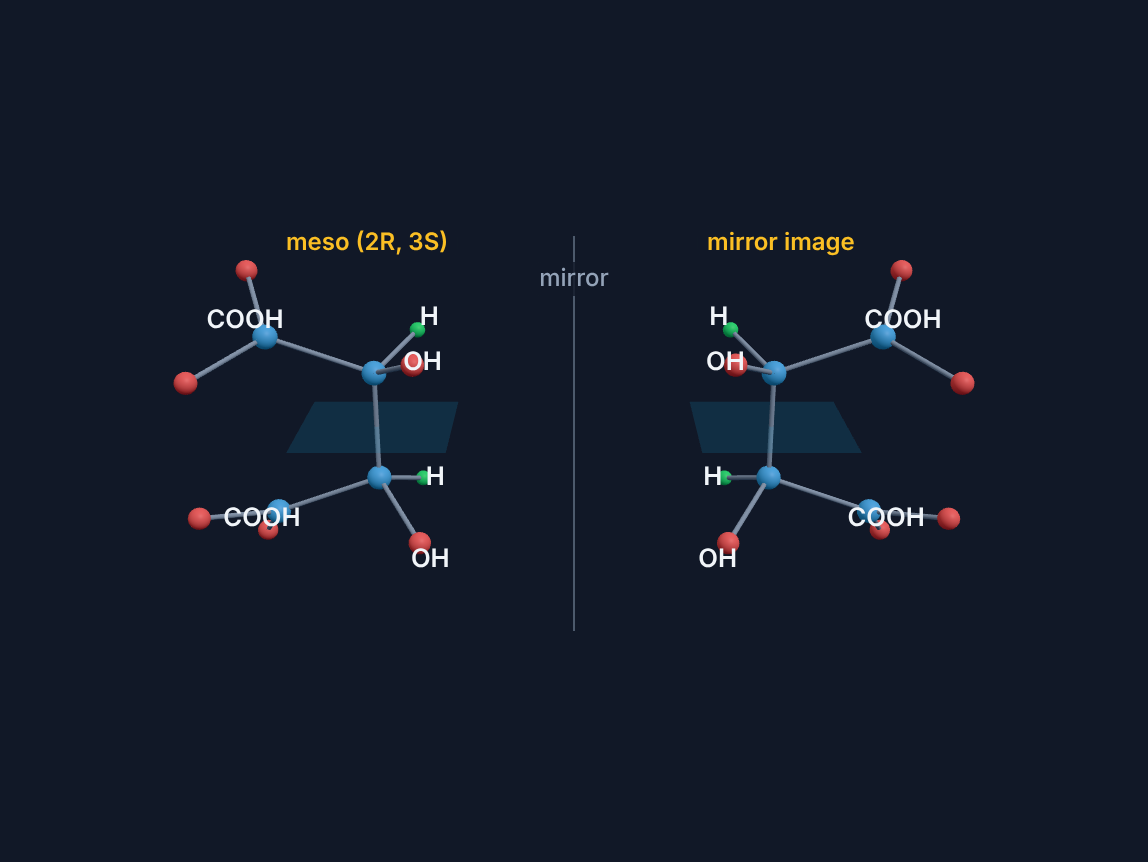
Meso compounds and diastereomers in 3D — Tartaric acid, HOOC–CH(OH)–CH(OH)–COOH, has two stereocentres, C2 and C3, carrying the same groups. In meso-tartaric acid (2R, 3S), held eclipsed about C2–C3, an internal plane of symmetry (σ, shaded) reflects the –COOH, –OH and –H on C2 onto those on C3. A turn lays its mirror image on it, so meso-tartaric acid is achiral and optically inactive: its two halves rotate light equally and oppositely (internal compensation). Two stereocentres allow 2² = 4 R/S assignments, but (2R, 3S) and (2S, 3R) are the same meso compound, so tartaric acid has only 3 stereoisomers: the meso form and the optically active pair (2R, 3R) and (2S, 3S), which have no internal mirror plane and are enantiomers. The meso form and either active form are diastereomers: they are not mirror images, they differ in physical properties such as melting point and solubility, and they can be separated by fractional crystallisation.
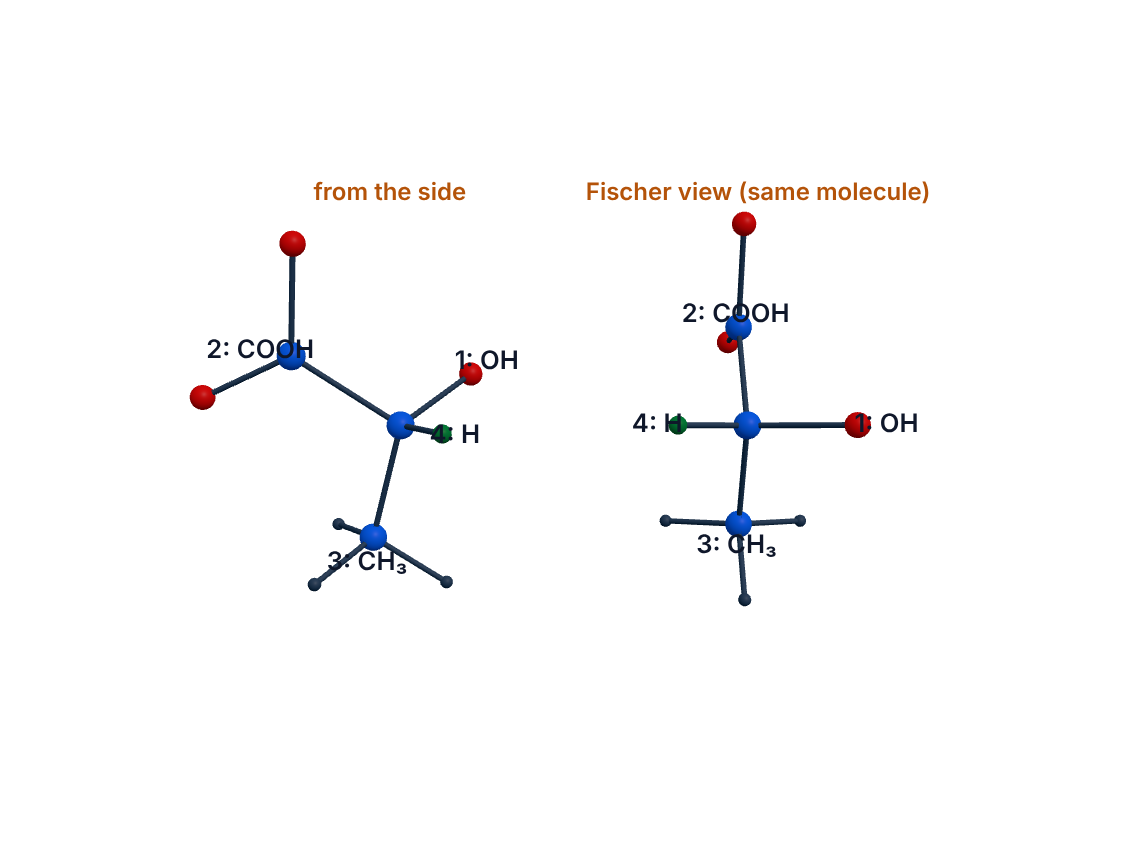
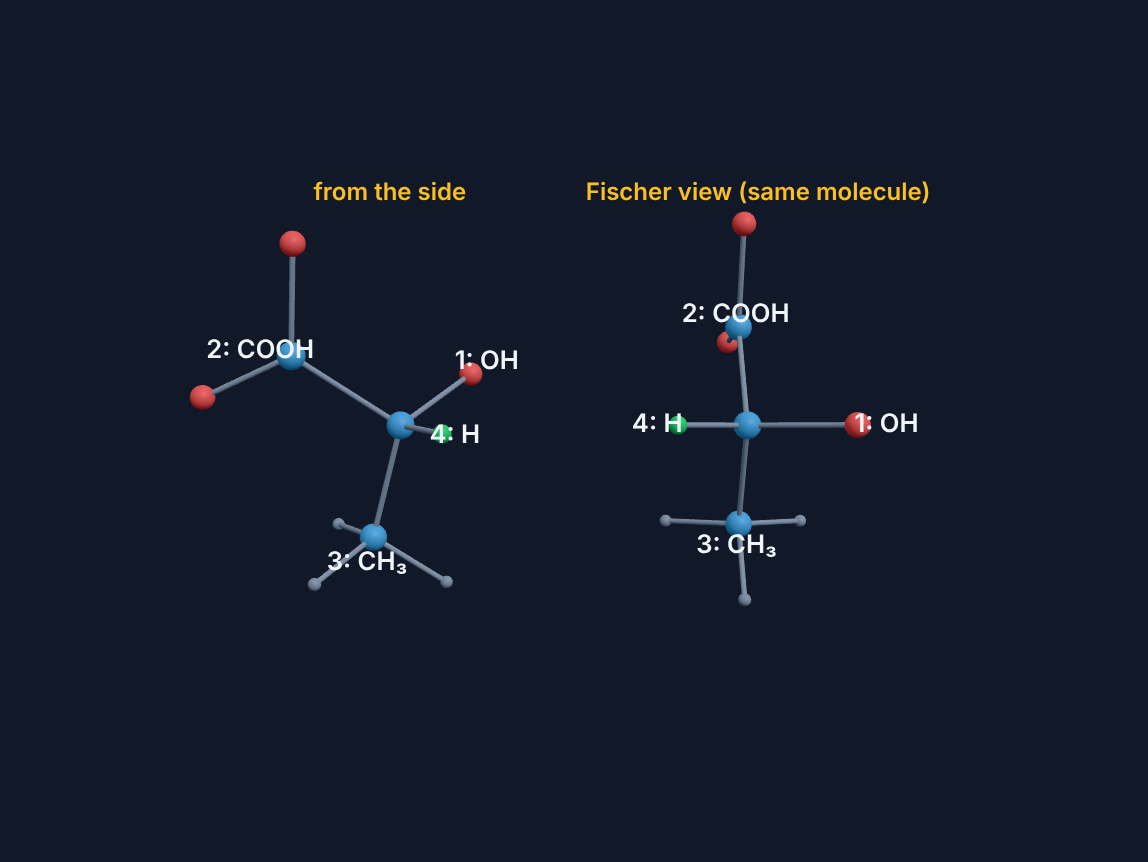
Fischer and wedge–dash projections in 3D — A Fischer projection draws a stereocentre as a cross. For lactic acid, CH₃–CH(OH)–COOH, C2 sits at the intersection, with the carbon chain vertical and the most oxidised carbon, –COOH, at the top. By convention the horizontal bonds (–OH and –H) point out of the page towards the observer (wedges) and the vertical bonds (–COOH and –CH₃) point into the page away from the observer (dashes); seen from the side, the vertical bonds lean back and the horizontal ones forward. Both views in the figure are the same molecule. Rotating a Fischer projection 180° in the plane keeps the horizontal bonds horizontal and the vertical bonds vertical, so it preserves the configuration; a 90° rotation in the plane swaps horizontal and vertical directions, inverting the stereocentre. To read R/S from a Fischer projection, trace 1 → 2 → 3: if the lowest-priority group (–H) lies on a horizontal bond (pointing towards you), the true configuration is the opposite of the one traced. Here 1 → 2 → 3 runs anticlockwise (apparently S) and H is horizontal, so this lactic acid, the D form, is (R).
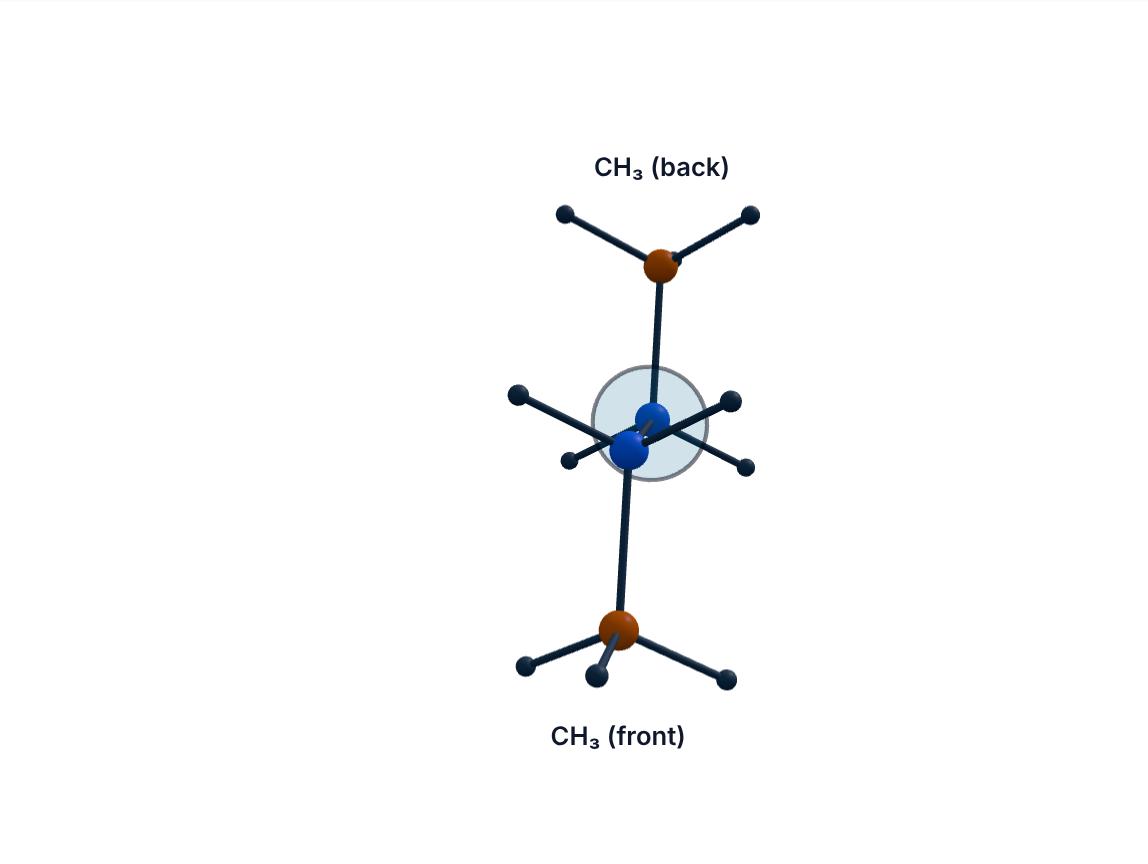
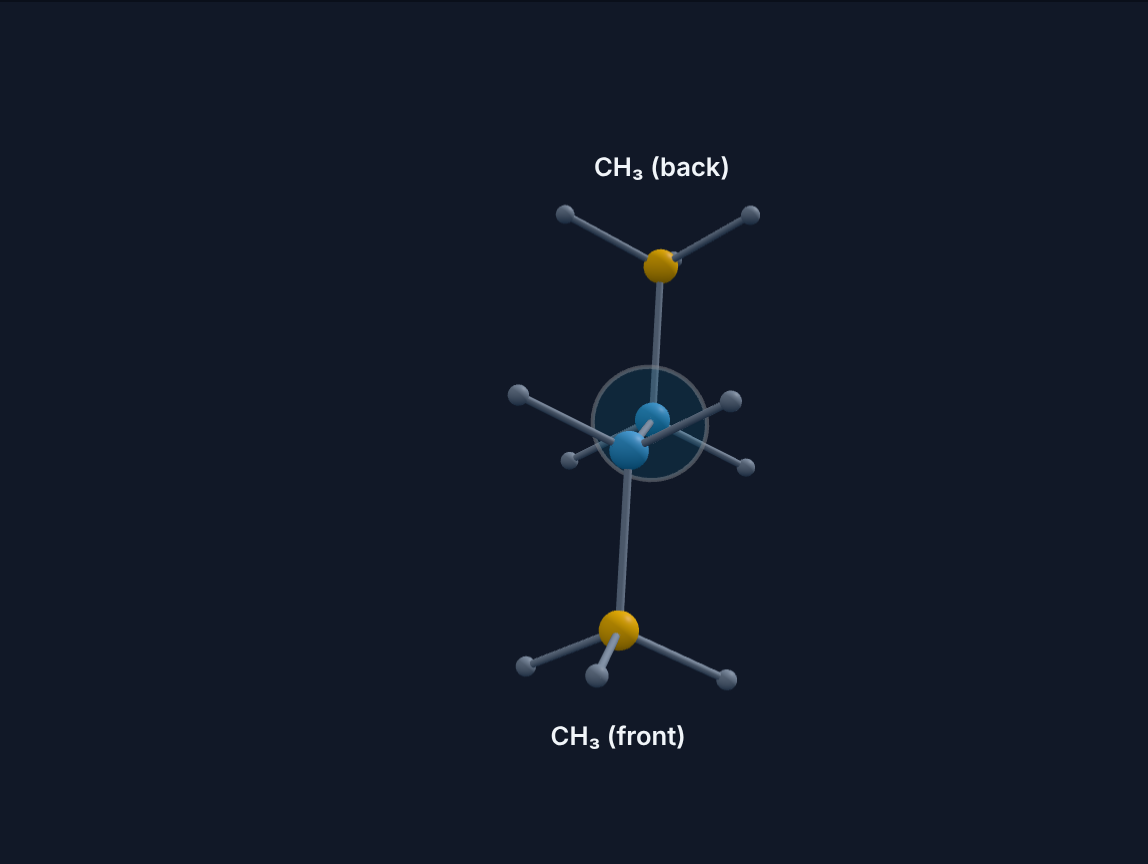
Conformations in 3D: staggered vs eclipsed, seen as Newman projections — Turning about a carbon–carbon single bond (154 pm) gives different arrangements in space, called conformations. The figure looks almost straight down the C–C bond, as a Newman projection does: the front carbon is at the centre and the back carbon sits behind the disc. In ethane, CH₃–CH₃, the staggered conformation (dihedral 60°) has each front C–H bond between two back ones and the least torsional strain (relative energy 0.0 kJ/mol); in the eclipsed conformation (dihedral 0°) each front C–H bond covers a back one, and the energy is higher by 12.5 kJ/mol (NCERT, Class XI Hydrocarbons). That barrier is small: at 25 °C it is crossed about 4 × 10¹⁰ times a second (an estimate from the Eyring equation), so the conformations cannot be isolated. In n-butane, CH₃–CH₂–CH₂–CH₃, turning about the central C2–C3 bond gives four key conformations: anti (dihedral 180°, 0.0 kJ/mol, most stable), gauche (dihedral 60°, 3.8 kJ/mol above anti, from the two methyl groups crowding each other), partially eclipsed (dihedral 120°, 16.0 kJ/mol: two CH₃/H eclipsings at 6.0 and one H/H at 4.0) and fully eclipsed (dihedral 0°, 19.0 kJ/mol: CH₃/CH₃ at 11.0 and two H/H at 4.0). The interaction energies are McMurry’s (Organic Chemistry, Table 3.5); NCERT gives ethane’s barrier only. The stability order is anti > gauche > partially eclipsed > fully eclipsed.

IUPAC Nomenclature Rules

  1. Choose the longest carbon chain containing the principal functional group — this is the parent chain.
  2. Number from the end nearest the principal functional group (or nearest branch if no FG).
  3. Principal group suffix (highest priority): –COOH (–oic acid) > –CHO (–al) > C=O (–one) > –OH (–ol) > –NH₂ (–amine).
  4. Substituents listed alphabetically as prefixes (ignore multiplying prefixes di/tri in alphabetisation).
  5. Multiple bonds: –ene (alkene), –yne (alkyne); get lowest locants.
🔢
GOC — Key Formulas & Rules
Degree of Unsaturation (DBE)
DBE = (2C + 2 + N − H − X) / 2
C = carbons, N = nitrogens, H = hydrogens, X = halogens. O and S don't appear. Each ring or π-bond = 1 DBE; benzene ring = 4 DBE (3 π + 1 ring).
Inductive Effect Order (–I, decreasing)
–I: F > OH > Cl > Br > I > OR > NH₂ > C₆H₅ > C≡CR > CH=CH₂ > H
Carbocation Stability
allylic/benzylic > 3° > 2° > 1° > CH₃⁺ (vinyl/aryl: least stable)
Allylic/benzylic stabilised by resonance; 3°/2°/1° by hyperconjugation and induction.
Carbanion & Free Radical Stability
Carbanion: CH₃⁻ > 1° > 2° > 3° (–I stabilises); sp > sp² > sp³ (s-char)
Free radical: 3° > 2° > 1° > CH₃•
Acidity Order (stronger acid → lower \(pK_a\))
H₂SO₄ > HCl > RCOOH > ArOH > H₂CO₃ > ROH > H₂O > HC≡CH > NH₃ > RH
\(pK_a\): RCOOH ≈ 5; PhOH ≈ 10; H₂O = 15.7; ROH ≈ 16–18; HC≡CH ≈ 25; NH₃ ≈ 38
Number of Stereoisomers
Max. stereoisomers = 2ⁿ (n = chiral centres)
Enantiomers if no internal plane; meso if internal symmetry
Hyperconjugating H count
No. of α-H: (CH₃)₃C⁺ = 9; (CH₃)₂CH⁺ = 6; CH₃CH₂⁺ = 3; CH₃⁺ = 0
More α-H → more hyperconjugation → greater stability.
🧮
GOC — Solved Examples
Example 1 Easy Calculate DBE for C₆H₅Cl
Calculate DBE for C₆H₅Cl
  1. Given: Molecular formula C₆H₅Cl (chlorobenzene)
  2. DBE \(= (2\times6 + 2 - 5 - 1) / 2 = (12 + 2 - 5 - 1) / 2 = 8 / 2 =\) 4
  3. Interpretation: benzene ring = 3 π-bonds + 1 ring = 4 DBE. ✓
Example 2 Easy Stability of carbocations: rank (CH₃)₃C⁺, CH₂=CH–CH₂⁺, CH₃⁺
Stability of carbocations: rank (CH₃)₃C⁺, CH₂=CH–CH₂⁺, CH₃⁺
  1. Analysis:
    • CH₂=CH–CH₂⁺ is allylic → resonance stabilised (electron delocalized over 3 carbons)
    • (CH₃)₃C⁺ is 3° → stabilised by 9 hyperconjugating H and +I of three CH₃
    • CH₃⁺ is a methyl cation — no resonance, no hyperconjugation, no alkyl groups
  2. Order: CH₂=CH–CH₂⁺ (allylic) > (CH₃)₃C⁺ (3°) > CH₃⁺ (methyl)
Example 3 Medium Arrange in decreasing acidity: CH₃COOH, CF₃COOH, CCl₃COOH, CH₃CH₂COOH
Arrange in decreasing acidity: CH₃COOH, CF₃COOH, CCl₃COOH, CH₃CH₂COOH
  1. Reasoning: Electron-withdrawing groups (EWG) on the α-carbon stabilise the carboxylate anion (–COO⁻) → increase acidity (decrease pKₐ).
    • CF₃COOH: 3 F atoms (strongest –I) → most acidic (pKₐ ≈ 0.5)
    • CCl₃COOH: 3 Cl atoms (weaker –I than F) → pKₐ ≈ 0.65
    • CH₃COOH: 1 CH₃ (+I, weak EDG) → pKₐ ≈ 4.76
    • CH₃CH₂COOH: ethyl (+I, slightly stronger EDG than methyl) → pKₐ ≈ 4.87 (least acidic)
  2. Order (decreasing acidity): CF₃COOH > CCl₃COOH > CH₃COOH > CH₃CH₂COOH
Example 4 Medium How many chiral centres in 2-chloro-3-hydroxybutanedioic acid (chloromalic acid)?
How many chiral centres in 2-chloro-3-hydroxybutanedioic acid (chloromalic acid)?
  1. Structure: HOOC–CHCl–CHOH–COOH
  2. C2: attached to H, Cl, COOH, –CHOH–COOH → 4 different groups → chiral
  3. C3: attached to H, OH, COOH, –CHCl–COOH → 4 different groups → chiral
  4. 2 chiral centres → max 2² = 4 stereoisomers (2 pairs of enantiomers; check for meso: not possible here due to Cl/OH asymmetry).
Example 5 Hard Compare basicity: aniline (C₆H₅NH₂), methylamine (CH₃NH₂), p-nitroaniline (O₂N–C₆H₄–NH₂), p-methylaniline (CH₃–C₆H₄–NH₂)
Compare basicity: aniline (C₆H₅NH₂), methylamine (CH₃NH₂), p-nitroaniline (O₂N–C₆H₄–NH₂), p-methylaniline (CH₃–C₆H₄–NH₂)
  1. Key principle: NH₂ basicity depends on lone pair availability on N. Resonance donation into ring (–R) delocalises lone pair → decreases basicity. EWG on ring further decrease basicity; EDG increase it.
    • CH₃NH₂: no aromatic ring; +I of CH₃ increases e⁻ density on N → most basic (pKₐ of conjugate acid ≈ 10.6)
    • p-CH₃–C₆H₄–NH₂: CH₃ is +I/+H on ring → slightly more e⁻ density on N than unsubstituted aniline → more basic than aniline
    • C₆H₅NH₂ (aniline): lone pair delocalised into ring via +R → pKₐ ≈ 4.6
    • p-O₂N–C₆H₄–NH₂: NO₂ is –R, –I → strongly withdraws e⁻ from N via two resonance paths → least basic (pKₐ ≈ 1.0)
  2. Order (decreasing basicity): CH₃NH₂ > p-toluidine > aniline > p-nitroaniline
📊
GOC — Key Diagrams
Click any diagram to zoom
⚡
GOC — Quick Quiz
Question 1
What is the DBE (degree of unsaturation) of pyridine C₅H₅N?
\(DBE = (2\times5 + 2 + 1 - 5) / 2 = (10 + 2 + 1 - 5) / 2 = \dfrac{8}{2} =\) 4. Ring (1) + 3 double bonds = 4. Pyridine is aromatic (6π electrons).
Question 2
Which carbocation is MOST stable?
Allylic carbocation is stabilised by resonance — the +ve charge is delocalized over C1 and C3. This resonance stabilization exceeds the hyperconjugation stabilization of even a 3° carbocation in most cases (allylic ≈ benzylic >> 3°).
Question 3
Arrange in increasing basicity (weakest first): aniline, p-nitroaniline, p-methylaniline, methylamine
p-NO₂ group (–R, –I) heavily withdraws electron density from N → least basic. Aniline: lone pair in resonance with ring → weak base. p-CH₃: +I/+H donates e⁻ slightly → more basic than aniline. CH₃NH₂: no aromatic ring, +I of CH₃ → most basic. Correct: p-NO₂–aniline < aniline < p-CH₃–aniline < CH₃NH₂.
Question 4
Which statement about tautomerism is CORRECT?
Tautomers are structural isomers (not stereoisomers) that interconvert readily — they differ in both proton position AND π-bond position. The keto form and enol form have different connectivity. In resonance structures, atoms don't move — only electrons do. Option D correctly describes keto–enol tautomerism.
⛽
Hydrocarbons
Alkanes · Alkenes · Alkynes · Arenes · Aromaticity · EAS

Alkanes — Nomenclature and Free Radical Halogenation

  • General formula CₙH₂ₙ₊₂ (acyclic). Sp³ hybridised, tetrahedral. Only σ bonds.
  • Free radical halogenation mechanism: Initiation (X₂ → 2X•), Propagation (X• + RH → HX + R•; R• + X₂ → RX + X•), Termination (two radicals combine).
  • Selectivity (BDE of C–H): 3° > 2° > 1° C–H bonds — 3° radicals most stable. Cl• is less selective (Cl₂ reactive); Br• is highly selective (Br₂ more stable, less reactive).
  • Anti-Markovnikov product in free radical addition of HBr to alkenes (peroxide/ROOR condition): Br• adds to less substituted C.

Alkenes — Addition Reactions

ReactionReagentProduct / Rule
HydrohalogenationHXMarkovnikov: H adds to C with more H; X to more substituted C
HydrationH₂O / H⁺ (acid catalysis)Markovnikov; forms alcohol
HalogenationBr₂/CCl₄Anti addition (trans); bromonium ion intermediate
Ozonolysis (reductive)O₃ then Zn/H₂OCleaves C=C → aldehydes/ketones
Ozonolysis (oxidative)O₃ then H₂O₂Aldehydes oxidised to carboxylic acids
EpoxidationmCPBA or H₂O₂/TiCl₄Syn addition; forms epoxide
Hydroboration-oxidationBH₃ then H₂O₂/OH⁻Anti-Markovnikov; syn addition; alcohol
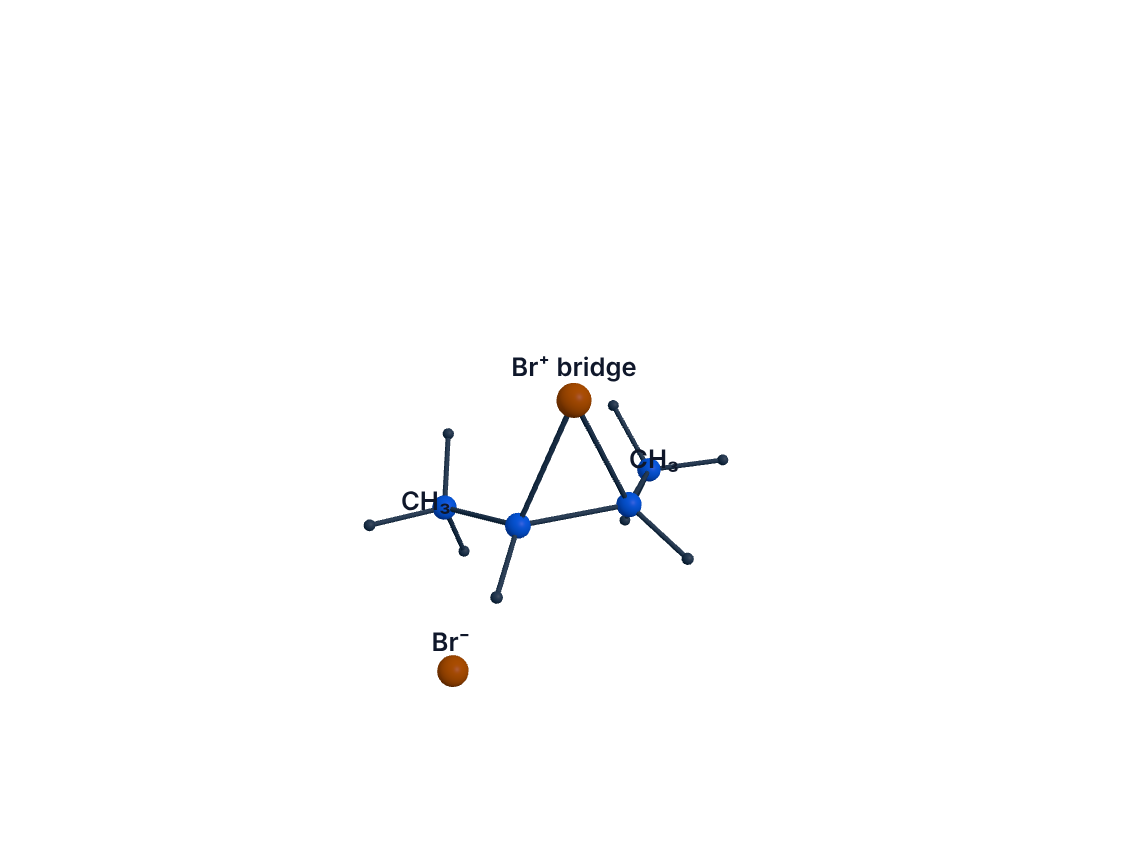
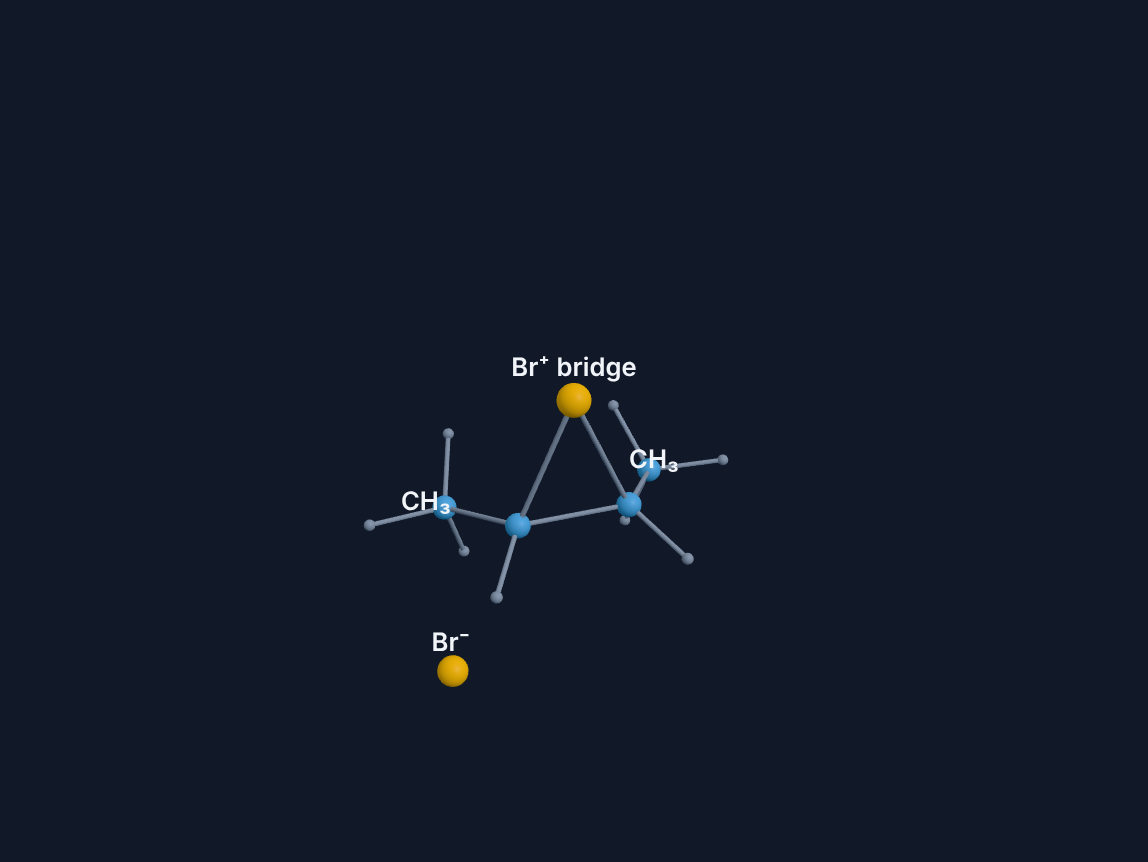
Anti addition of \(\text{Br}_2\) through a bromonium ion in 3D — Bromine adds to an alkene in two steps. Br₂ approaches one face of the π bond and leaves a bromonium ion: one Br⁺ bonded to both carbons, a three-membered ring on that face. Br⁻ can then reach a carbon only from the other face, straight behind its C–Br bond, so the two Br atoms end up on opposite faces: anti addition. The geometry decides the product. From cis-but-2-ene the product is (2R,3R)-2,3-dibromobutane when Br⁻ opens the ring at C2, and its mirror image, (2S,3S), when it opens it at C3; both are equally likely, so the product is racemic. From trans-but-2-ene either route gives (2R,3S)-2,3-dibromobutane, a meso compound: as formed, with the two Br atoms anti, it has a centre of symmetry. The fading of bromine’s reddish-orange colour in CCl₄ is the test for an alkene (NCERT, Class XI Hydrocarbons).

Alkynes — Key Reactions

  • Terminal alkynes: Acidic C≡C–H (\(pK_a \sim 25\)). React with NaNH₂, Na metal, AgNO₃ → Ag salt (white ppt), CuCl → Cu salt (red ppt) — diagnostic tests for terminal alkynes.
  • Hydration: H₂O/H₂SO₄/HgSO₄ (Markovnikov addition) → enol → tautomerises to ketone. Exception: CH≡CH → ethanal (CH₃CHO, anti-Markovnikov product if Wacker).
  • HX addition: Two additions possible (Markovnikov each time) → geminal dihalide (1,1-dihalide).
  • Lindlar catalyst: H₂/Pd-BaSO₄ (poisoned) → syn addition → cis alkene. Na/NH₃(l): anti addition → trans alkene (Birch-like).
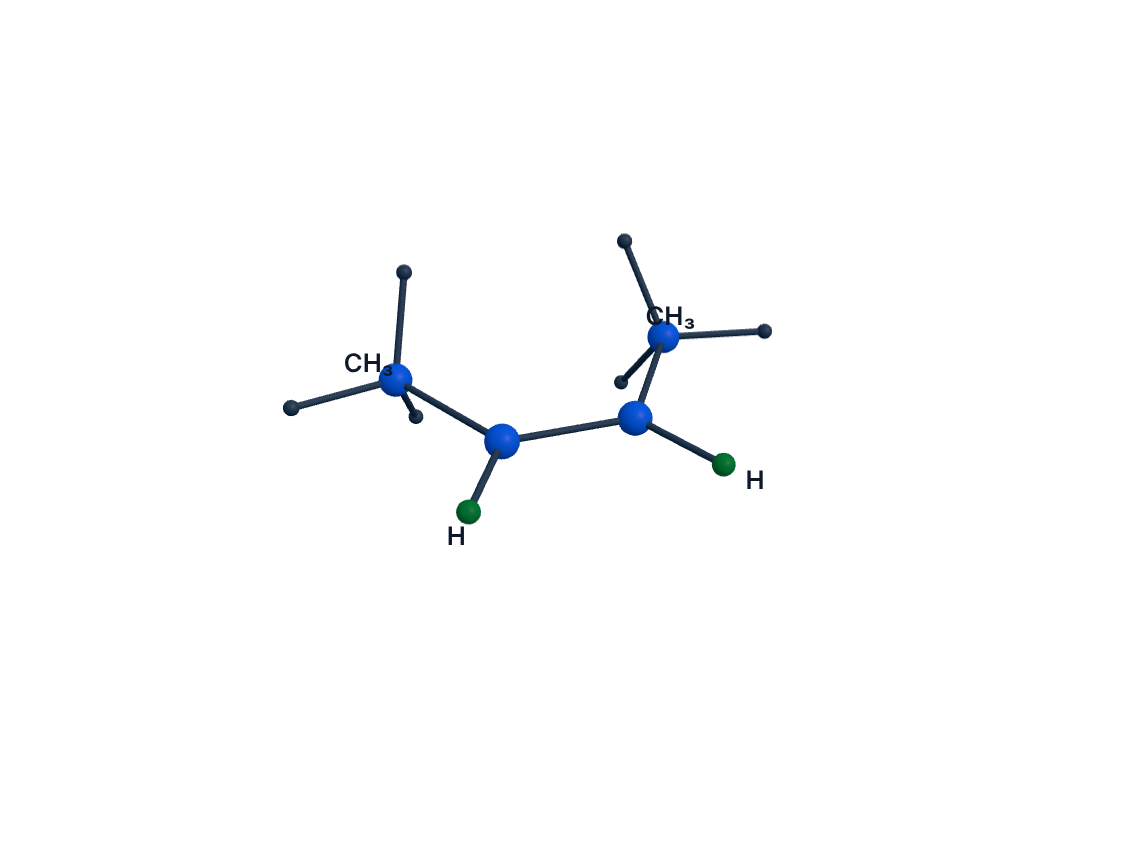
Syn and anti additions in 3D — But-2-yne, CH₃–C≡C–CH₃, is straight (sp carbons, 180°; C≡C 120 pm). Adding one H₂ can give either but-2-ene, depending on how the two H atoms arrive. Over Lindlar’s catalyst (palladium on charcoal partly deactivated with sulphur compounds or quinoline), both H atoms come from the metal surface onto the same face: syn addition, giving cis-but-2-ene, with the two new H atoms on the same side (H–C=C–H 0°). Sodium in liquid ammonia adds one electron and one H⁺ at a time, and the intermediate takes the trans shape: anti addition, giving trans-but-2-ene (H–C=C–H 180°) (NCERT, Class XI Hydrocarbons). Additions that deliver both parts together are syn for the same reason: a peroxyacid adds one O atom to one face of cis-but-2-ene, so the methyl groups stay cis in cis-2,3-dimethyloxirane, a meso compound (2S,3R); hydroboration likewise adds H and B to one face.
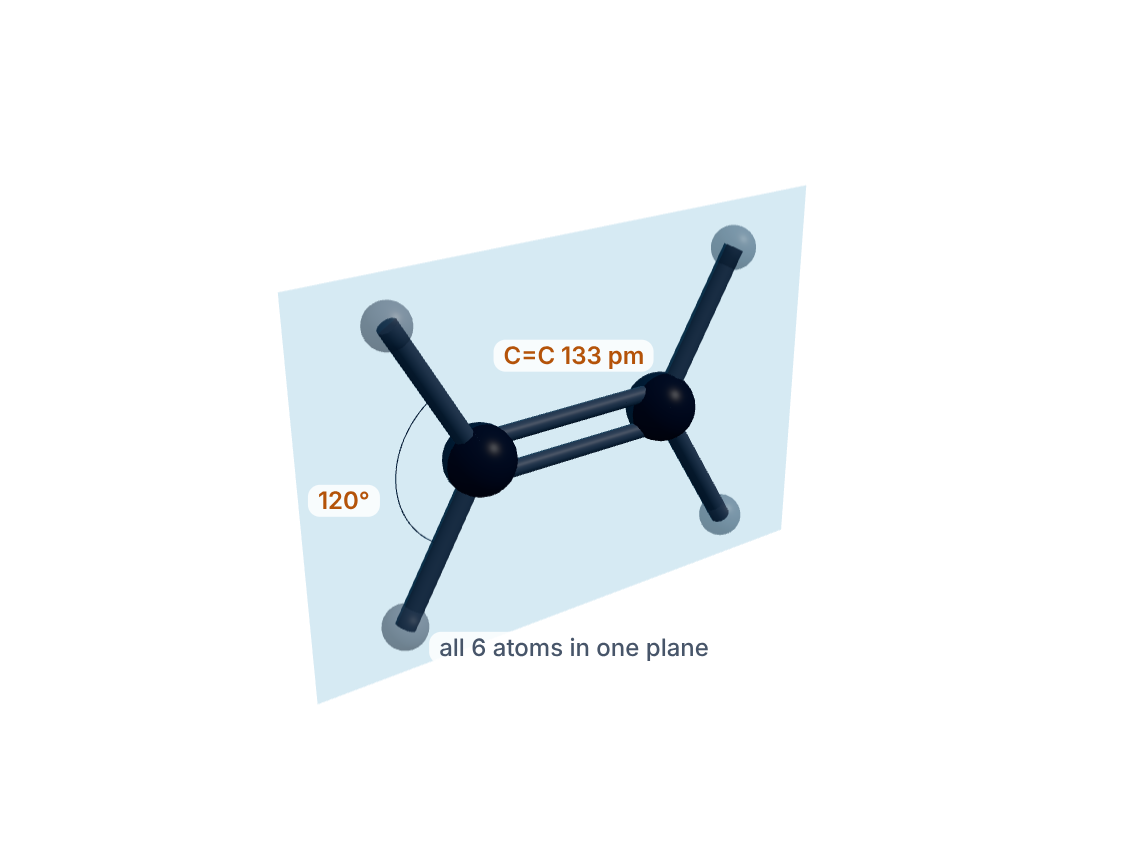
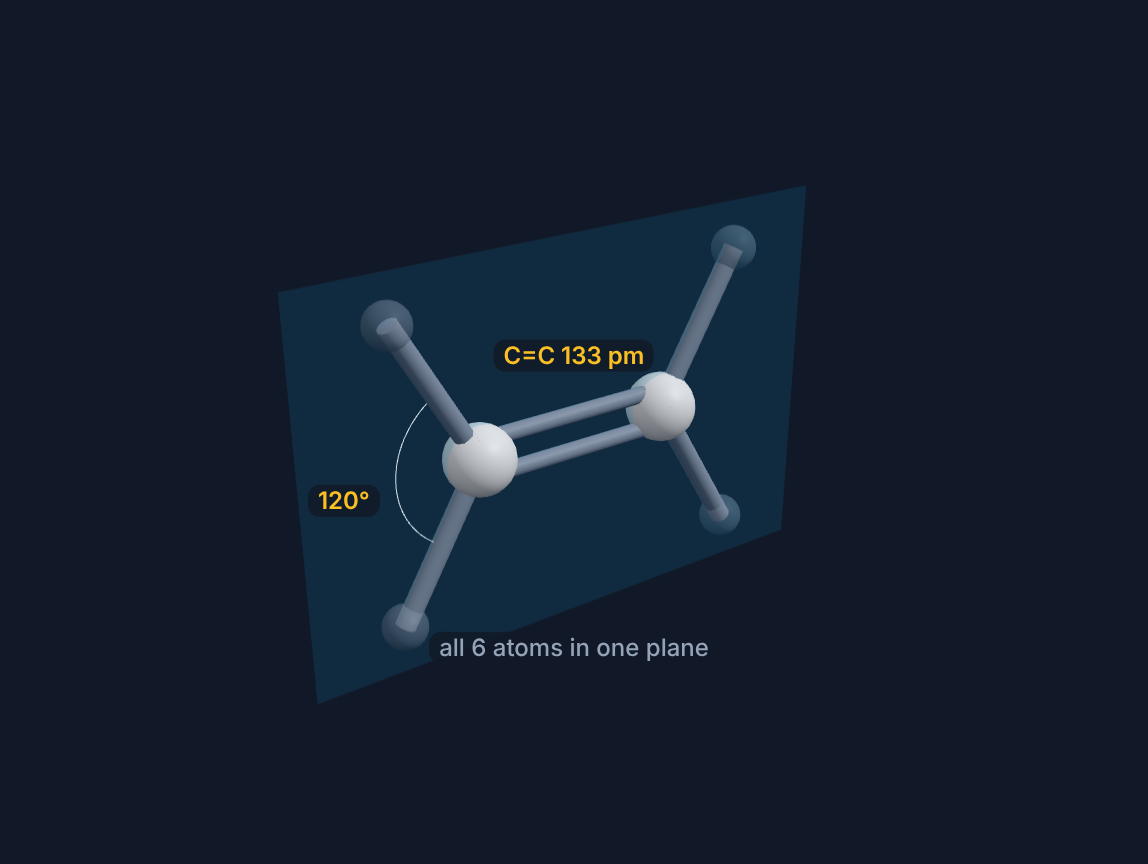
Ethane, ethene and ethyne in 3D — In ethane each carbon is sp³, its four σ bonds pointing to the corners of a tetrahedron: H–C–H is 109.5° and the C–C single bond is 154 pm (drawn staggered). In ethene each carbon is sp²: three σ bonds 120° apart in one plane, and all six atoms lie in that plane; the C=C double bond, σ + π, is 133 pm. In ethyne each carbon is sp: two σ bonds 180° apart, so all four atoms lie on one line; the C≡C triple bond, σ + 2π, is 120 pm. Ethane has 7 σ bonds, ethene 5 σ and 1 π, ethyne 3 σ and 2 π. The angles come from the hybrids, \(\cos\theta = -1/n\) for spⁿ; the C–C lengths are NCERT’s and are drawn to scale.

Arenes — Aromaticity and EAS

  • Hückel rule: Aromatic if cyclic, planar, fully conjugated, with (4n+2) π electrons.
    Benzene: 6π (n=1). Naphthalene: 10π. Pyridine: 6π (N sp², lone pair not in π system). Pyrrole: 6π (N sp², its lone pair in the 2p and IN the π system). Cyclobutadiene: 4π (anti-aromatic).
  • EAS mechanism: Electrophile (E⁺) attacks benzene ring → arenium (Wheland) intermediate → deprotonation restores aromaticity.
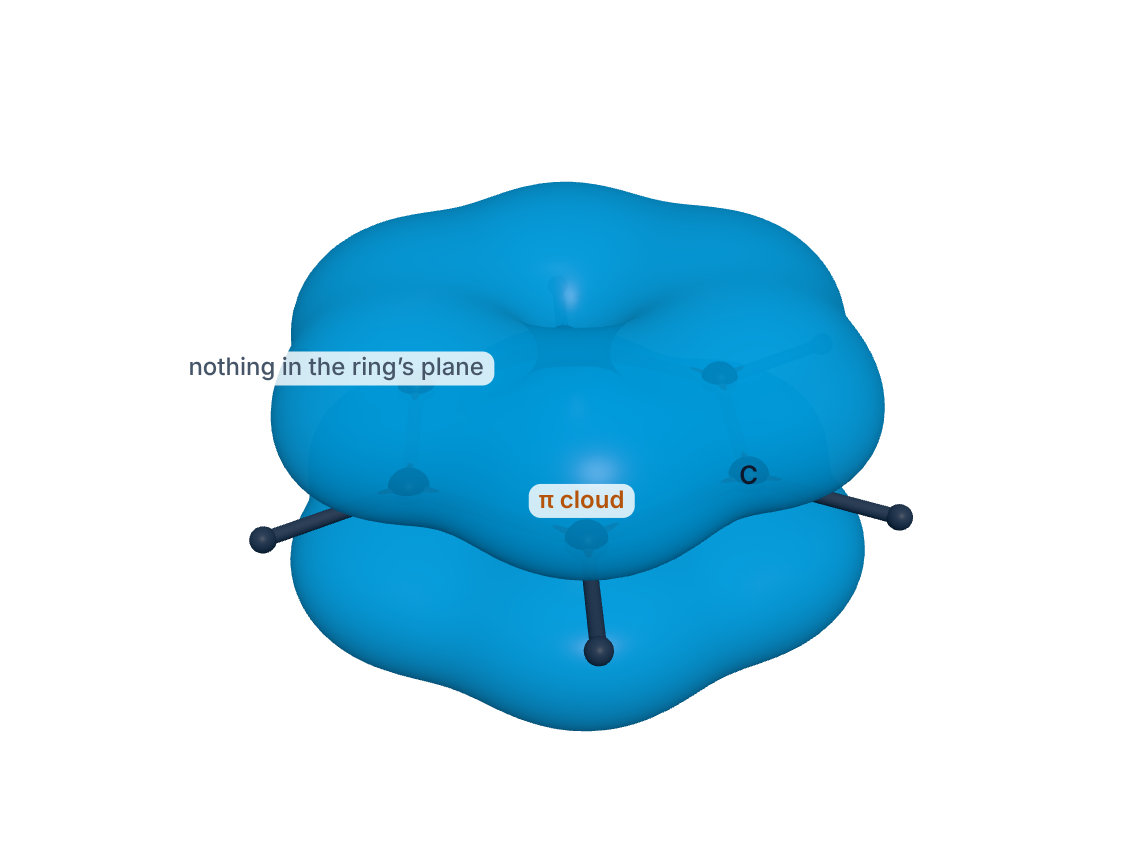
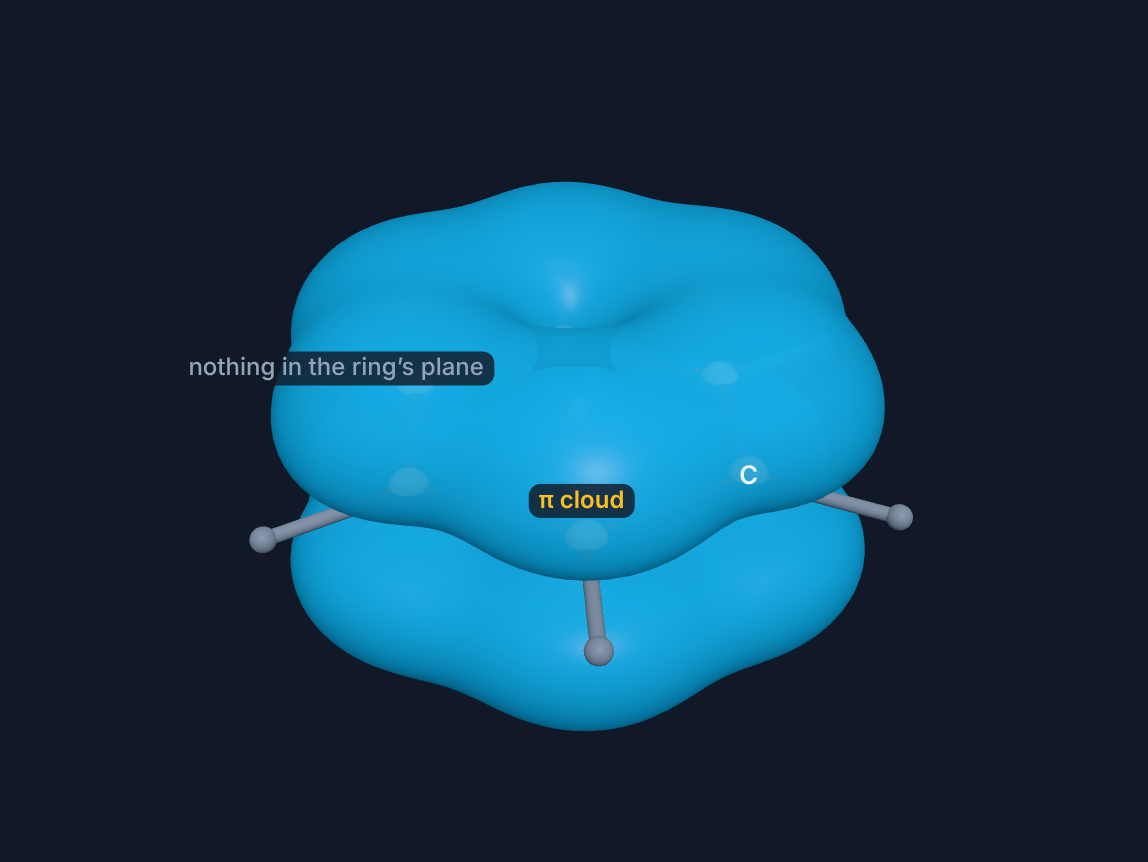
Benzene’s π cloud in 3D — Benzene’s six carbons are sp² and the ring is flat (C–C–C 120°, every C–C 139 pm). Each carbon keeps one electron in a 2p orbital at right angles to the ring, and each 2p overlaps both its neighbours side by side. In the lowest π orbital all six combine in phase: a ring of electron density above the plane and one below, with the plane itself a node. The six π electrons exactly fill the three bonding levels (Hückel levels 2, 1 and 1, in units of β), which is the 4n + 2 rule with n = 1: benzene is aromatic. Every C–C has the same π bond order, 0.67, which is why all six bonds are the same length. Surfaces enclose 90% of the probability and are drawn to scale.
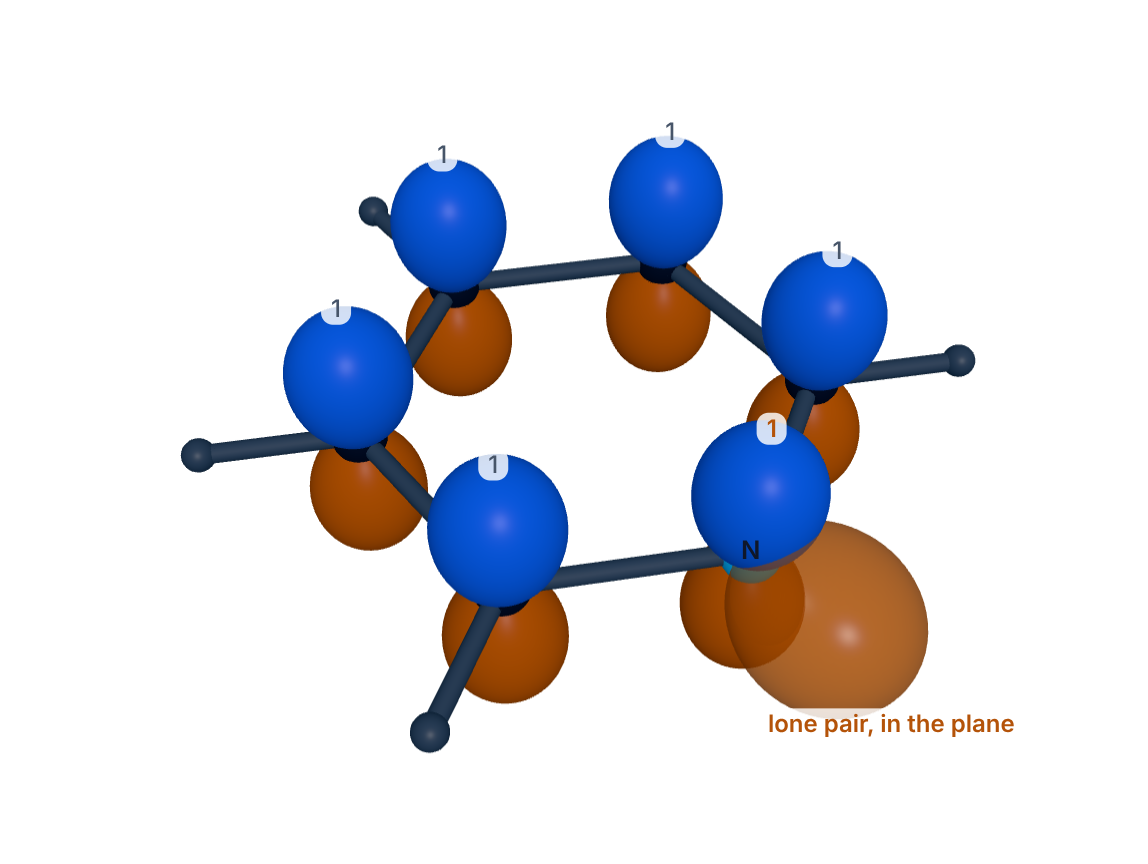
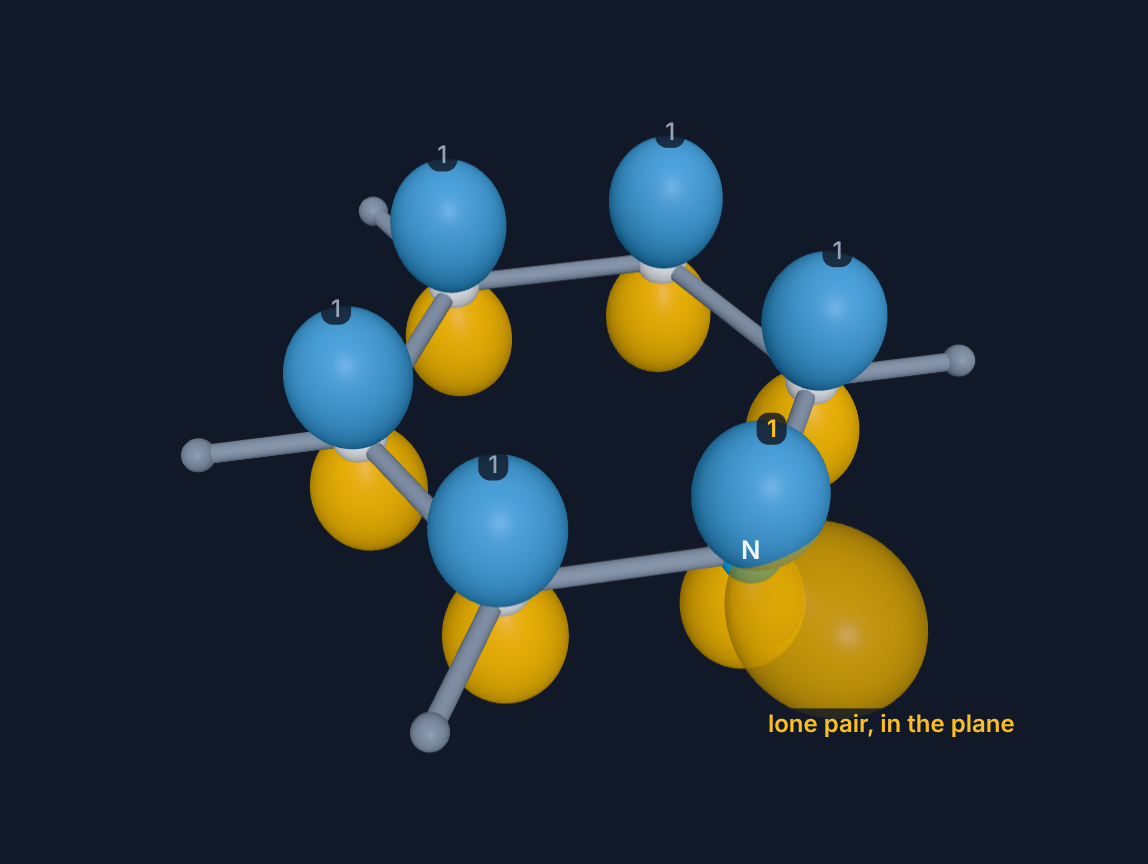
Pyridine, pyrrole and cyclobutadiene in 3D — Every ring atom is sp², and the 2p orbital each holds at right angles to the ring brings its π electrons. In pyridine each atom gives one: 6 π electrons, aromatic, and nitrogen’s lone pair sits in an sp² orbital in the plane of the ring, outside the π system and free to take H⁺. In pyrrole the four carbons give one each and nitrogen gives its lone pair, held in its 2p: again 6 π electrons, aromatic, with the N–H in the plane. Cyclobutadiene has 4 π electrons, 4n with n = 1: Hückel’s levels leave two of them unpaired in two equal non-bonding levels, so it is anti-aromatic and very unstable. Orbitals are drawn as polar plots, not to scale.
EAS ReactionReagentsKey Point
NitrationHNO₃ + H₂SO₄ (conc.)Electrophile: NO₂⁺ (nitronium ion)
HalogenationCl₂/Br₂ + Lewis acid (FeCl₃/FeBr₃)Electrophile: Br⁺ or Cl⁺ (via Br–FeBr₃)
SulfonationH₂SO₄ (fuming), SO₃Reversible; SO₃ is electrophile
Friedel–Crafts alkylationRCl + AlCl₃Carbocation R⁺ may rearrange; polyalkylation possible
Friedel–Crafts acylationRCOCl + AlCl₃Acylium RCO⁺; no rearrangement; deactivates ring (no polyacylation)

Directing Effects in EAS

Group TypeDirectionRing ActivityExamples
o/p directorsortho and paraActivating–OH, –OR, –NH₂, –NHR, –CH₃, halogens (weak via +M/+I)
o/p directors (halogen)ortho and paraDeactivating (−I > +M)–F, –Cl, –Br, –I
m directorsmetaDeactivating–NO₂, –CN, –CHO, –COOH, –SO₃H, –COR, –NR₃⁺
💡 JEE Tip: Markovnikov's rule — H adds to carbon with more H atoms (more H → more stable carbocation forms). Anti-Markovnikov occurs only with: (1) HBr + peroxide/ROOR (free radical), (2) BH₃ hydroboration. Remember: HCl and HI do NOT show anti-Markovnikov even with peroxides.
⚠ Common Error: Halogens (–F, –Cl, –Br, –I) are o/p directors yet deactivating — they direct CORRECTLY to o/p via +M resonance, but deactivate via their −I inductive effect. Students often forget this dual character and say halogens are meta directors.
🔢
Hydrocarbons — Formula Sheet
General Formulas
Alkane CₙH₂ₙ₊₂ | Alkene CₙH₂ₙ | Alkyne CₙH₂ₙ₋₂ | Benzene C₆H₆
Degree of unsaturation (DBE) = (2C + 2 + N − H − X)/2. Each ring or double bond = 1 DBE; triple bond = 2 DBE.
Markovnikov: H→ more H carbon, X→ less H carbon
Anti-Markovnikov (radical HBr): Br→ less substituted carbon. Hydroboration: OH→ less substituted (syn addition).
Ozonolysis Products
R–CH=CH–R′ + O₃ → [ozonide] →(Zn/H₂O) RCHO + R′CHO
Reductive ozonolysis: cleaves C=C, terminal =CH₂ gives HCHO (formaldehyde). Oxidative: RCHO → RCOOH.
R₂C=CH₂ →(O₃/Zn/H₂O) R₂C=O + HCHO
Disubstituted end gives ketone; terminal =CH₂ always gives formaldehyde in reductive ozonolysis.
Aromaticity Hückel Rule
Aromatic: (4n+2) π electrons, n = 0, 1, 2, …
\(n=0: 2\pi\) (cyclopropenyl cation C₃H₃⁺); \(n=1: 6\pi\) (benzene, pyridine, pyrrole); \(n=2: 10\pi\) (naphthalene, azulene)
Anti-aromatic: 4n π electrons → destabilised, avoid planarity
n=1: 4π (cyclobutadiene, cyclopentadienyl cation). Anti-aromatic species are highly reactive or non-existent.
🧮
Hydrocarbons — Solved Examples
Example 1 Easy Degree of Unsaturation and Structure
Compound A: C₈H₁₀. Compound B: C₅H₈. Compound C: C₆H₆ (IR shows no C–H stretch above 3000 cm⁻¹, NMR: 1 singlet). Calculate DBE for each and predict structure type.
  1. C₈H₁₀: DBE = (2×8 + 2 − 10)/2 = (18−10)/2 = 4. DBE 4 → one benzene ring (4 DBE = 3 double bonds + 1 ring). C₈H₁₀ is a dimethylbenzene (xylene) — 3 isomers: o-, m-, p-xylene.
  2. C₅H₈: DBE = (10+2−8)/2 = 2. DBE 2 → either 2 double bonds, 1 triple bond, or 1 double bond + 1 ring. Could be cyclopentene (1 ring + 1 C=C) or pentadiene or pent-1-yne.
  3. C₆H₆ with DBE = (12+2−6)/2 = 4. No C–H stretch above 3000 cm⁻¹ = no sp3 C–H (all sp² or sp C–H). 1 singlet NMR = all 6 H equivalent → benzene. 6 equivalent aromatic H, DBE = 4 ✓.
Example 2 Medium EAS — Directing Effects and Product Prediction
Predict the major product of nitration of: (a) toluene, (b) chlorobenzene, (c) nitrobenzene. State the reasoning.
  1. Toluene (–CH₃): –CH₃ is o/p director (hyperconjugation and inductive +I) and activating. Major products: o-nitrotoluene + p-nitrotoluene. Para is preferred (less steric hindrance). Major: p-nitrotoluene.
  2. Chlorobenzene (–Cl): –Cl is o/p director (resonance donation +M) but deactivating (−I > +M). Major product: p-nitrochlorobenzene (para favoured over ortho due to steric effect; ring deactivated so harsher conditions needed).
  3. Nitrobenzene (–NO₂): –NO₂ is m director and strongly deactivating (electron withdrawal by both −M and −I). Major product: m-dinitrobenzene. Very slow reaction; requires conc. HNO₃ + H₂SO₄ at elevated temperature.
Example 3 Hard Ozonolysis — Identifying Alkene Structure
An alkene C₅H₁₀ on reductive ozonolysis gives: propanal (CH₃CH₂CHO) and ethanal (CH₃CHO). Identify the alkene and give its IUPAC name.
  1. Ozonolysis cleaves C=C. Propanal → contributes CH₃CH₂CH= fragment. Ethanal → contributes CH₃CH= fragment.
  2. Reconnect at the C=C bond: CH₃CH₂CH=CHCH₃. This is pent-2-ene (C₅H₁₀ ✓).
  3. Check: DBE = (10+2−10)/2 = 1 ✓ (one double bond). IUPAC name: pent-2-ene. Can be cis or trans depending on substituents.
✓ General method: Each ozonolysis fragment =C gives one R–CHO (or R₂C=O). Reconnect the C=O carbons from each fragment with a C=C double bond to rebuild the original alkene.
📊
Hydrocarbons — Visual Concepts
Click any diagram to zoom
⚡
Hydrocarbons — Quick Quiz
Question 1
Propene reacts with HBr in the presence of organic peroxide (ROOR). The major product is:
Peroxides initiate free radical mechanism. Br• adds to the less substituted carbon (gives more stable secondary radical at C2, but Br• attacks C1 to give 1-bromopropane via termination). Major product = 1-bromopropane (anti-Markovnikov). This peroxide effect applies only to HBr. Answer: B ✓
Question 2
Which of the following is NOT aromatic according to Hückel's rule?
Hückel: (4n+2) π electrons for aromaticity. Cyclobutadiene has 4π electrons (n=1 → 4n=4, NOT 4n+2=6) → anti-aromatic. Anti-aromatic compounds are highly unstable. Cyclobutadiene exists only briefly as a reactive intermediate. Answer: C ✓
Question 3
Nitrobenzene undergoes EAS at the meta position because the –NO₂ group:
–NO₂ withdraws electrons by −M (resonance: O=N=O draws e⁻ from ring via delocalization) and −I (inductive). This withdrawal is strongest at ortho/para → those positions are most depleted. Meta positions have relatively MORE electron density → EAS attack occurs there. Answer: A ✓
⚗
Functional Groups & Named Reactions
Alcohols · Aldehydes & Ketones · Carboxylic Acids · Amines · Named Reactions

Haloalkanes and Haloarenes

  • Nature of the C–X bond: polar (halogen more electronegative than carbon), so the carbon is electrophilic and open to nucleophilic attack. Bond strength falls C–F > C–Cl > C–Br > C–I, so iodides are the most reactive.
  • Substitution mechanisms: SN1 — two steps via a carbocation, favoured by 3° halides and polar protic solvents, gives racemisation; SN2 — one step, backside attack, favoured by 1° halides, gives inversion (Walden inversion).
  • Haloarenes are far less reactive to nucleophilic substitution than haloalkanes (partial double-bond character from resonance + sp² carbon).
  • Uses & environmental effects: chloroform (CHCl₃) — solvent/former anaesthetic, oxidises in air/light to poisonous phosgene; iodoform (CHI₃) — antiseptic; freons (CFCs) — refrigerants that deplete the ozone layer; DDT — a persistent insecticide that bioaccumulates and is now largely banned.
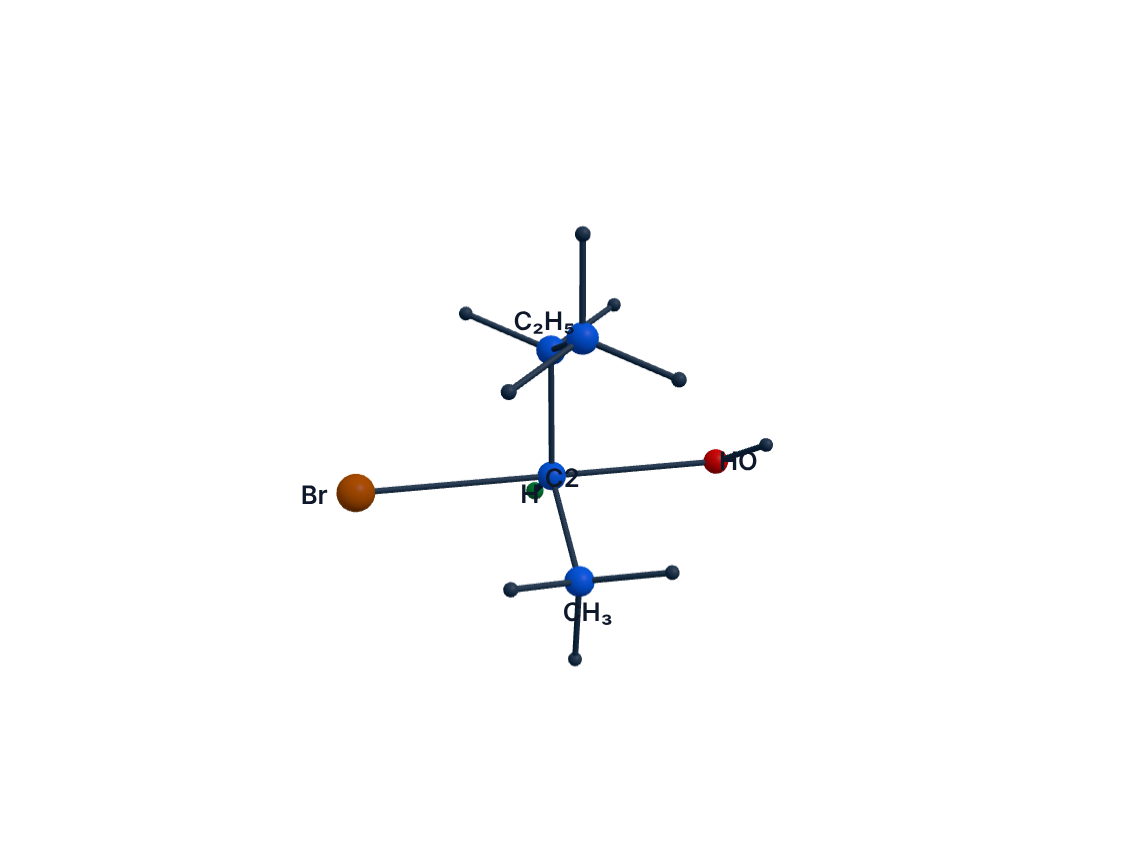
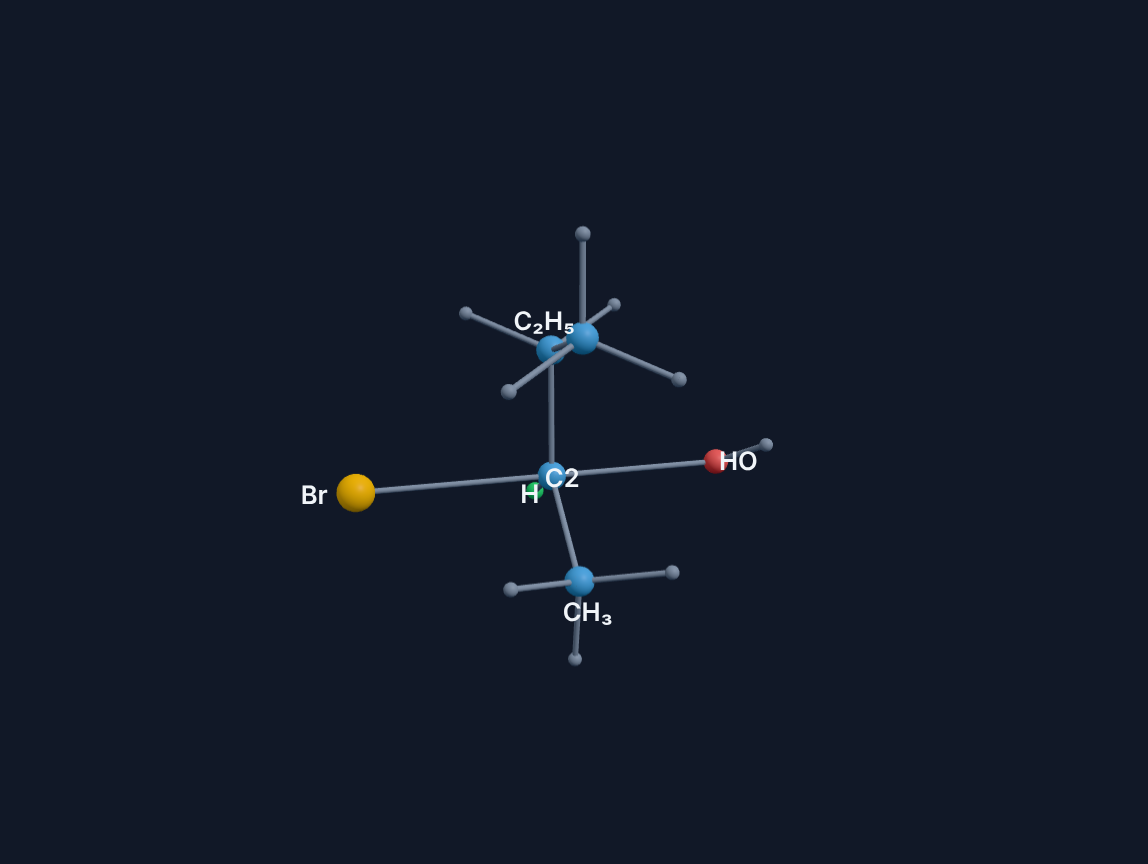
\(\text{S}_\text{N}2\): backside attack and Walden inversion in 3D — In an \(\text{S}_\text{N}2\) reaction the nucleophile bonds as the leaving group leaves, in one step, so the rate depends on both: rate = k[RBr][OH⁻] (NCERT, Class XII Haloalkanes and Haloarenes). OH⁻ attacks the carbon from the side opposite the C–Br bond: in the transition state O, C2 and Br lie on one straight line (180°), and the other three groups, CH₃, C₂H₅ and H, are flat, 120° apart. As Br⁻ leaves, those three groups turn inside out like an umbrella in the wind: before, each leans 70.5° from the line of attack; after, 109.5°. This is Walden inversion. Here (2R)-2-bromobutane gives (2S)-butan-2-ol: OH takes Br’s place as the highest-priority group, so the R/S letter changes with the shape. With other groups the letter can stay the same even though the shape inverts.
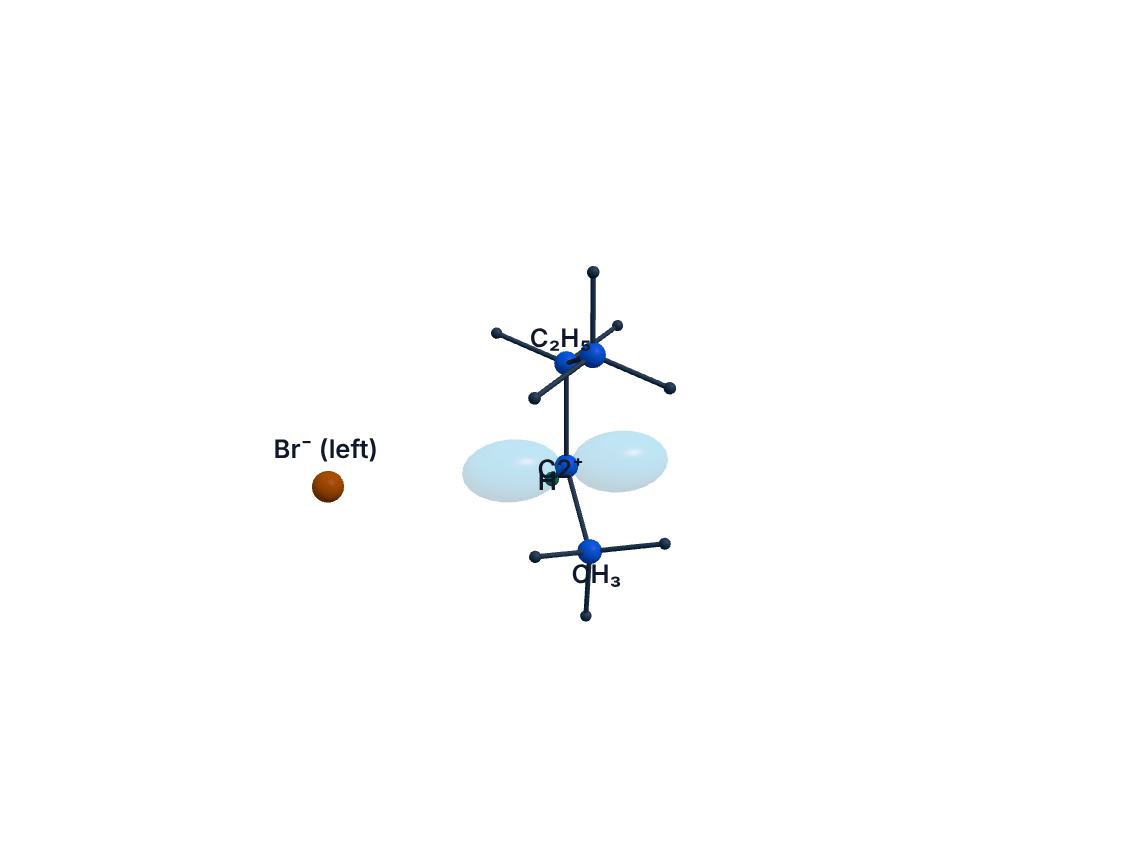
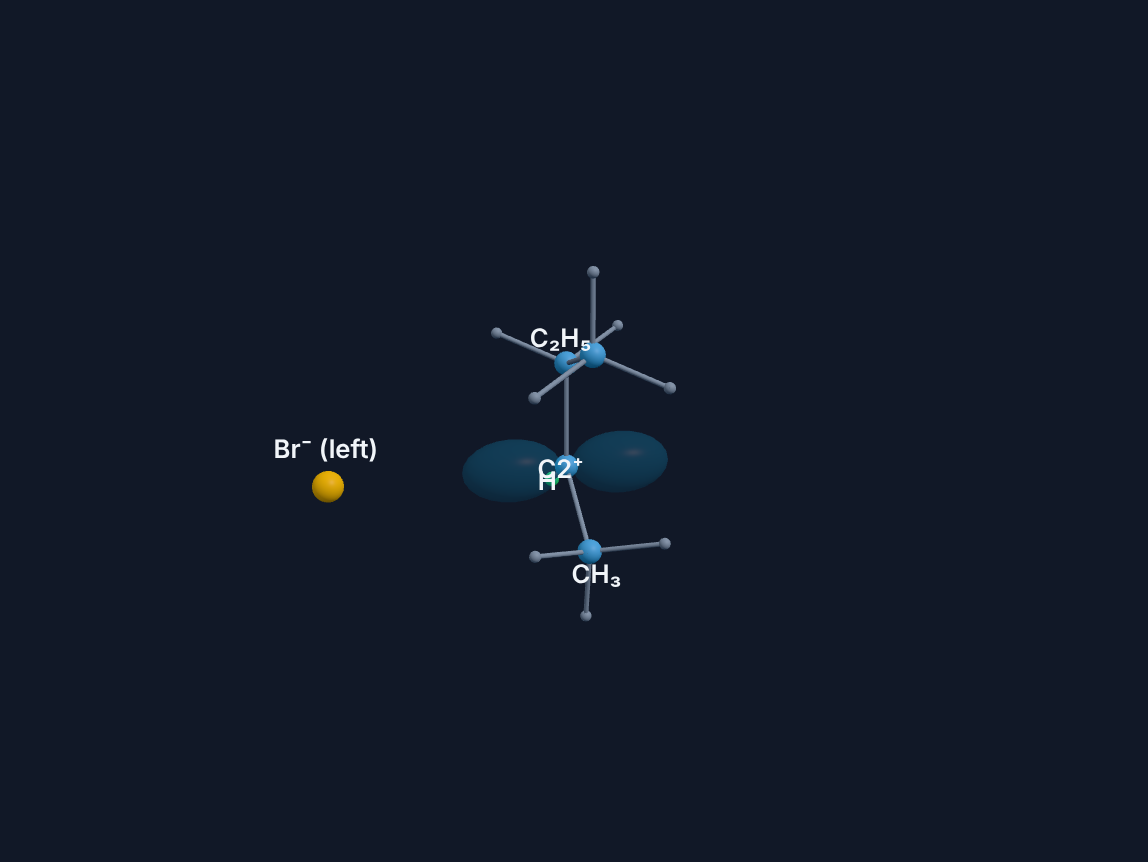
\(\text{S}_\text{N}1\): the flat carbocation and racemisation in 3D — An \(\text{S}_\text{N}1\) reaction goes in two steps. First the C–Br bond breaks on its own, slowly, so the rate depends only on the haloalkane: rate = k[RBr]. That leaves a carbocation whose carbon is sp²: its three groups lie flat, 120° apart, with the empty 2p orbital at right angles, one lobe on each face. In the fast second step the nucleophile, here water, can bond on either face. On the face Br left from it gives the starting arrangement (retention); on the other face, the inverted one. From (2R)-2-bromobutane these are (2R)- and (2S)-butan-2-ol, mirror images formed in equal amounts, so the product is racemic, (±)-butan-2-ol, and optically inactive. This is NCERT’s example: hydrolysis of optically active 2-bromobutane gives (±)-butan-2-ol (Class XII, Haloalkanes and Haloarenes).
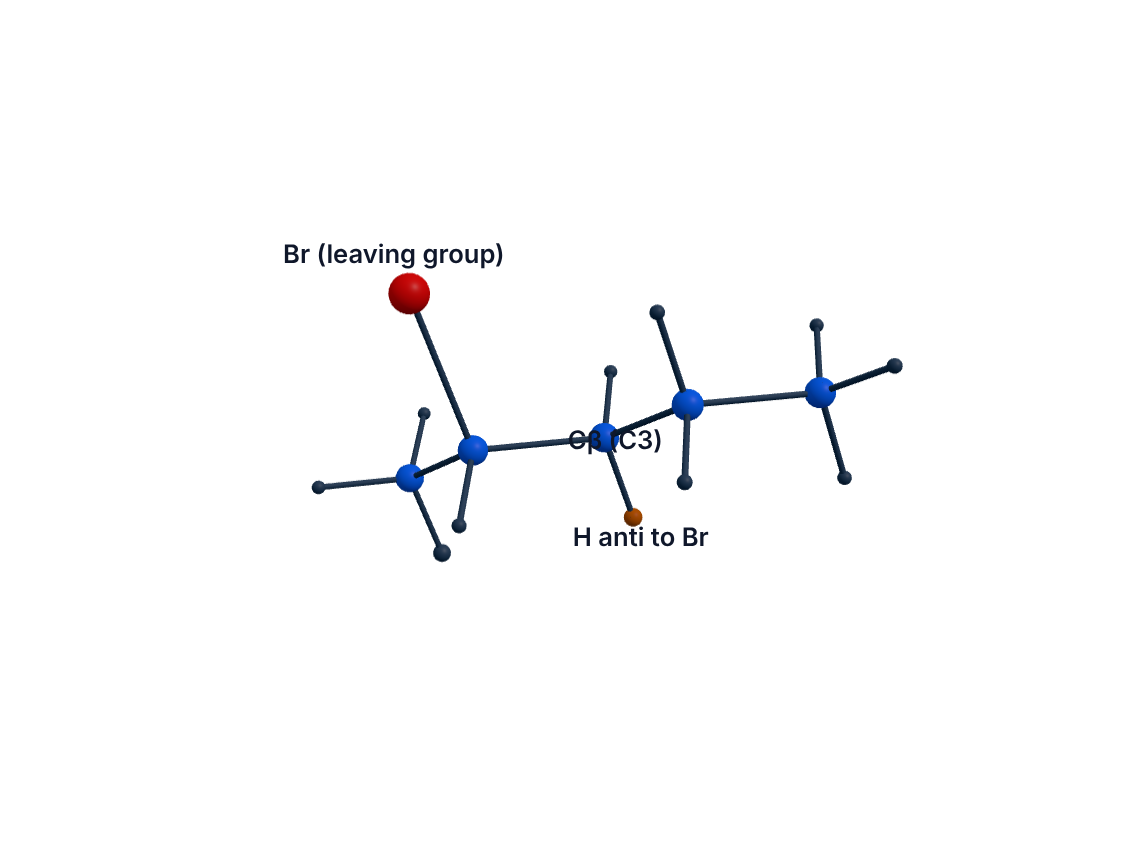
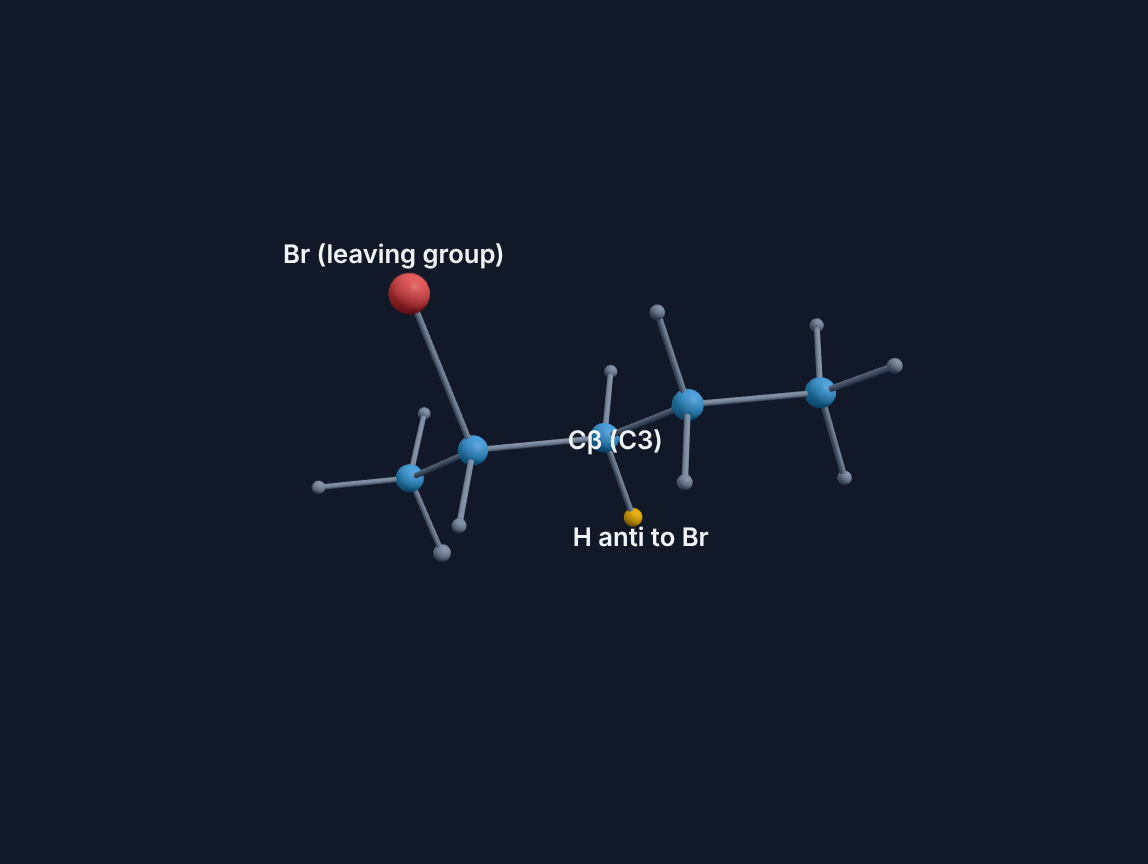
E2 elimination and Saytzeff's rule in 3D — Heating a haloalkane with alcoholic KOH removes HBr in one step (E2): the base takes a β-hydrogen as the C–Br bond breaks and the new π bond forms. The H and the Br must be anti-periplanar: in one plane, on opposite sides of the C–C bond (dihedral angle 180°), so that the breaking \(\sigma_{\text{C–H}}\) orbital lines up with the \(\sigma^*_{\text{C–Br}}\) orbital and the two overlap to form the \(\pi\) bond. 2-Bromopentane, CH₃–CH(Br)–CH₂–CH₂–CH₃, has two β-carbons, and the figure holds it in a conformation in which each has an H anti to Br. Losing the H on C3 gives pent-2-ene, CH₃–CH=CH–CH₂–CH₃, a disubstituted alkene and the major product (81%); losing an H on C1 gives pent-1-ene, CH₂=CH–CH₂–CH₂–CH₃, monosubstituted and minor (19%) (NCERT, Class XII Haloalkanes and Haloarenes). This is Saytzeff’s (Zaitsev’s) rule: the H goes from the β-carbon with fewer hydrogens (C3 has 2, C1 has 3), and the alkene with more alkyl groups on its double bond predominates, because more \(\alpha\)-hydrogens (5 in pent-2-ene, 2 in pent-1-ene) give more hyperconjugation and a lower-energy transition state.

Alcohols

  • Classification: 1° (–CH₂OH), 2° (–CHOH), 3° (–COH). Acidity: H₂O > ROH (alkyl groups donate electrons, destabilise RO⁻).
  • Lucas test: ZnCl₂ + conc. HCl. 3° → immediate turbidity; 2° → turbidity in 5 min; 1° → no turbidity at room temp.
  • Oxidation: 1° → aldehyde (PCC/CrO₃/pyridine) → carboxylic acid (KMnO₄/K₂Cr₂O₇). 2° → ketone. 3° → no oxidation.
  • Dehydration: Conc. H₂SO₄ at 170°C → alkene (Saytzeff's rule: more substituted alkene preferred); at 130°C → ether.
  • Esterification: RCOOH + R′OH ⇌ RCOOR′ + H₂O (Fischer esterification; acid catalyst; reversible).

Phenols

  • Acidity: phenol (\(pK_a \approx 10\)) is more acidic than alcohols because the phenoxide ion is resonance-stabilised. Electron-withdrawing groups (–NO₂, especially ortho/para) increase acidity; electron-donating groups decrease it.
  • Electrophilic substitution: –OH is ortho/para-directing and activating — halogenation (Br₂/H₂O → 2,4,6-tribromophenol), nitration and sulphonation occur readily.
  • Reimer–Tiemann reaction: phenol + CHCl₃ + NaOH → ortho-hydroxybenzaldehyde (salicylaldehyde), via a dichlorocarbene intermediate.
  • Kolbe's reaction: sodium phenoxide + CO₂ (under pressure) → sodium salicylate → salicylic acid (used to make aspirin).

Aldehydes and Ketones

  • Nucleophilic addition to C=O: Nu attacks electrophilic C. Aldehyde more reactive than ketone (less steric hindrance + more electrophilic C).
  • Tollens' test: Ag(NH₃)₂OH → silver mirror. Positive for aldehydes ONLY (not ketones). Formic acid (HCOOH) and glucosealso positive.
  • Fehling's test: Cu²⁺ (blue) → Cu₂O (red ppt). Positive for aliphatic aldehydes and reducing sugars. Negative for aromatic aldehydes and ketones.
  • Iodoform test: I₂/NaOH. Positive for: CH₃CHO, CH₃COR, CH₃CH(OH)R — all have CH₃CO– or CH₃CHOH– group. Yellow CHI₃ ppt (triiodomethane, mp 119°C).
  • Aldol condensation: Base + aldehyde/ketone having α-H → β-hydroxy carbonyl compound → dehydration → α,β-unsaturated compound.
  • Cannizzaro reaction: Aldehydes WITHOUT α-H + conc. NaOH → disproportionation (one → acid, one → alcohol). E.g., 2HCHO → CH₃OH + HCOO⁻.
  • Clemmensen reduction: C=O → CH₂ (Zn–Hg/HCl). For acid-sensitive substrates.
  • Wolff–Kishner reduction: C=O → CH₂ (NH₂NH₂/KOH/ethylene glycol, heat). For base-sensitive substrates.
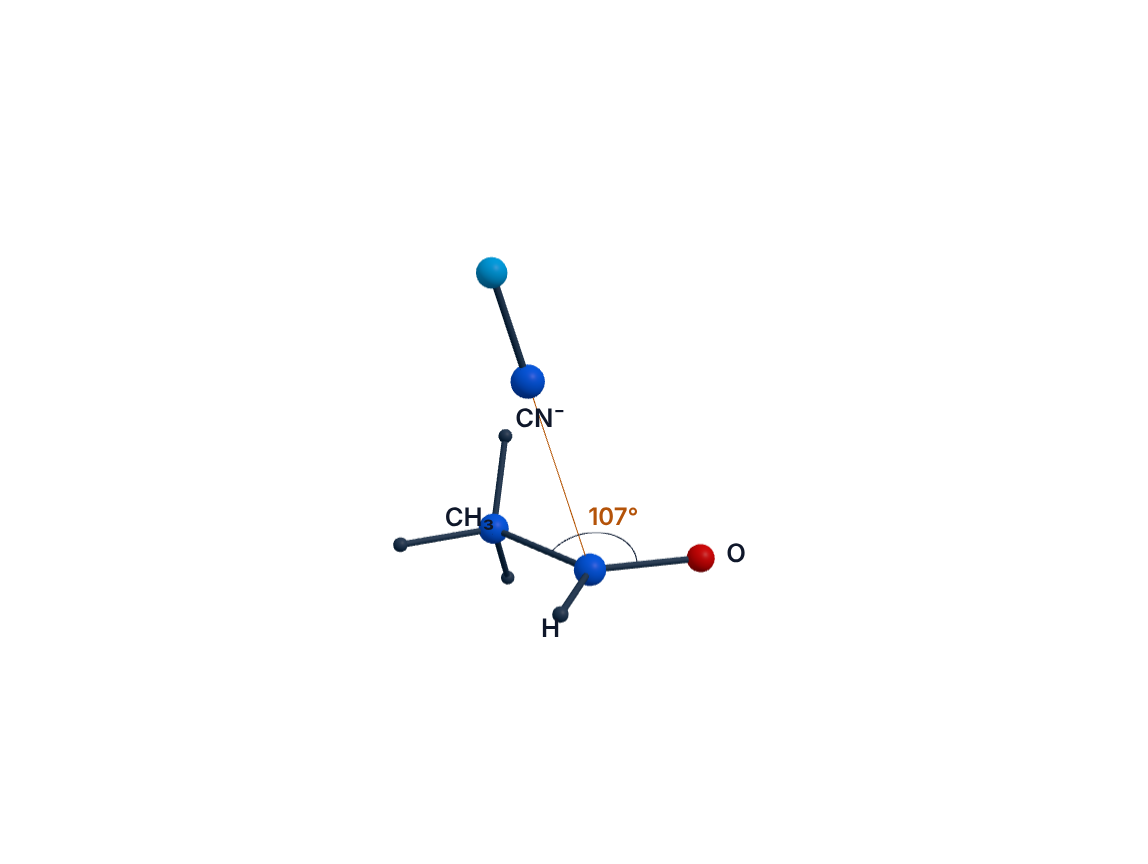
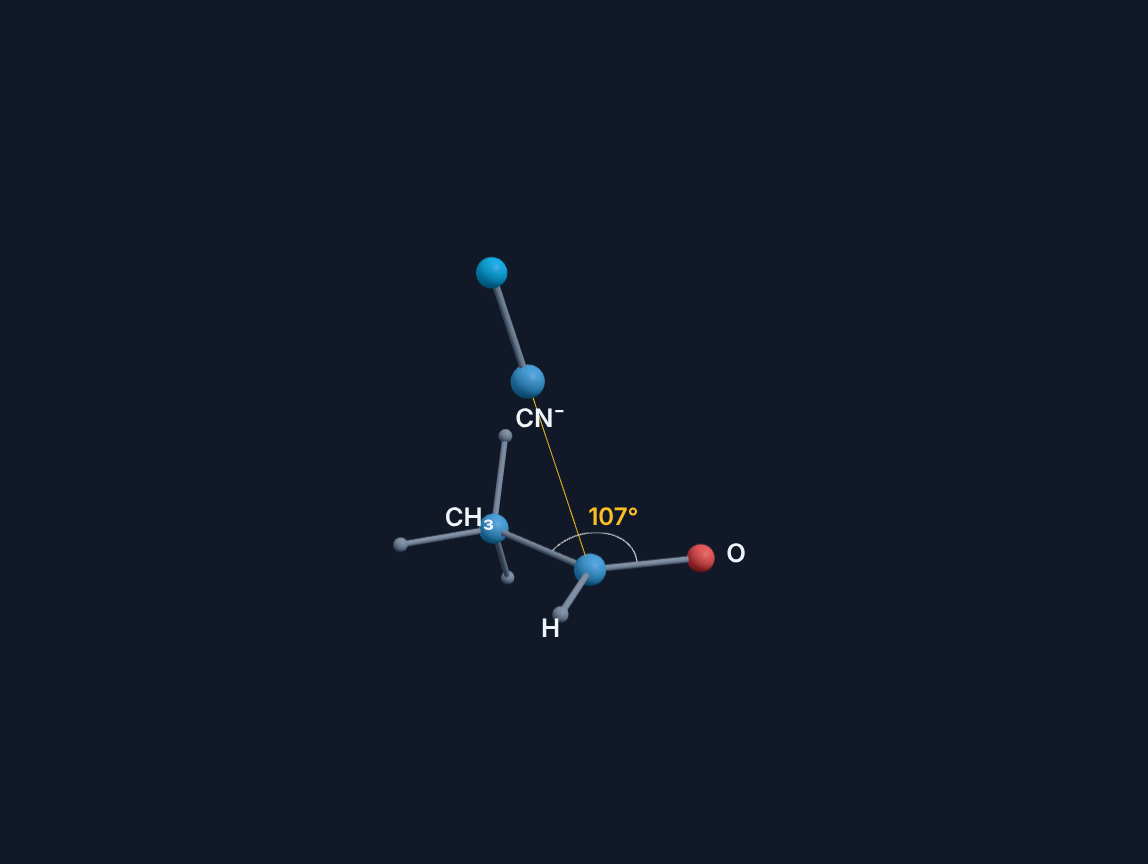
Nucleophilic addition to \(\text{C}=\text{O}\): the Bürgi–Dunitz angle in 3D — The carbonyl carbon of an aldehyde is flat: in ethanal, CH₃CHO, the O, CH₃ and H around it are 120° apart in one plane, and the polar C=O bond leaves the carbon electron-poor (NCERT, Class XII Aldehydes, Ketones and Carboxylic Acids). A nucleophile such as CN⁻ attacks it from above or below that plane, but not straight down: it comes in at about 107° to the C=O bond, tilted away from the oxygen, where it overlaps best with the empty \(\pi^*\) orbital of C=O and keeps clear of oxygen’s electrons. Bürgi and Dunitz found this angle in crystal structures (105 ± 5°) and by calculation (about 107°). As CN⁻ bonds, the carbon becomes sp³: the O (now O⁻), CH₃ and H fold away from the incoming group to the tetrahedral angle, 109.5°, and CN stays on the face it came from. Adding H⁺ to O⁻ gives the cyanohydrin, CH₃CH(OH)CN.

Carboxylic Acids and Derivatives

  • Acidity order: RCOOH > carbonic acid > phenol > water > alcohol (inductive effects). Electron-withdrawing groups increase acidity.
  • Reactivity of derivatives: Acid chloride > anhydride > ester > amide (decreasing leaving group ability).
  • Hofmann bromamide degradation: RCONH₂ + Br₂/KOH → RNH₂. Product has ONE LESS carbon than starting acid. Used to prepare primary amines.
  • Hell–Volhard–Zelinsky: RCOOH + Br₂/P → α-bromoacid. Only at α position (via acid enolisation).

Amines

  • Basicity order in solution: 2° > 1° > 3° > ArNH₂. (3° has no H for solvation; aromatic amine has lone pair delocalised.)
  • Gabriel synthesis: Phthalimide + RX → N-alkylphthalimide → hydrolysis → 1° amine (pure, no 2°/3° contamination).
  • Carbylamine test: 1° amines + CHCl₃ + KOH → isocyanide (R–NC, foul smell). Negative for 2° and 3° amines.
  • Diazonium salts (ArN₂⁺Cl⁻): ArNH₂ + NaNO₂/HCl (0–5°C) → ArN₂⁺Cl⁻. Reactions: Sandmeyer (Cl, Br, CN), Balz–Schiemann (F), reduction (N=N coupling → azo dyes).
  • Coupling reaction: ArN₂⁺ + phenol/amine → azo dye (orange/red colour). Occurs at pH 5–7.

Grignard Reagent

  • RMgX (in dry ether). Strong nucleophile and base. Reacts with C=O, C≡N, CO₂, esters, epoxides.
  • HCHO + RMgX → 1° alcohol (after H₃O⁺). RCHO + R′MgX → 2° alcohol. R₂CO + R′MgX → 3° alcohol. CO₂ + RMgX → RCOOH.
💡 JEE Tip: Iodoform test positive: any compound that gives CH₃CO– or CH₃CH(OH)– on oxidation. Ethanol (CH₃CH₂OH) is positive (oxidises to CH₃CHO → iodoform). Methanol is negative. Propan-2-ol (CH₃CHOHCH₃) is positive; propan-1-ol is negative. This is a favourite JEE distinction.
⚠ Common Error: Fehling's test is negative for aromatic aldehydes (like benzaldehyde) even though they are aldehydes. This is because Fehling's reagent only oxidises aliphatic (not aromatic) aldehydes. Tollens' test, however, is positive for ALL aldehydes including benzaldehyde.
🔢
Functional Groups — Formula Sheet
Named Reactions — Quick Reference
Aldol: 2 CH₃CHO →(NaOH) CH₃CH(OH)CH₂CHO →(−H₂O) CH₃CH=CHCHO
α-H required. Base removes α-H → enolate attacks another C=O. Product: β-hydroxyaldehyde → α,β-unsaturated aldehyde on heating.
Cannizzaro: 2HCHO →(conc NaOH) CH₃OH + HCOONa
Aldehydes WITHOUT α-H (HCHO, PhCHO, CCl₃CHO). One molecule oxidised (→ acid), one reduced (→ alcohol). Requires conc base.
Hofmann: RCONH₂ + Br₂/KOH → RNH₂ + CO₂ + 2KBr + H₂O
Degradation: amide loses one carbon → primary amine. Used to synthesise 1° amines from amides (available from acids).
Sandmeyer: ArN₂⁺Cl⁻ + CuCl → ArCl + N₂   (or CuBr → ArBr, CuCN → ArCN)
Replaces –NH₂ (via diazonium) with –Cl, –Br, –CN. Balz–Schiemann: ArN₂⁺BF₄⁻ → ArF + N₂ + BF₃.
Grignard Synthesis Summary
HCHO + RMgX → RCH₂OH (1°) | RCHO + R′MgX → RR′CHOH (2°) | R₂CO + R′MgX → RR′R″COH (3°)
Product alcohol class depends on carbonyl substrate. HCHO gives 1° (only methylene source). CO₂ gives carboxylic acid; HCN gives aldehyde (via hydrolysis).
🧮
Functional Groups — Solved Examples
Example 1 Easy Iodoform Test — Which Compounds Test Positive?
Which of the following give a positive iodoform test? (a) Ethanol, (b) Methanol, (c) Propan-2-ol, (d) Propan-1-ol, (e) Acetone, (f) Diethyl ketone.
  1. Positive iodoform test: compound must have CH₃CO– group or be oxidisable to it (i.e., CH₃CH(OH)– group).
  2. Ethanol CH₃CH₂OH: Oxidises to CH₃CHO (acetaldehyde = CH₃CO–H). Positive ✓
  3. Methanol CH₃OH: Oxidises to HCHO (no CH₃ group on C=O). Negative ✗
  4. Propan-2-ol CH₃CH(OH)CH₃: Has CH₃CHOH– group directly. Positive ✓
  5. Propan-1-ol CH₃CH₂CH₂OH: Oxidises to CH₃CH₂CHO (propanal; no CH₃ adjacent to C=O). Negative ✗
  6. Acetone CH₃COCH₃: Has CH₃CO– group. Positive ✓
  7. Diethyl ketone CH₃CH₂COCH₂CH₃: No CH₃ adjacent to C=O (it's CH₂). Negative ✗
Example 2 Medium Basicity Order of Amines
Arrange in decreasing order of basicity in aqueous solution: (a) Methylamine (CH₃NH₂), (b) Dimethylamine (CH₃)₂NH, (c) Trimethylamine (CH₃)₃N, (d) Aniline (C₆H₅NH₂), (e) Ammonia (NH₃).
  1. Two factors: inductive effect of alkyl groups (increases basicity) and solvation (NH, NH₂ better than N for H-bonding with water → stabilises conjugate acid).
  2. Aniline: lone pair on N is delocalised into benzene ring → less available → very low basicity (\(pK_b \approx 9.4\)).
  3. Ammonia: no alkyl group → moderate basicity (\(pK_b = 4.74\)).
  4. Methylamine vs Dimethylamine: in water, dimethylamine is MORE basic than methylamine (better inductive donation by 2 CH₃, and still has 1 N–H for solvation). Trimethylamine: 3 CH₃ groups donate more inductively BUT no N–H for solvation → LESS basic than dimethylamine.
✓ Order (decreasing basicity): (CH₃)₂NH > CH₃NH₂ > (CH₃)₃N > NH₃ > C₆H₅NH₂. (\(pK_b\) values: 3.3, 3.4, 4.2, 4.7, 9.4 respectively.)
Example 3 Hard Multi-step Synthesis — Grignard + Named Reactions
Starting from ethanol only (and any inorganic reagents), synthesise butanol-2 (butan-2-ol, CH₃CH(OH)CH₂CH₃).
  1. Oxidise CH₃CH₂OH → CH₃CHO (ethanal) using mild oxidant (PCC or CrO₃/pyridine).
  2. Prepare Grignard from another ethanol-derived source: CH₃CH₂OH → CH₃CH₂Br (HBr or PBr₃) → CH₃CH₂MgBr (Mg/dry ether).
  3. React Grignard with ethanal: CH₃CH₂MgBr + CH₃CHO → CH₃CH(OMgBr)CH₂CH₃.
  4. Hydrolysis (H₃O⁺/H₂O) → CH₃CH(OH)CH₂CH₃ (butan-2-ol). ✓
✓ Butan-2-ol is a 2° alcohol — accessible via Grignard addition of ethyl group to ethanal. Both fragments (ethanal and ethyl Grignard) come from ethanol.
📊
Functional Groups — Visual Concepts
Click any diagram to zoom
⚡
Functional Groups — Quick Quiz
Question 1
Which alcohol does NOT give a positive iodoform test?
Iodoform test positive: compound must have CH₃CO– or CH₃CHOH– group. Propan-1-ol: oxidises to CH₃CH₂CHO (propanal) — no CH₃ on the carbonyl carbon → negative. Ethanol → CH₃CHO ✓; Propan-2-ol has CH₃CHOH– ✓; Butan-2-ol has CH₃CHOH– ✓. Answer: C ✓
Question 2
Formaldehyde (HCHO) does NOT undergo Aldol condensation with itself because:
Aldol condensation requires α-hydrogen (H on the carbon adjacent to C=O). In HCHO (H–CHO), there is no carbon adjacent to the carbonyl — it IS the terminal carbon. No α-H means no enolate can form. HCHO instead undergoes Cannizzaro reaction (disproportionation). Answer: A ✓
Question 3
The Hofmann bromamide reaction of benzamide (C₆H₅CONH₂) gives:
Hofmann bromamide: RCONH₂ + Br₂/KOH → RNH₂. The amide loses the carbonyl carbon as CO₂, leaving the R group attached to NH₂. C₆H₅CONH₂ → C₆H₅NH₂ (aniline). Product is a primary amine with ONE FEWER carbon than the starting amide. Answer: B ✓
🧫
Biomolecules & Polymers
Carbohydrates · Proteins · Nucleic Acids · Vitamins · Polymers

Carbohydrates

  • Classification: Monosaccharides (cannot hydrolyse), disaccharides (hydrolyse to 2 monosaccharides), polysaccharides (many units).
  • Glucose (C₆H₁₂O₆): Aldohexose. Open chain: CHO–(CHOH)₄–CH₂OH. Cyclic: α-D-glucopyranose (OH at C1 axial) and β-D-glucopyranose (OH at C1 equatorial) — anomers. Undergoes mutarotation in solution.
  • Fructose: Ketohexose. Sweetest sugar. Cyclic form is furanose (5-membered ring).
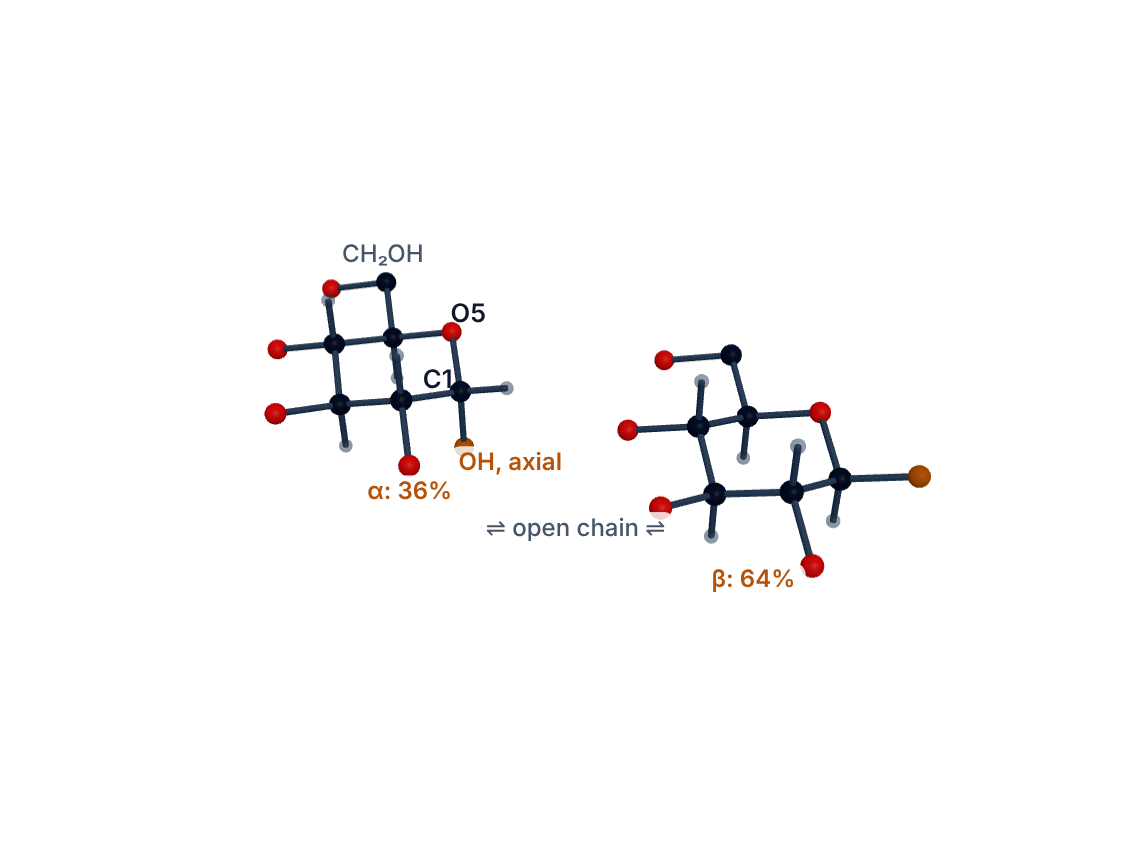
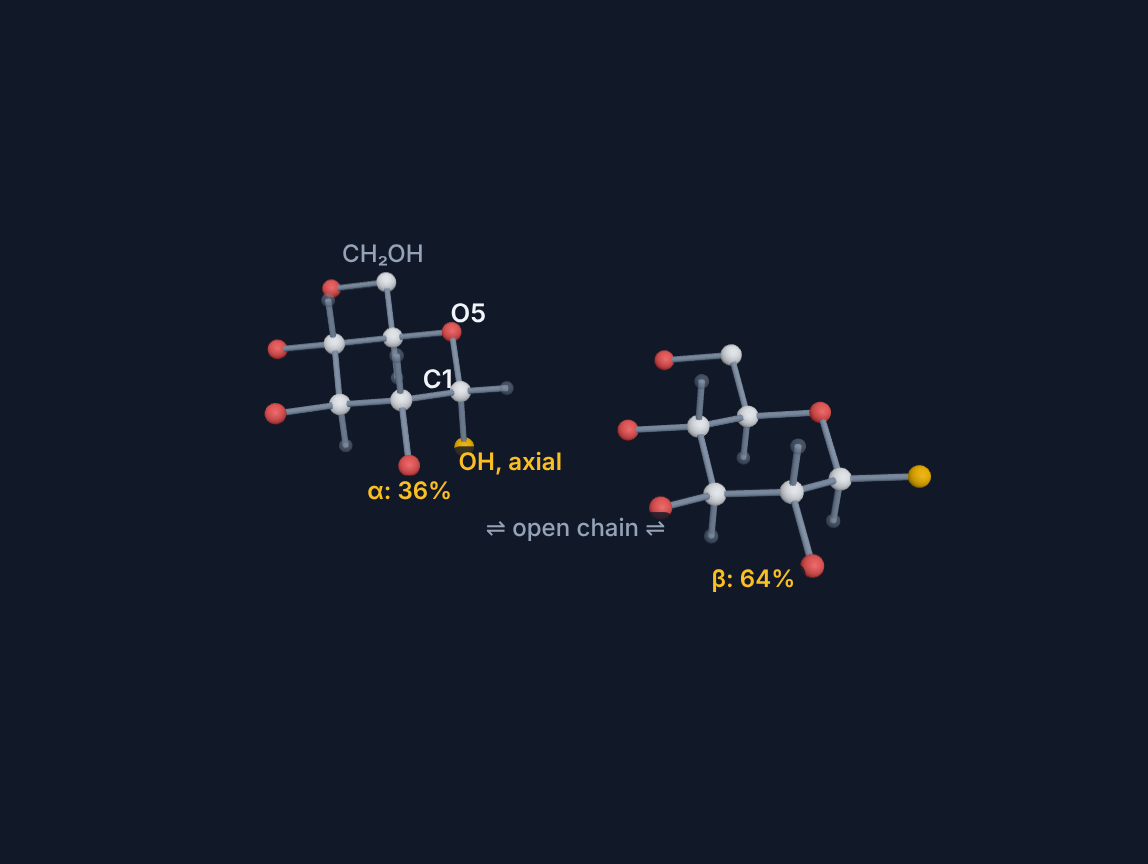
Glucose: the pyranose chair, α and β — The six-membered ring of glucopyranose, five carbons and the ring O, is puckered into a chair: in the ideal chair drawn here its ring torsions are 60°, alternating in sign all the way round. Each ring carbon has one bond along the ring’s axis (axial) and one pointing out round the ring (equatorial). In β-D-glucopyranose every group, the OH on C1, C2, C3 and C4 and the CH₂OH on C5, is equatorial, and every H on the ring is axial. α-D-glucopyranose differs only at C1: its OH is axial, on the face opposite the CH₂OH. The two interconvert through the open chain. The ring opens to the aldehyde, C1 becomes flat (sp²), and the O on C5 can add to either face of the C=O: turning the CHO group 180° about the C1–C2 bond swaps the faces, so the ring closes to α or to β. This is mutarotation: in water α ([α]D +112.2°) and β (+18.7°) each change to +52.7°, which puts the equilibrium at 36% α and 64% β, β being favoured because all its groups are equatorial. The chair is drawn ideal, with equal ring bonds and ring angles of 109.5°; H atoms on O and on C6 are not shown.
DisaccharideUnitsBondReducing?
Maltose (malt sugar)2 glucoseα-1,4 glycosidicYes (free anomeric –OH at C1)
Lactose (milk sugar)Galactose + Glucoseβ-1,4 glycosidicYes
Sucrose (cane sugar)Glucose + Fructoseα,β-1,2 glycosidic (both anomeric C involved)No (no free anomeric –OH)
  • Reducing sugar: Has free anomeric –OH (hemiacetal/hemiketal) → can reduce Tollens/Fehling → glucose, fructose, maltose, lactose. Non-reducing: sucrose, trehalose.
  • Starch: Amylose (linear, α-1,4) + Amylopectin (branched, α-1,4 + α-1,6 at branches). Gives blue-black colour with I₂.
  • Cellulose: β-1,4 glucose units (humans lack β-glucosidase → indigestible). Most abundant organic polymer on Earth.
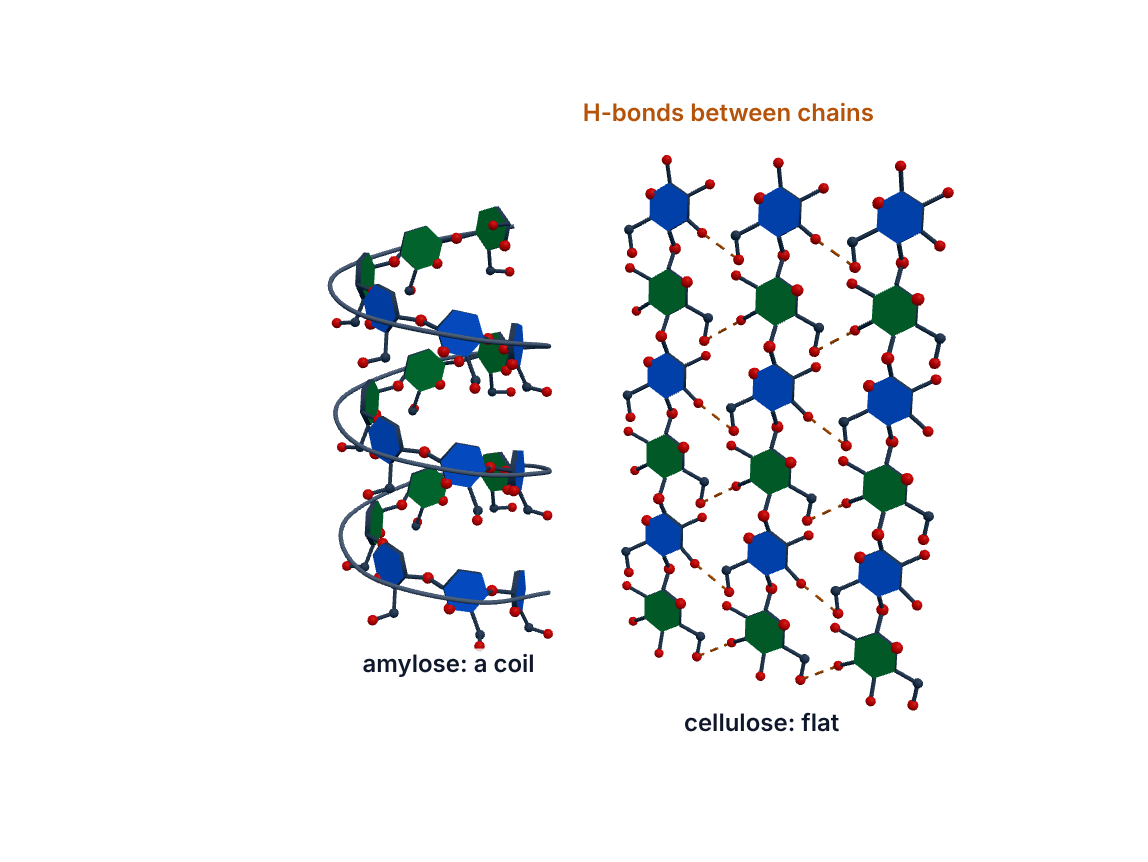
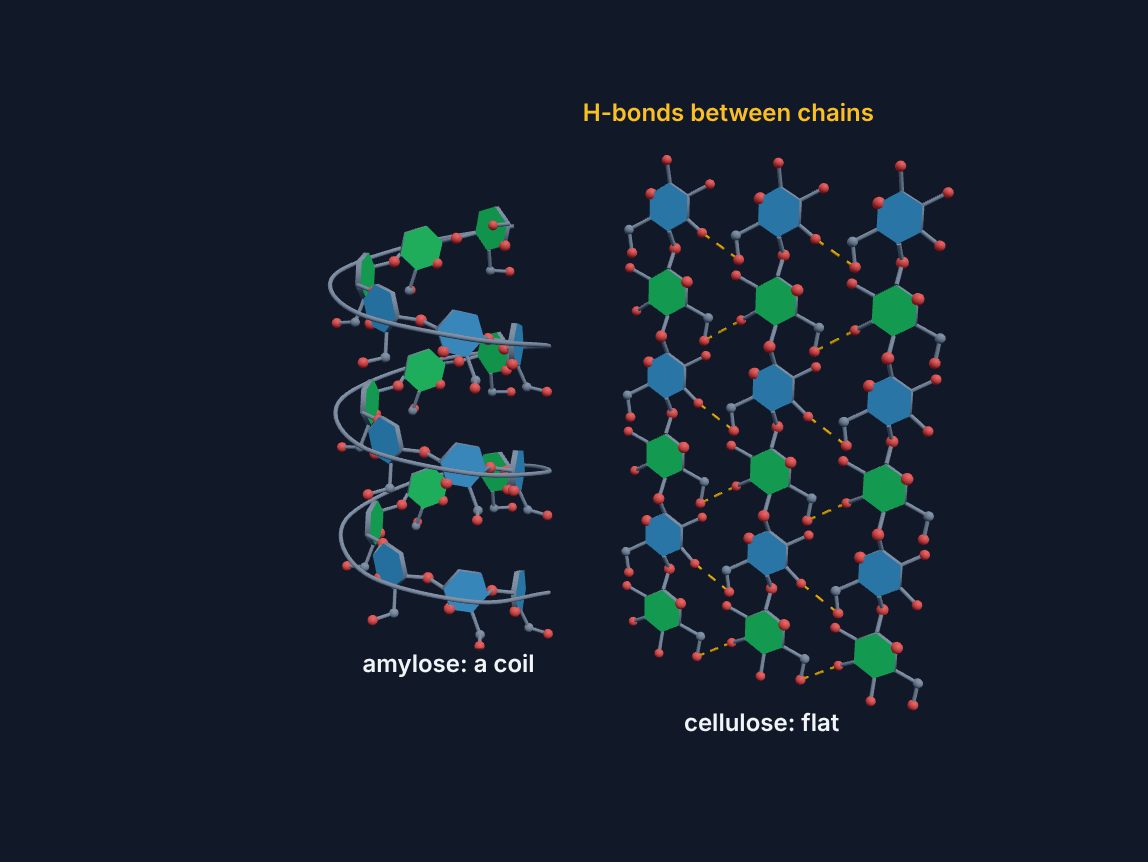
Starch coils, cellulose lies flat: α-1,4 against β-1,4 — Both are chains of glucose joined C1 to C4; only the link differs. In amylose (15–20% of starch) the α-1,4 link leaves C1 below the ring, so each glucose sits turned 60° from the last and the chain coils into a left-handed helix of 6 glucose units a turn, every ring facing the same way out. I₂ fits in the channel down the middle of the coil, which gives the blue-black colour of the iodine test. Amylopectin (80–85% of starch) is made of the same α-1,4 chains, branched by α-1,6 links from C1 of the branch to C6 of a glucose in the chain, about once every 24–30 glucose units. In cellulose the β-1,4 link leaves C1 in the plane of the ring, so each glucose is turned 180° from the last: every other ring is flipped over and the chain runs straight and flat. The flat chains lie side by side and hydrogen-bond into sheets, between the OH groups at C3 and C6 of neighbouring chains; the sheets stack into strong, insoluble fibres, and humans have no enzyme for the β links. The rings are drawn flat, with the top face blue and the bottom face green: in the coil every ring has its blue face outwards, so the green seen through the coil is the inside of the rings at the back, while along each cellulose chain blue and green alternate.

Proteins and Amino Acids

  • 20 naturally occurring α-amino acids. Each has H₂N–CH(R)–COOH. At physiological pH they exist as zwitterions: ⁺H₃N–CH(R)–COO⁻.
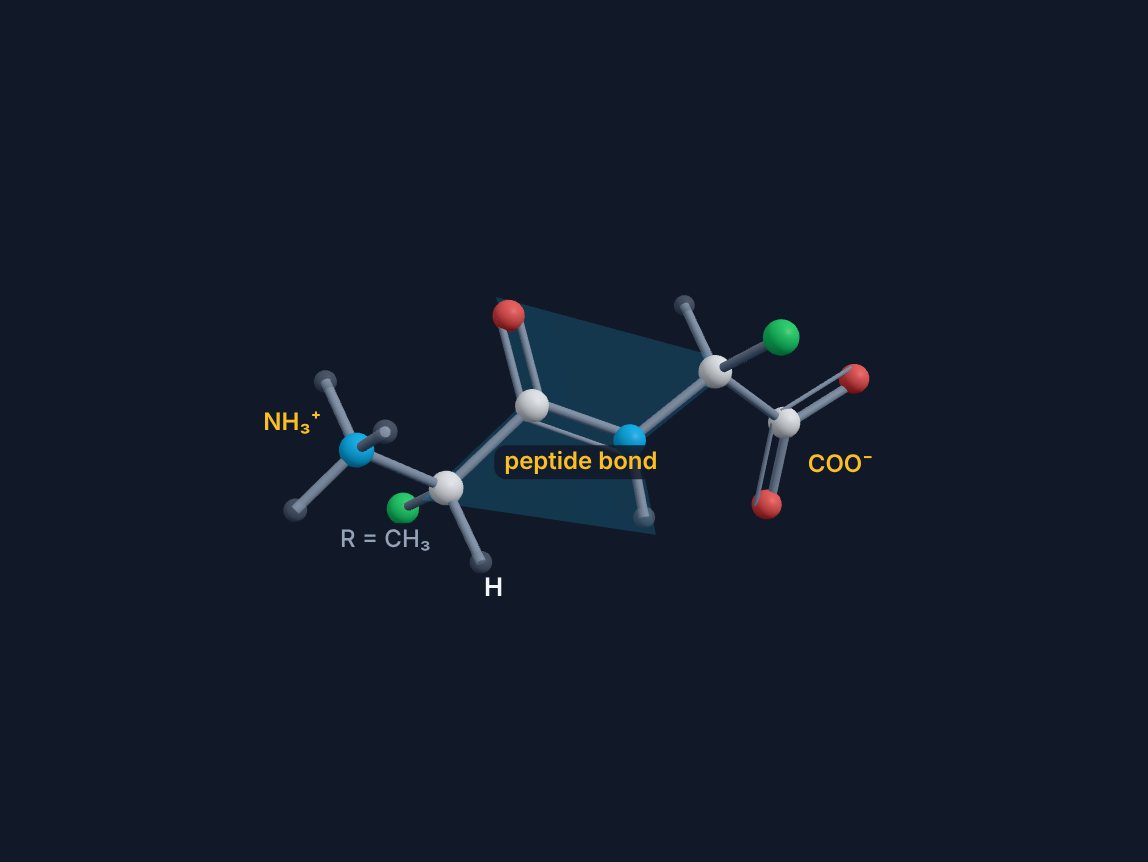
  • Peptide bond: –CO–NH– formed by condensation of –COOH of one amino acid with –NH₂ of another (water lost). Peptide bond is planar (partial double bond character due to resonance).
  • Protein structure levels:
    1° (primary): amino acid sequence.
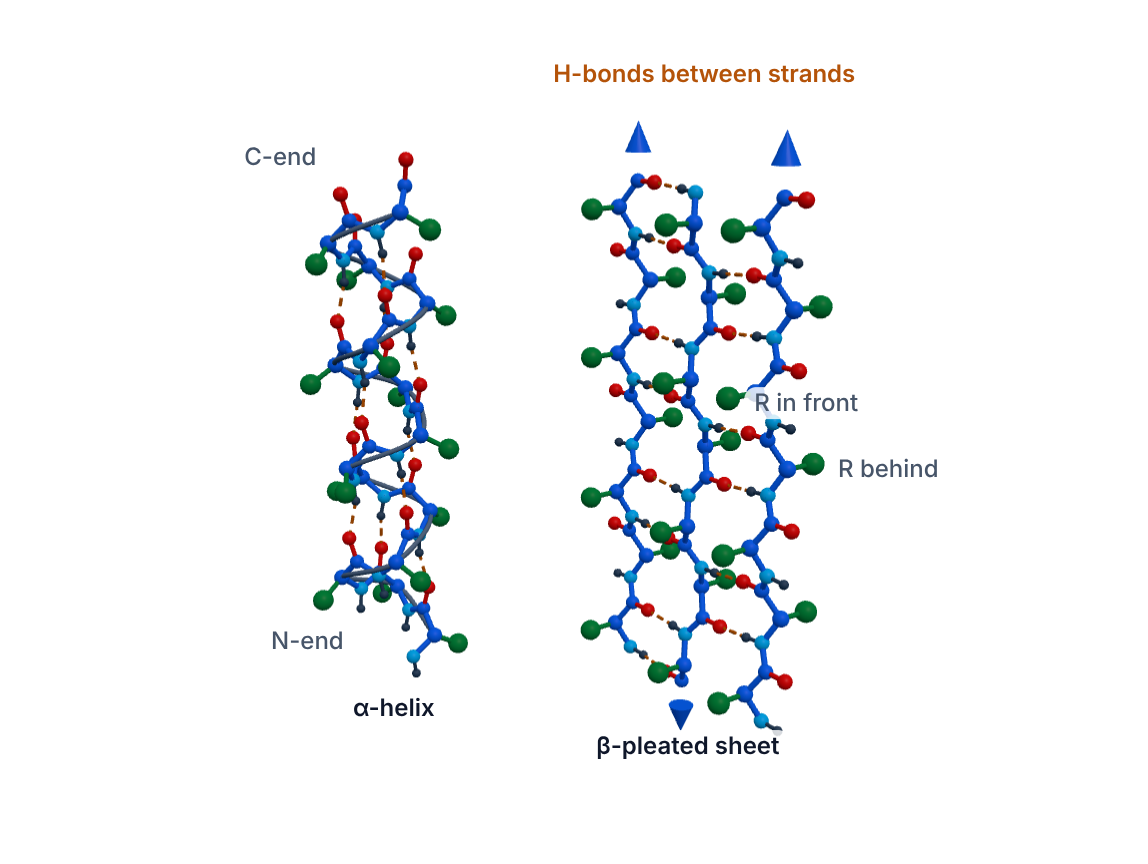
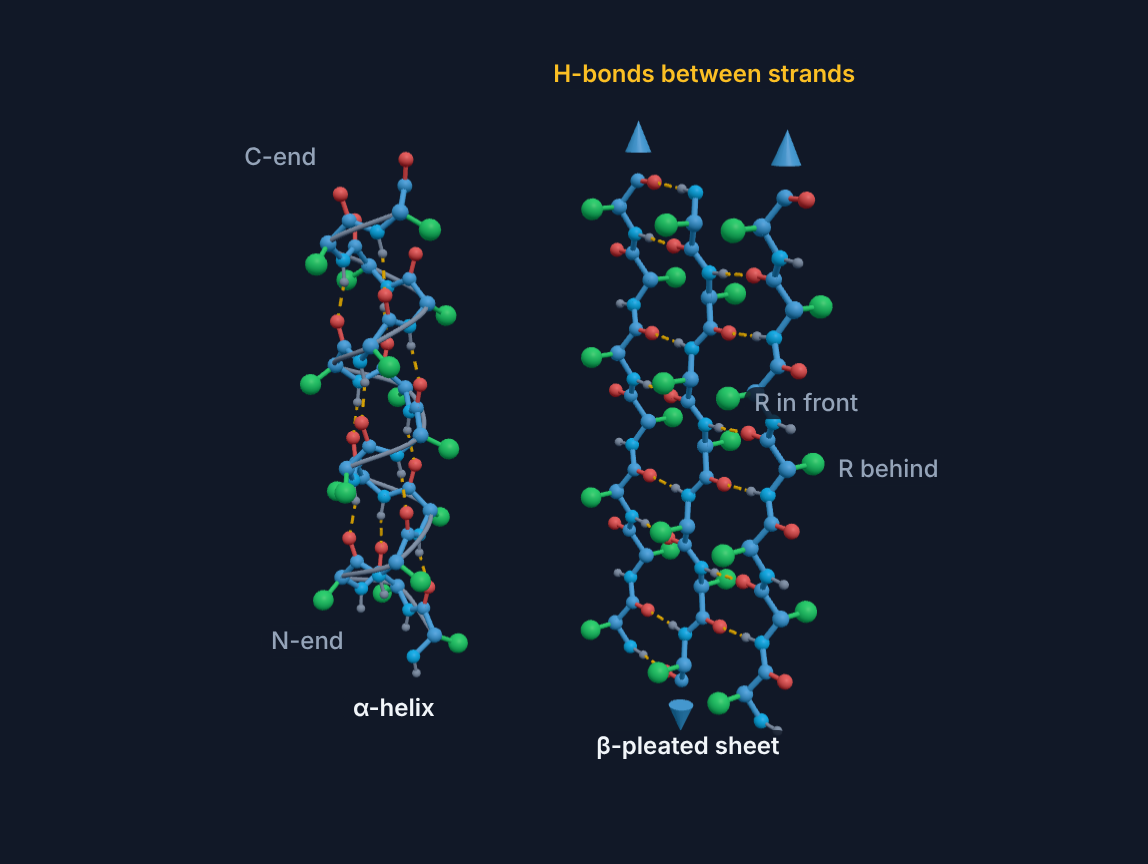
    2° (secondary): α-helix and β-sheet (H-bonding between C=O and N–H).
    3° (tertiary): 3D folding (disulfide bridges, H-bonds, hydrophobic interactions).
    4° (quaternary): multiple polypeptide subunits (e.g., haemoglobin = 4 subunits).
  • Denaturation: Disruption of 2°/3°/4° structure (not peptide bonds). Caused by heat, pH change, organic solvents, heavy metals. Reversible (renaturation) or irreversible.
  • Enzymes: Biological catalysts (protein). Lock-and-key model vs induced fit. Specific: active site complementary to substrate.
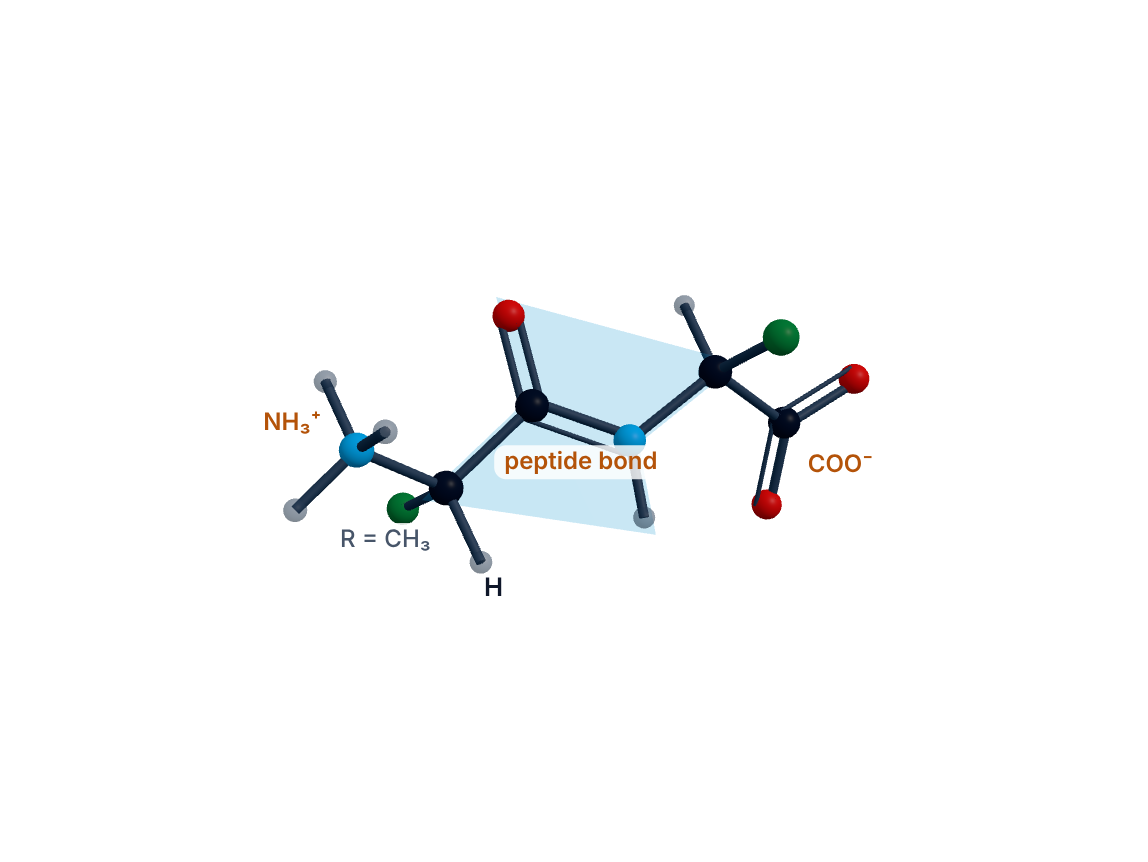
The zwitterion and the peptide bond in 3D — At physiological pH an α-amino acid is a zwitterion, H₃N⁺–CH(R)–COO⁻: +1 on the N and −1 shared by the two O, net 0. In L-alanine (R = CH₃), seen with the H on the α-carbon towards you, CO, R and N run clockwise (the CORN rule): that is L. When two alanines join, the C=O of one and the N–H of the next form the peptide group, and its six atoms, Cα, C, O, N, H and Cα, lie in one plane. Its C–N bond, 133 pm, is shorter than the N–Cα single bond, 146 pm: resonance gives it partial double-bond character, so it does not turn, and the two α-carbons sit on opposite sides of it (trans, ω = 180°). The chain turns only about the N–Cα (φ) and Cα–C (ψ) bonds: turning ψ and φ from the β-sheet’s values to the α-helix’s, −47° and −57°, leaves every peptide group flat.
Secondary structure: the α-helix and the β-pleated sheet — In the α-helix the polypeptide chain coils into a right-handed helix of 3.6 amino-acid residues a turn with a pitch of 0.54 nm, so each residue rises 0.54 ÷ 3.6 = 0.15 nm and turns 100°. The C=O of each residue is hydrogen-bonded to the N–H of the residue four places on (residue i to residue i + 4): the bonds run along the axis from one turn to the next, all within one chain, and the side chains (R) point outwards. In the β-pleated sheet the chains are stretched out almost fully, about 0.35 nm a residue, and lie side by side, here running in opposite directions (antiparallel). Hydrogen bonds between C=O and N–H join neighbouring chains, each chain zigzags into pleats, and the side chains point alternately to either side of the sheet.

Nucleic Acids

  • DNA: deoxyribonucleic acid. Double helix (Watson–Crick). Base pairing: A–T (2 H-bonds), G–C (3 H-bonds). Deoxyribose sugar + phosphate backbone.
  • RNA: Ribonucleic acid. Single-stranded (mostly). Uracil instead of thymine. A–U pairing. Types: mRNA, tRNA, rRNA.
  • Nucleotide = nitrogenous base + pentose sugar + phosphate. Nucleoside = base + sugar (no phosphate).
  • Purine bases: Adenine (A), Guanine (G). Pyrimidine bases: Cytosine (C), Thymine (T, in DNA), Uracil (U, in RNA).

Vitamins and Hormones

VitaminTypeDeficiency disease
A (retinol)Fat-solubleNight blindness, xerophthalmia
B₁ (thiamine)Water-solubleBeriberi
B₂ (riboflavin)Water-solubleCheilosis, corneal vascularisation
B₁₂ (cobalamin)Water-solublePernicious anaemia
C (ascorbic acid)Water-solubleScurvy
D (calciferol)Fat-solubleRickets (children), osteomalacia (adults)
E (tocopherol)Fat-solubleReproductive failure, muscular dystrophy
K (phylloquinone)Fat-solubleImpaired blood clotting

Fat-soluble: A, D, E, K (mnemonic: ADEK). Water-soluble: B-complex and C.

Polymers

PolymerTypeMonomersUse
Nylon-6,6Condensation, polyamideHexamethylenediamine + adipic acidFibres, ropes
Nylon-6Condensation (ring-opening)CaprolactamFibres
Dacron (Terylene)Condensation, polyesterEthylene glycol + terephthalic acidFibres, bottles
BakeliteCondensation, thermosettingPhenol + formaldehydeElectrical fittings
PVCAdditionVinyl chloride (CH₂=CHCl)Pipes, insulation
Teflon (PTFE)AdditionTetrafluoroethylene CF₂=CF₂Non-stick coating
Buna-S (SBR)Addition (copolymer)Butadiene + styreneSynthetic rubber tyres
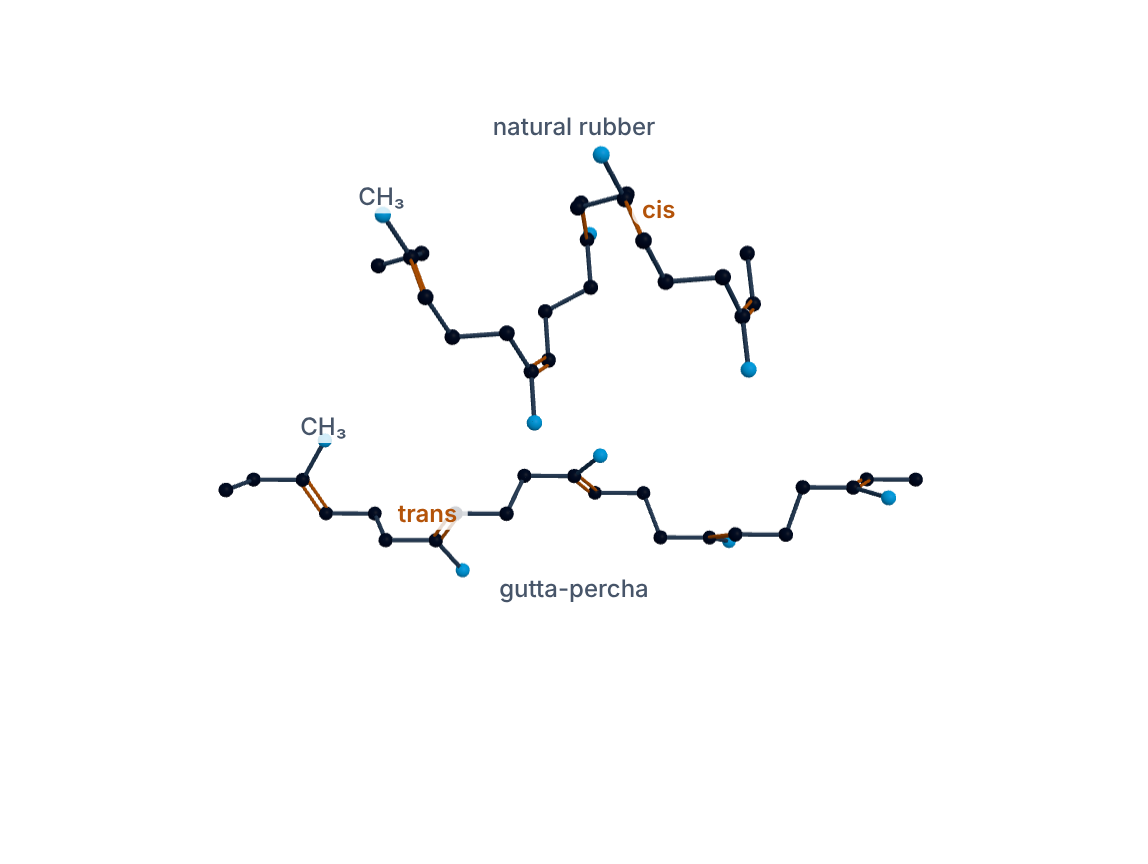
Natural rubberAddition (natural)Isoprene (cis-1,4)Elastic applications
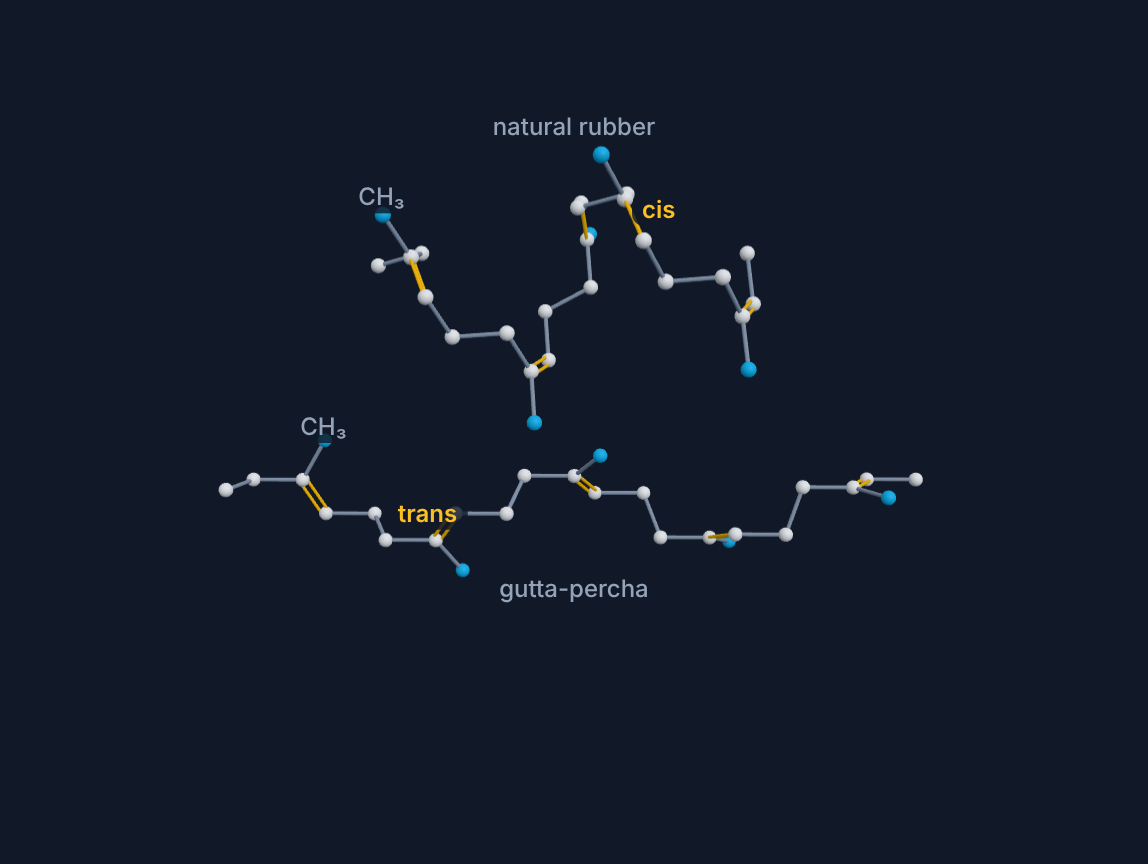
Natural rubber, gutta-percha and Bakelite in 3D — Natural rubber is cis-1,4-polyisoprene, –[CH₂–C(CH₃)=CH–CH₂]ₙ–: at every C=C the chain’s two CH₂ groups are on the same side (torsion 0°), so the chain turns back on itself and coils. Gutta-percha is the trans polymer (torsion 180°), and its chain runs straight. The two chains are drawn with the same turns about their single bonds; only the C=C differs. Coiled cis chains cannot pack closely and the forces between them are weak, so rubber is elastic; straight trans chains pack closely, so gutta-percha is hard and not elastic. Bakelite, from phenol and formaldehyde, is thermosetting: CH₂ bridges join each phenol ring to others at its ortho and para positions, branching in three directions, so the whole solid becomes one cross-linked network that cannot be melted again. The Bakelite piece is schematic; H atoms are not shown.
💡 JEE Tip: Sucrose is the ONLY common non-reducing disaccharide because BOTH anomeric carbons (C1 of glucose AND C2 of fructose) are involved in the glycosidic bond — no free hemiacetal group left. All monosaccharides (glucose, fructose, galactose) are reducing sugars.
⚠ Common Error: Nylon-6 and Nylon-6,6 sound similar but differ: Nylon-6 is made from ONE monomer (caprolactam, ring-opening), while Nylon-6,6 is from TWO monomers (hexamethylenediamine + adipic acid). The numbers refer to the carbon atoms in each monomer unit.
🔢
Biomolecules & Polymers — Formula Sheet
Key Condensation Polymer Reactions
Nylon-6,6: H₂N(CH₂)₆NH₂ + HOOC(CH₂)₄COOH → [–NH(CH₂)₆NHCO(CH₂)₄CO–]ₙ + nH₂O
Hexamethylenediamine (6C) + adipic acid (6C) → polyamide. –CO–NH– linkage (amide bond).
Dacron: HOCH₂CH₂OH + HOOC–C₆H₄–COOH → polyester + H₂O
Ethylene glycol + terephthalic acid → poly(ethylene terephthalate). –CO–O– linkage (ester bond).
Carbohydrate Reactions
Fehling's: RCHO + 2Cu²⁺ + 5OH⁻ → RCOO⁻ + Cu₂O↓ + 3H₂O
Reduces Cu²⁺ (blue) to Cu₂O (brick-red ppt). Positive for: aliphatic aldehydes, glucose, fructose (via enol), maltose, lactose. Negative for: sucrose, aromatic aldehydes, ketones.
Mutarotation: α-D-glucose ⇌ open chain ⇌ β-D-glucose (in aqueous solution)
Specific rotation changes from +112° (α) or −92° (β) to equilibrium +52.7°. The anomers differ only at C1 (anomeric carbon). Catalysed by acid or base.
DNA Base Pairing
DNA: A–T (2 H-bonds), G–C (3 H-bonds) | RNA: A–U (2 H-bonds), G–C (3 H-bonds)
In any DNA sample: %A = %T and %G = %C (Chargaff's rule). %A+%T+%G+%C = 100%.
🧮
Biomolecules & Polymers — Solved Examples
Example 1 Easy Reducing vs Non-reducing Sugars
Classify as reducing or non-reducing: (a) Glucose, (b) Sucrose, (c) Maltose, (d) Fructose, (e) Cellulose.
  1. Reducing sugar = has free anomeric –OH (hemiacetal or hemiketal group) → can open ring to give free aldehyde/ketone → reduces Fehling's/Tollens'.
  2. Glucose: Monosaccharide, free anomeric C1–OH. Reducing ✓
  3. Sucrose: Glycosidic bond uses BOTH anomeric carbons (C1 of glucose + C2 of fructose). No free anomeric –OH. Non-reducing ✗
  4. Maltose: Two glucose units, α-1,4 bond. C1 of second glucose is free (anomeric –OH present). Reducing ✓
  5. Fructose: Monosaccharide (ketohexose). Free anomeric C2–OH. Reduces Fehling's (via enolization). Reducing ✓
  6. Cellulose: Polysaccharide (β-1,4). The reducing end has a free anomeric –OH, but for practical purposes (high MW, insoluble) — treated as non-reducing in JEE context.
Example 2 Medium Polymer Classification
Classify each polymer: (a) Nylon-6, (b) Natural rubber, (c) Bakelite, (d) Teflon, (e) Buna-S. State the type of polymerization and give the monomer(s).
  1. Nylon-6: Condensation polymer (ring-opening of caprolactam). 1 monomer. Polyamide (–CO–NH– links). Thermoplastic.
  2. Natural rubber: Addition polymer (cis-1,4-polyisoprene). Monomer: isoprene (CH₂=C(CH₃)–CH=CH₂). Natural (biosynthesised). cis configuration gives elasticity.
  3. Bakelite: Condensation polymer (phenol + formaldehyde). Cross-linked 3D network. Thermosetting (cannot be remelted). Used for electrical fittings.
  4. Teflon (PTFE): Addition polymer. Monomer: tetrafluoroethylene (CF₂=CF₂). Thermoplastic. Chemically inert due to strong C–F bonds. Non-stick surface.
  5. Buna-S (SBR): Addition copolymer. Monomers: butadiene (CH₂=CH–CH=CH₂) + styrene (C₆H₅CH=CH₂). Synthetic rubber. Used in tyres.
Example 3 Hard DNA Composition — Chargaff's Rules
In a DNA sample, adenine constitutes 30% of the bases. Find the percentages of thymine, guanine, and cytosine. Also find the number of hydrogen bonds if the DNA has 10,000 base pairs.
  1. Chargaff's rule: %A = %T and %G = %C.
  2. %A = 30% → %T = 30%. %A + %T = 60% → %G + %C = 40% → %G = %C = 20%.
  3. In 10,000 base pairs: A–T pairs = 30% of 10,000 = 3,000 pairs; G–C pairs = 20% = 2,000 pairs.
  4. H-bonds: A–T = 2 H-bonds each → 3,000 × 2 = 6,000. G–C = 3 H-bonds each → 2,000 × 3 = 6,000.
✓ Total H-bonds = 6,000 + 6,000 = 12,000. T = 30%, G = 20%, C = 20%. Note: A+T-rich DNA has lower melting temperature (fewer H-bonds per bp).
📊
Biomolecules & Polymers — Visual Concepts
Click any diagram to zoom
⚡
Biomolecules & Polymers — Quick Quiz
Question 1
Sucrose does NOT reduce Fehling's solution because:
In sucrose, the glycosidic bond (α,β-1,2) involves the anomeric C1 of glucose AND the anomeric C2 of fructose. Both are locked in the bond → no free hemiacetal/hemiketal → cannot open to give free carbonyl → non-reducing. Answer: B ✓
Question 2
Nylon-6,6 is synthesised from:
Nylon-6,6: condensation polymerization of hexamethylenediamine (6C diamine) + adipic acid (6C diacid) → polyamide with –CO–NH– (amide) linkages. The "6,6" refers to 6 carbons in each monomer. Nylon-6 (A) comes from caprolactam alone. Dacron (B) uses ethylene glycol + terephthalic acid (polyester). Answer: C ✓
Question 3
In DNA, if guanine constitutes 22% of the bases, the percentage of adenine is:
Chargaff's rule: %G = %C = 22%. So %G + %C = 44%. Therefore %A + %T = 100% − 44% = 56%. Since %A = %T → %A = 56%/2 = 28%. Answer: A ✓
🎉 All Organic Chemistry topics mastered! Next: Mathematics →