🧪 Chemistry · Inorganic 🔥 Day 1
0/6 topics mastered

Inorganic Chemistry — Chemistry

🗂
Periodic Table & Chemical Bonding
Periodicity · VSEPR · Hybridisation · MO theory · Hydrogen bonding

Periodic Table Organisation

  • s-block (Groups 1–2): alkali and alkaline earth metals — fill ns orbitals
  • p-block (Groups 13–18): fill np orbitals; includes metalloids, nonmetals, noble gases
  • d-block (Groups 3–12): transition metals — fill (n−1)d orbitals
  • f-block (Lanthanides, Actinides): fill (n−2)f orbitals; placed separately below
  • Period number = number of shells; Group number relates to valence electrons
PropertyAcross Period (→)Down Group (↓)Key Reason
Atomic radiusDecreasesIncreases↑ Z_eff across; ↑ shells down
Ionic radius (cation)DecreasesIncreasesSame trend as atomic radius
Ionisation energy (IE)IncreasesDecreases↑ Z_eff; farther e⁻ easier to remove
Electron affinity (EA)Increases (general)DecreasesCompact atoms hold extra e⁻ better
ElectronegativityIncreasesDecreasesF most electronegative (3.98)

Key anomalies in IE: Be > B (2s vs 2p); N > O (half-filled 2p stable); Mg > Al; P > S — extra stability of half-filled/filled subshells.

Electron affinity anomalies: N has zero/negative EA (half-filled 2p repels extra e⁻); F < Cl (F is too small, e⁻ repulsion).

Chemical Bonding Types

Bond TypeFormed byCharacterExample
IonicComplete e⁻ transferElectronegativity diff > 1.7NaCl, MgO
Covalent (polar)Shared pairs, unequalΔEN = 0.4–1.7HCl, H₂O
Covalent (non-polar)Shared pairs, equalΔEN < 0.4H₂, Cl₂, CH₄
MetallicSea of electronsDelocalisedNa, Fe, Cu
Coordinate (dative)Both e⁻ from one atomLewis acid–baseNH₄⁺, BF₃·NH₃
  • Formal charge = Valence e⁻ − Non-bonding e⁻ − ½(Bonding e⁻)
  • Lattice energy ∝ (charge product)/(ionic radii sum); more negative = more stable ionic compound
  • Bond order = (bonding e⁻ − antibonding e⁻) / 2; higher BO → shorter, stronger bond
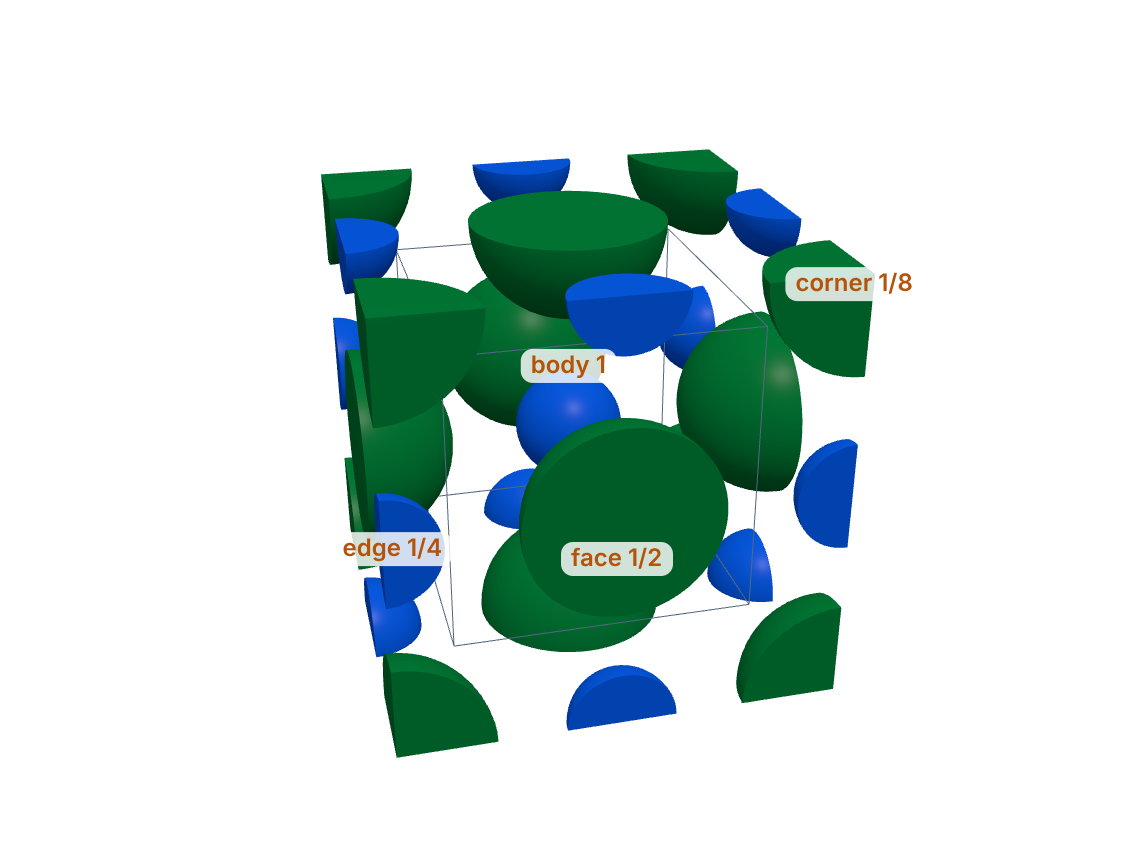
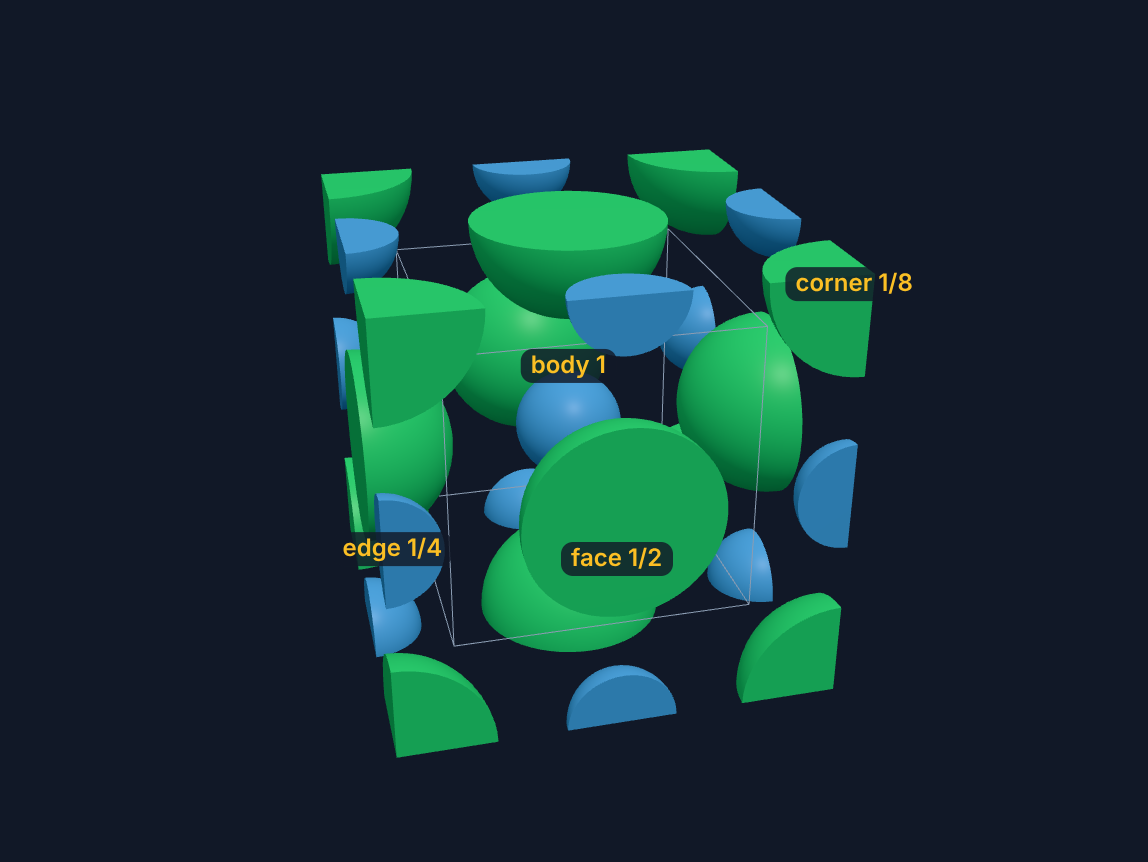
Rock salt, NaCl — The Cl⁻ ions sit on a face-centred cubic (fcc) lattice, at the 8 corners and 6 face centres of the cell. The Na⁺ ions fill every octahedral void of that lattice: the 12 edge centres and the body centre. Each Na⁺ has 6 Cl⁻ round it at a/2, at the corners of an octahedron (90° apart), and each Cl⁻ has 6 Na⁺ in the same way, one of them in the next cell: the coordination is 6:6. The radius ratio r⁺/r⁻ = 102/181 = 0.56 lies in the octahedral range, 0.414 to 0.732. Na⁺ and Cl⁻ touch along every edge, so \(a = 2(r^+ + r^-)\) = 2(102 + 181) = 566 pm (X-ray: 564 pm); the Cl⁻ do not touch one another, since \(a/\sqrt{2}\) = 400 pm is more than 2r⁻ = 362 pm. A corner is shared by 8 cells, an edge by 4 and a face by 2, so one cell holds Cl⁻: 8 × 1/8 + 6 × 1/2 = 4 and Na⁺: 12 × 1/4 + 1 × 1 = 4, that is Z = 4 formula units of NaCl. Radii are six-coordinate values (Shannon); the ball model shrinks the ions, and the cut-away view is to scale.

VSEPR Theory — Molecular Shapes

BP + LPBond PairsLone PairsShapeExample
220Linear (180°)BeCl₂, CO₂
330Trigonal planar (120°)BF₃, SO₃
321Bent (~120°)SO₂, SnCl₂
440Tetrahedral (109.5°)CH₄, NH₄⁺
431Trigonal pyramidal (~107°)NH₃, PCl₃
422Bent (~104.5°)H₂O, H₂S
550Trigonal bipyramidalPCl₅
660Octahedral (90°)SF₆, PCl₆⁻
642Square planarXeF₄, ICl₄⁻

Lone pair repulsion > bond pair repulsion → lone pairs compress bond angles (NH₃: 107°, H₂O: 104.5° vs 109.5° tetrahedral).
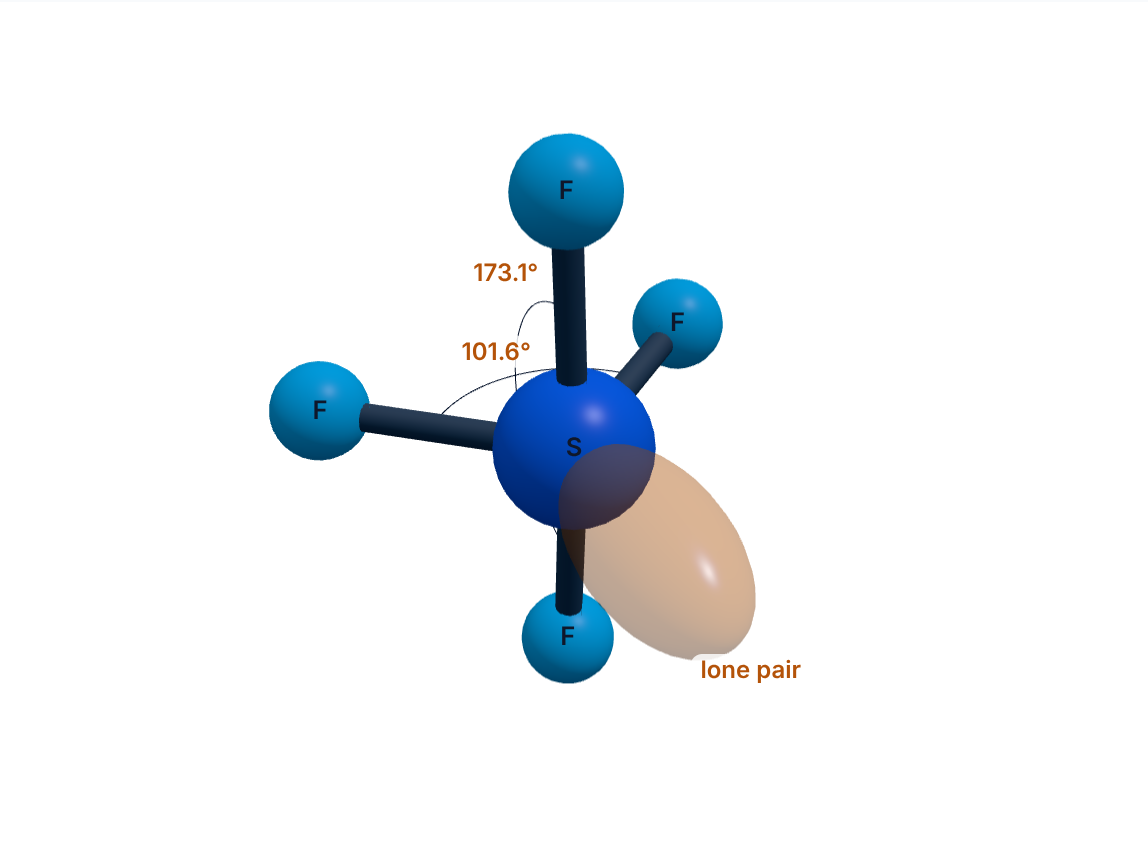
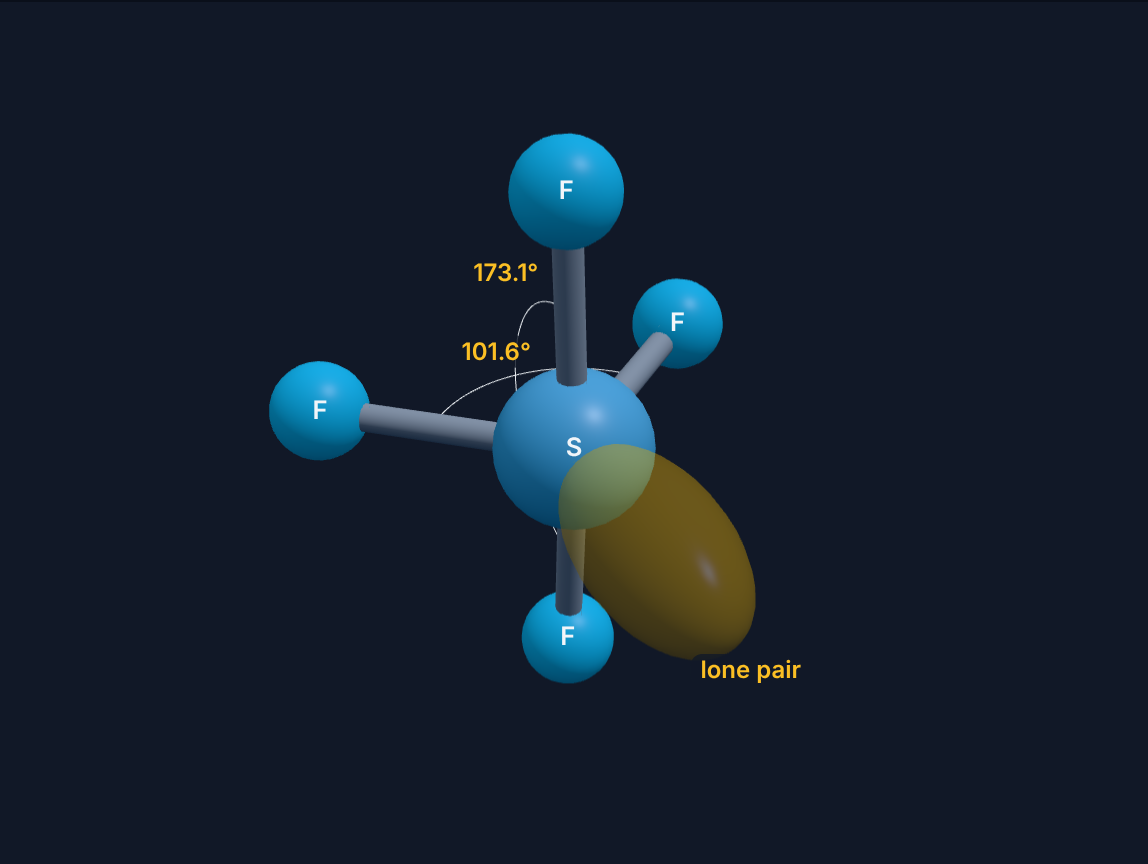
VSEPR shapes with 5, 6 and 7 electron pairs — Five electron pairs point to the corners of a trigonal bipyramid: three equatorial pairs 120° apart and two axial pairs at 90° to them. An axial pair has 3 other pairs at 90° to it, an equatorial pair only 2, so a lone pair, which repels more than a bond pair, takes an equatorial corner. (The 3D view finds every placement by counting these 90° contacts.) PCl₅ (AX₅) is trigonal bipyramidal, 90° and 120°; its two axial bonds are longer than the three equatorial ones, since each meets 3 bonds at 90° and an equatorial bond only 2. SF₄ (AX₄E) has one equatorial lone pair and is see-saw shaped: the measured F–S–F angles are 101.6° between the equatorial F and 173.1° between the axial F. ClF₃ (AX₃E₂) has two equatorial lone pairs and is T-shaped, F–Cl–F 87.5° (measured). XeF₂ (AX₂E₃) has all three lone pairs equatorial and is linear, 180°. Six pairs point to the corners of an octahedron, 90° apart: SF₆ (AX₆) is octahedral, and BrF₅ (AX₅E) square pyramidal. In XeF₄ (AX₄E₂) the two lone pairs sit opposite each other (trans), never at 90°, so XeF₄ is square planar, 90°. IF₇ (AX₇) has seven pairs and is pentagonal bipyramidal: five equatorial F 72° apart (360°/5) and two axial F at 90° to them. XeF₆ also has seven pairs, one of them a lone pair, and is a distorted octahedron; it is not drawn, because VSEPR does not fix how far it is distorted. BrF₅ is drawn at the ideal 90°, though its real angles differ a little. Bond lengths and lone-pair clouds are not to scale.
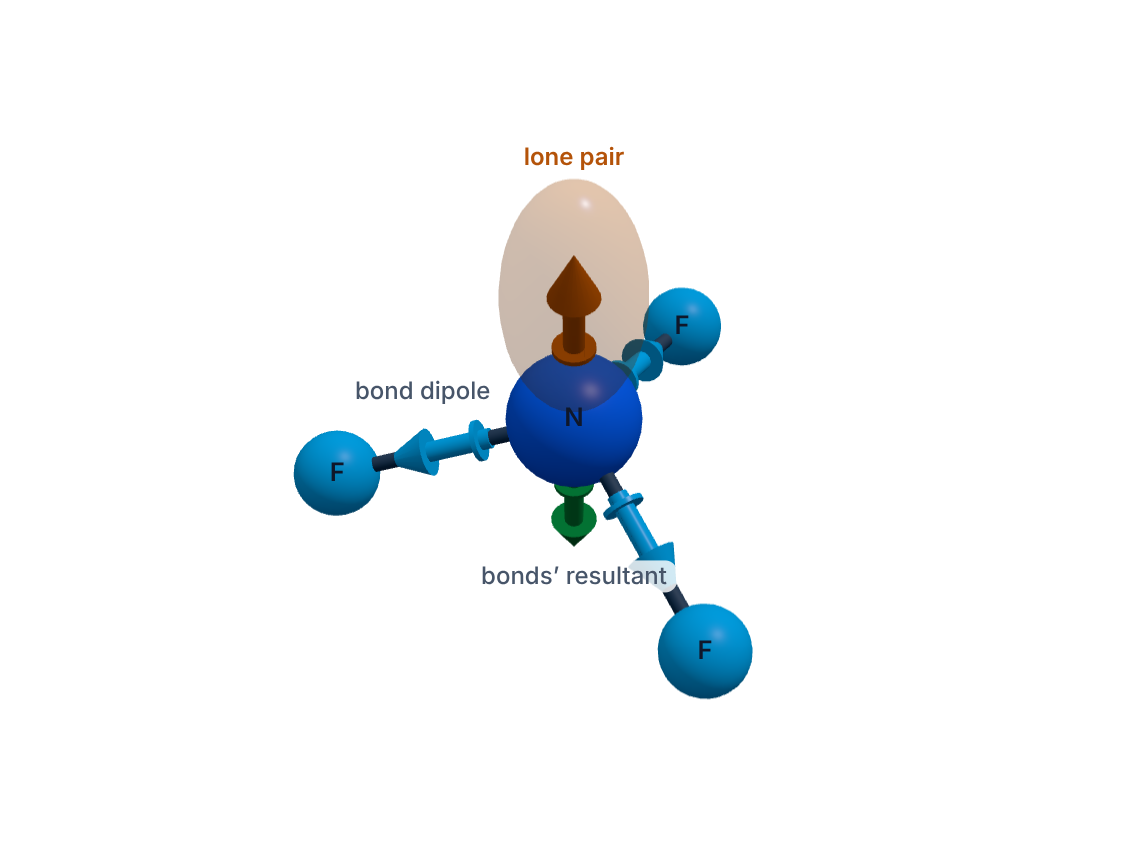
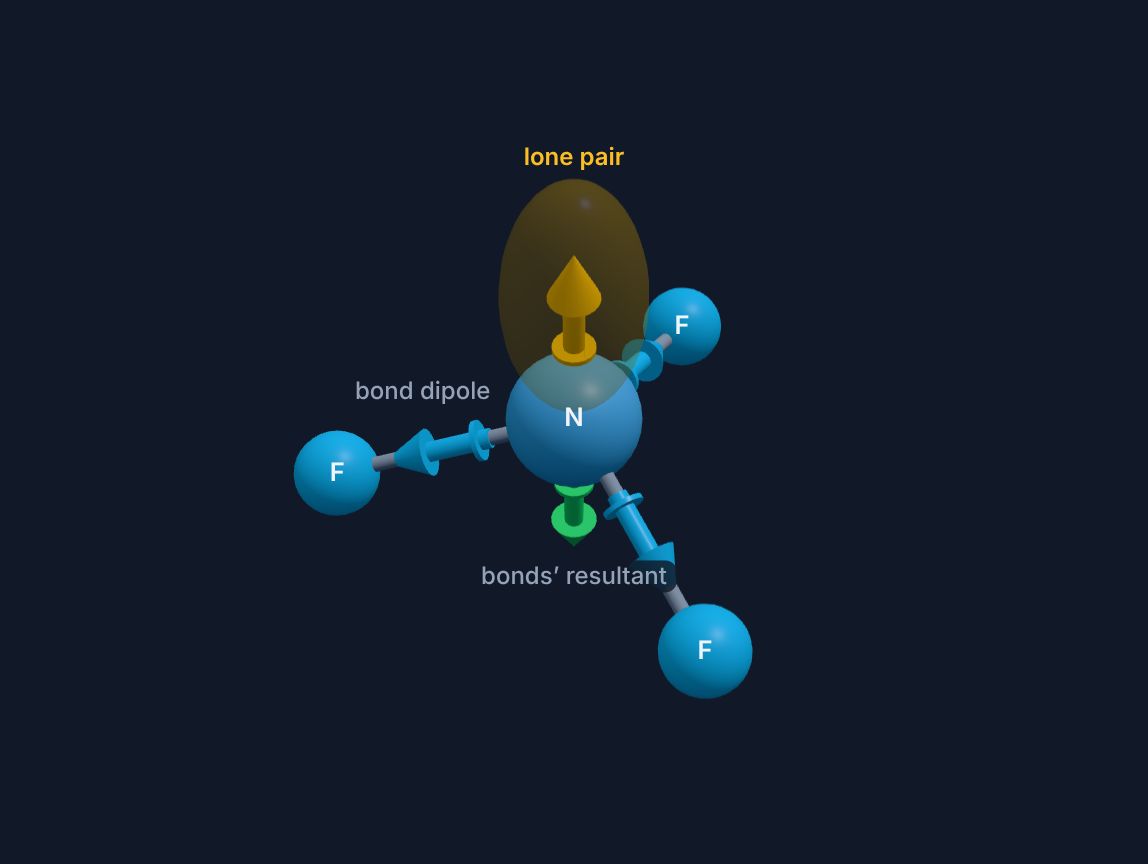
Dipole moment as a vector sum — A polar bond has a bond dipole, drawn as an arrow from δ+ to δ− (towards the more electronegative atom). A molecule’s dipole moment is the vector sum of its bond dipoles, so it depends on the shape. In linear CO₂ the two C=O dipoles point in opposite directions; in trigonal planar BF₃ the three B–F dipoles are 120° apart; in tetrahedral CCl₄ the four C–Cl dipoles point to the corners of a tetrahedron. In each the sum is exactly zero, so these molecules have no dipole moment although their bonds are polar. In bent H₂O (H–O–H 104.5°) the two O–H dipoles add up to a resultant along the bisector, towards O, so water is polar. NH₃ and NF₃ are both pyramidal, with a lone pair on N. In NH₃ the N–H dipoles point towards N, so their resultant points the same way as the lone pair’s moment and the two add: μ = 4.90 × 10⁻³⁰ C m. In NF₃ the N–F dipoles point away from N, so their resultant opposes the lone pair’s moment and μ is only 0.8 × 10⁻³⁰ C m, although F is more electronegative than H (both values from NCERT). Arrow lengths are schematic: only their directions and the zero sums are worked out.

Hybridisation

HybridisationGeometryBond angleExamples
spLinear180°BeCl₂, C₂H₂, CO₂
sp²Trigonal planar120°BF₃, C₂H₄, SO₃, graphite
sp³Tetrahedral109.5°CH₄, NH₃, H₂O, diamond
sp³dTrigonal bipyramidal90°, 120°PCl₅, SF₄
sp³d²Octahedral90°SF₆, PCl₆⁻, XeF₄
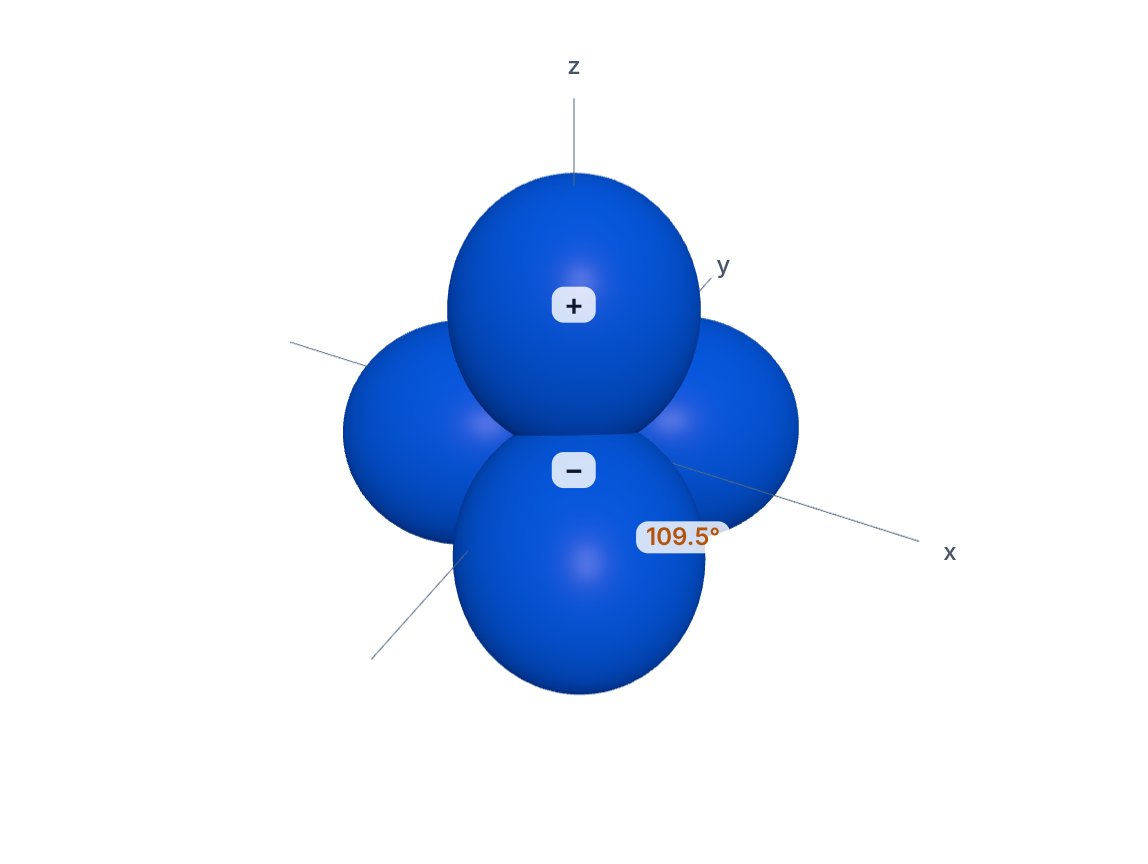
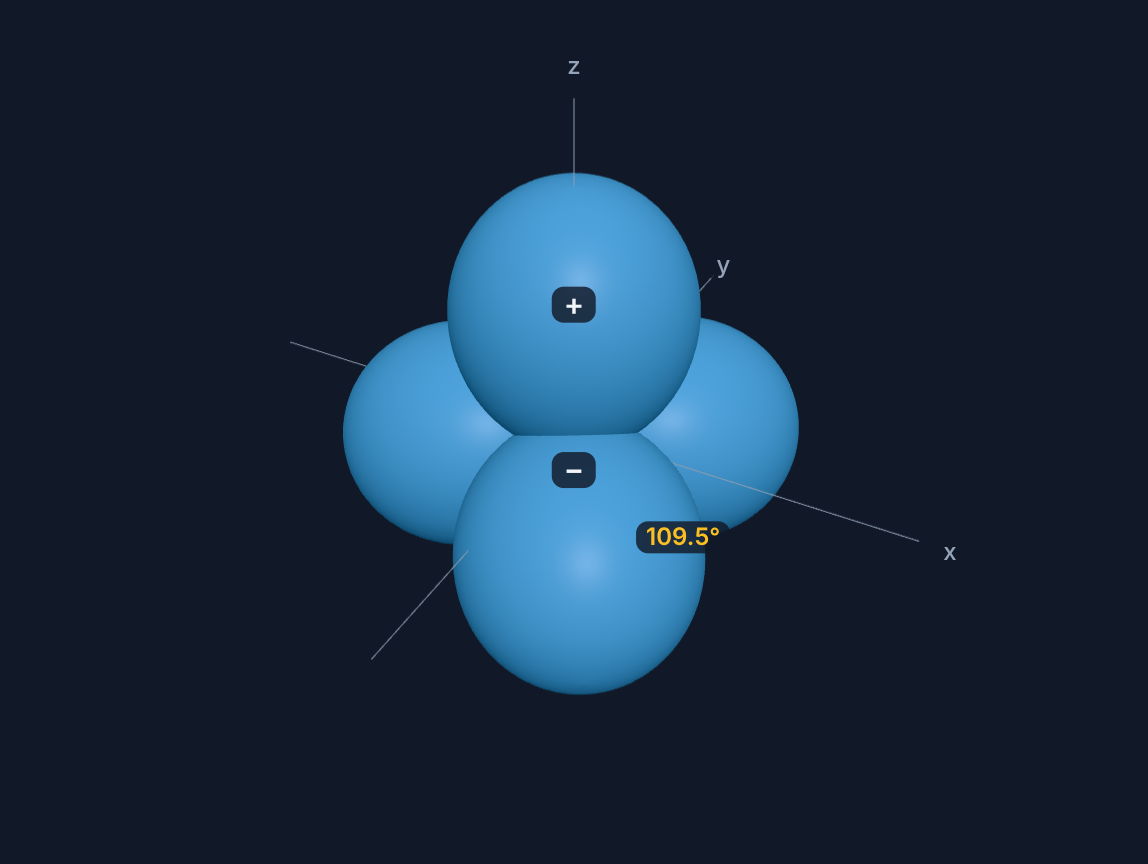
Hybrid orbitals in 3D — Mixing orbitals gives exactly as many hybrids as orbitals mixed: sp (one s + one p) gives 2 hybrids 180° apart; sp² gives 3 at 120° in a plane; sp³ gives 4 at 109.5°; sp³d gives 5 (trigonal bipyramidal, 90° and 120°); sp³d² gives 6 (octahedral, 90°). Each hybrid has one big lobe pointing along its bond and a small back lobe of opposite sign. Its s character falls from 50% (sp) to 33% (sp²) and 25% (sp³), and its back lobe grows from 7% to 18% to 25% of the main lobe's length. sp leaves two p orbitals and sp² one p orbital unhybridised, at right angles to the hybrids; these form π bonds. In sp³d the three equatorial hybrids (33% s) and the two axial ones (made from p and d only: slimmer, with a small ring round the middle instead of a back lobe) are not equivalent. The 3D view draws each hybrid as a polar plot of its angular part: a lobe's length in each direction shows how likely the electron is to be found that way.
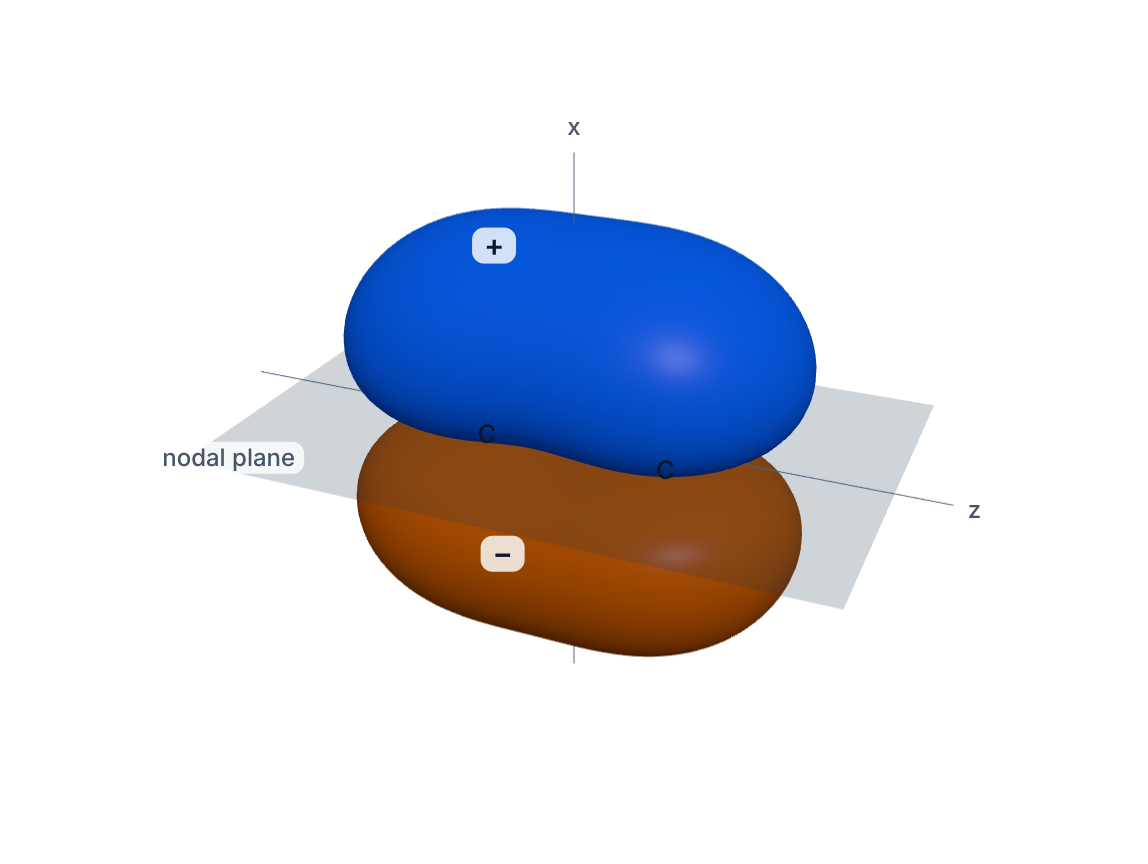
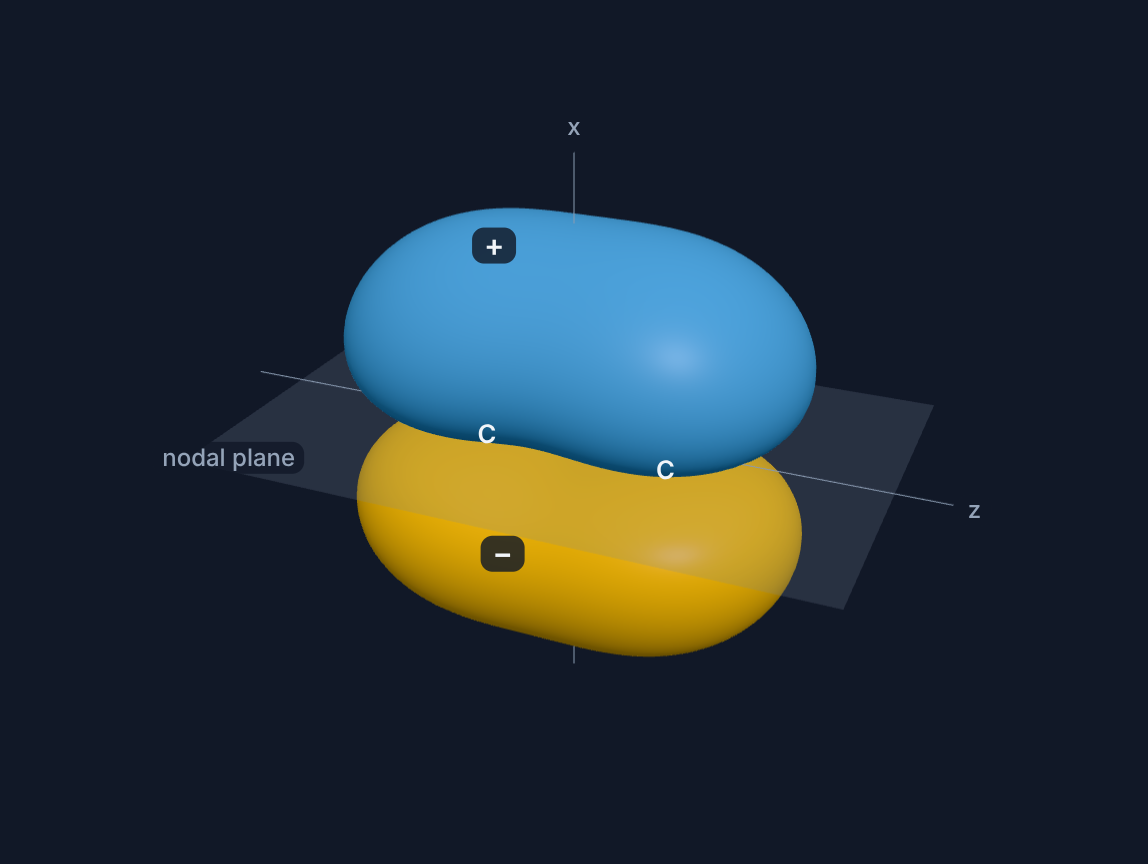
σ and π bonds in 3D — Two carbon 2p orbitals 133 pm apart (the C=C bond length). Meeting end-on, they overlap on the bond axis and make a σ bond (overlap S = 0.32); side by side, they overlap above and below the axis and make a π bond (S = 0.27), whose nodal plane contains the axis. Turn one end 90° about the axis and the overlap falls to exactly zero (it goes as cos θ), so the π bond breaks: this is why a C=C bond does not rotate freely, and cis and trans isomers are different compounds. In C=C the σ bond is made by sp² hybrids (S = 0.75) and the π bond by the leftover 2p orbitals; in C≡C (120 pm) the σ bond is made by sp hybrids (S = 0.81), and two π bonds (S = 0.34 each) lie at right angles. In every case the σ overlap is the larger, which is why a σ bond is stronger than a π bond. Each surface encloses 90% of the probability; colour shows the sign of ψ, not charge.

Molecular Orbital Theory

  • MOs formed by LCAO: bonding MO (lower energy, σ or π), antibonding MO (higher energy, σ* or π*)
  • Filling order (homonuclear diatomics up to N₂): σ1s, σ*1s, σ2s, σ*2s, π2p (before σ2p), σ2p, π*2p, σ*2p
  • For O₂, F₂: σ2p fills before π2p (order reverses after N₂)
  • Bond order = (bonding − antibonding)/2; paramagnetism if unpaired electrons in MOs
  • O₂: BO = 2, paramagnetic (2 unpaired e⁻ in π*2p) — explains liquid O₂ being attracted to magnets
  • N₂: BO = 3, diamagnetic; CO: BO = 3, diamagnetic (isoelectronic with N₂)
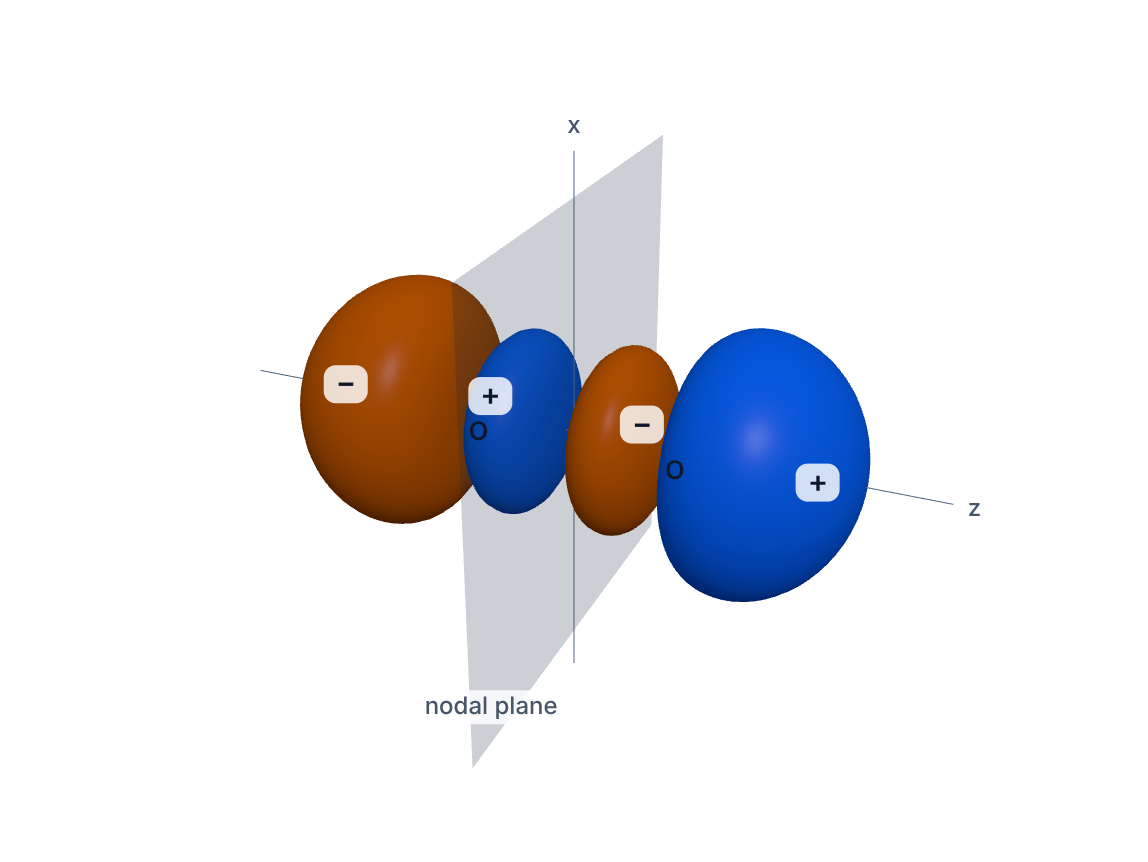
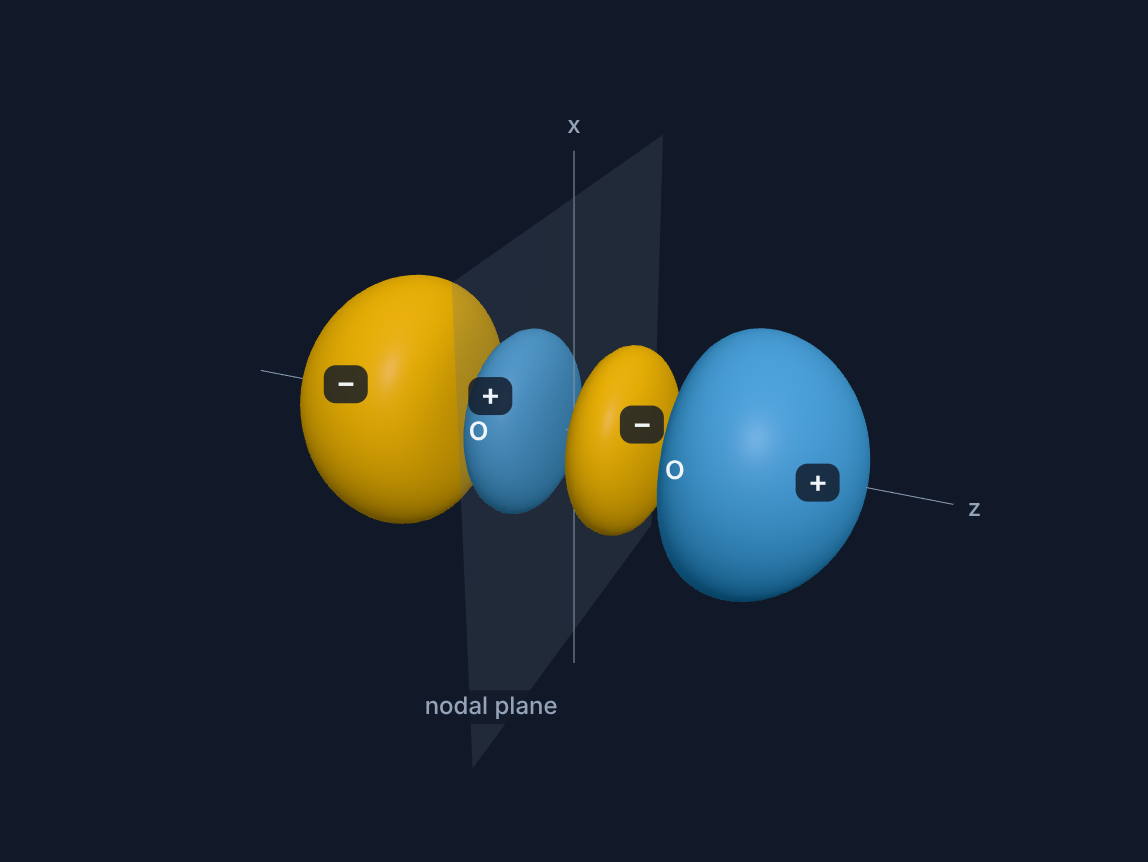
Molecular orbitals in 3D — The six molecular orbitals NCERT draws, each made from two atomic orbitals: in phase (ψA + ψB) for a bonding MO, out of phase (ψA − ψB) for an antibonding one. σ1s and σ*1s are drawn for H₂ (74 pm; overlap S = 0.75); σ2pz, σ*2pz, π2px and π*2px for O₂ (121 pm; S = 0.31 end-on and 0.15 side by side). A bonding MO builds up electron density between the nuclei; every antibonding MO has a nodal plane between them. A σ MO is unchanged by turning about the bond axis; a π MO has a nodal plane containing the axis, so π*2px has two nodal planes. Each surface encloses 90% of the probability and is drawn to scale; colour shows the sign of ψ, not charge.

Hydrogen Bonding

  • Forms between H bonded to highly electronegative atom (F, O, N) and lone pair of another F/O/N
  • Intermolecular H-bonding: H₂O, HF, NH₃, carboxylic acids — raises BP and melting point
  • Intramolecular H-bonding: o-nitrophenol, salicylaldehyde — lowers BP (no intermolecular association)
  • HF has highest BP among hydrogen halides (strong H-bonding); H₂O has anomalously high BP vs H₂S
  • Ice is less dense than water (open H-bond network) — maximum density at 4°C
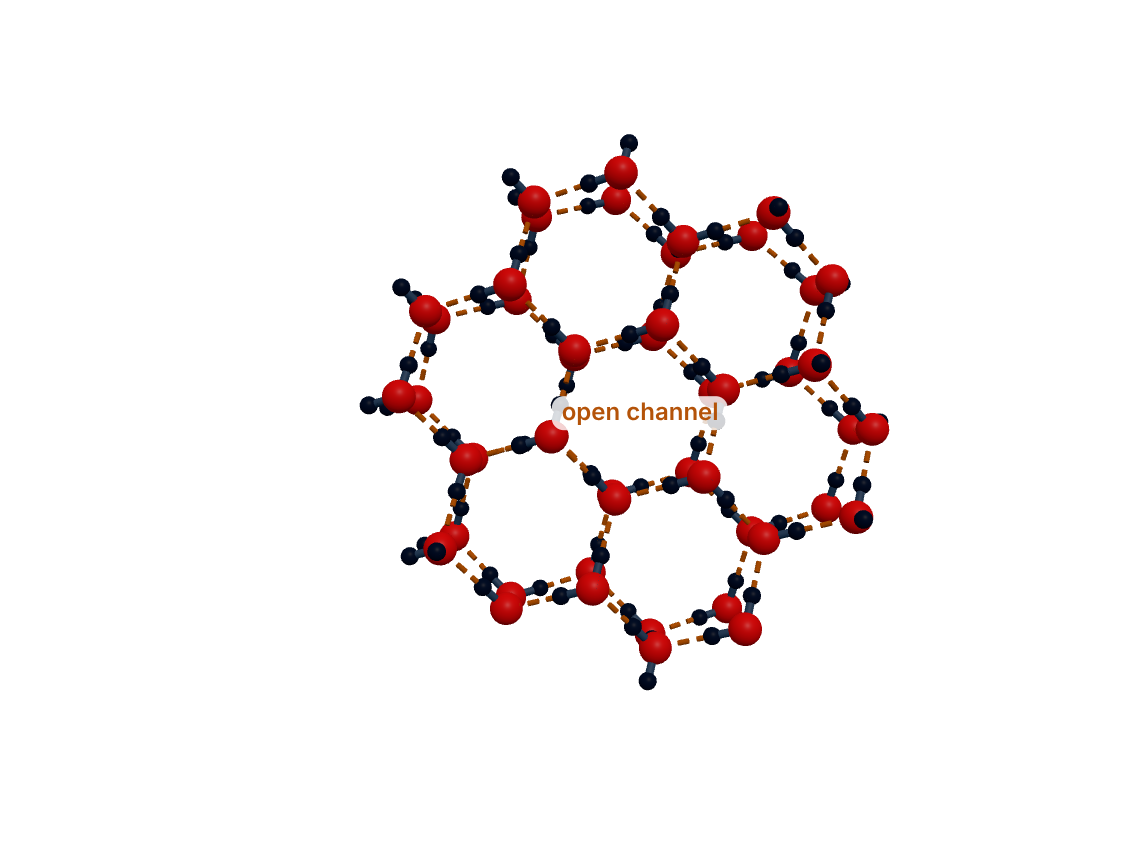
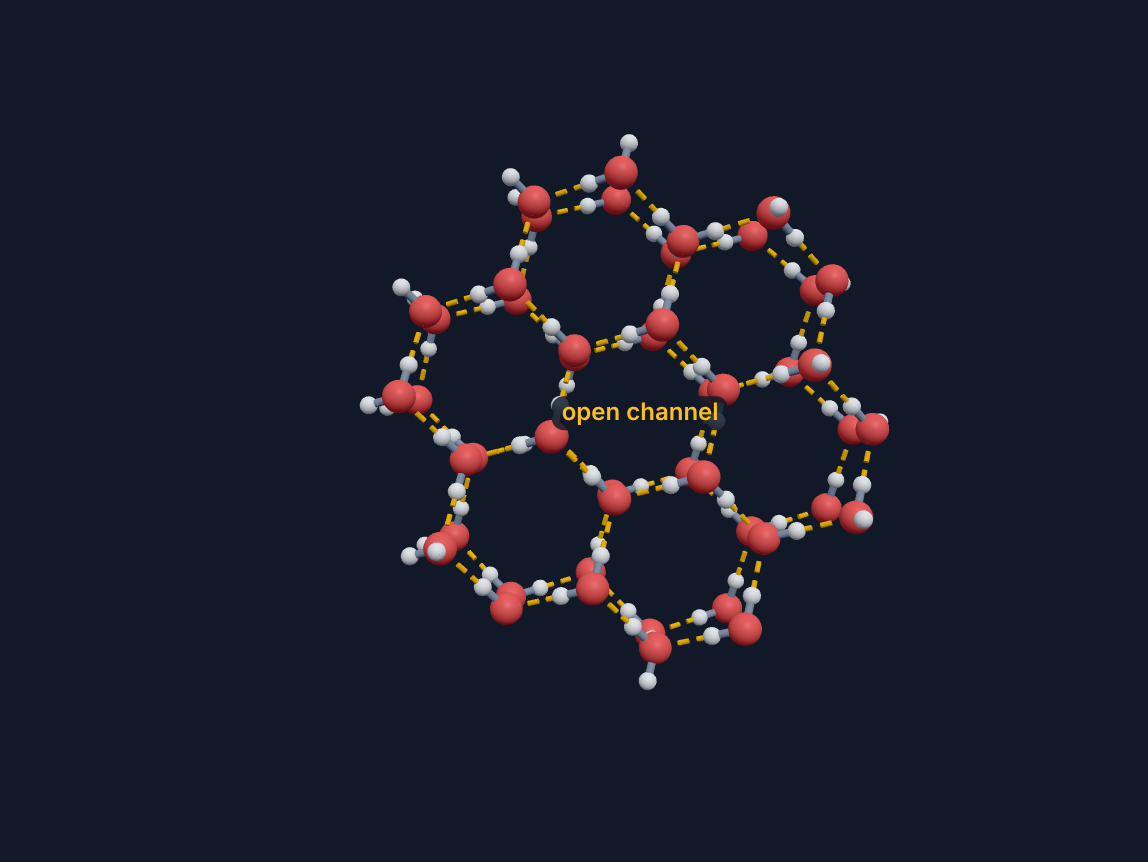
Ice: an open hexagonal network — In ice each O holds 2 H by covalent bonds and accepts 2 hydrogen bonds from H of neighbouring molecules, so it has 4 O neighbours at the corners of a tetrahedron (O–O–O 109.5°), each 276 pm away (NCERT). Every H lies between two O: covalent to one, hydrogen-bonded to the other. The molecules join in puckered rings of 6 O, which stack to leave wide open channels. That open structure is why ice is less dense than water: this ideal geometry gives 0.92 g cm⁻³ (measured, 0.917 g cm⁻³ at 0 °C), against 1.00 g cm⁻³ for liquid water at 4 °C, so ice floats. When ice melts the network partly collapses into the holes. The H shown are one arrangement that keeps two near and two far from every O; in real ice the arrangement varies.
💡 JEE Tip: For hybridisation, count: steric number = bond pairs + lone pairs on central atom. sp = 2, sp² = 3, sp³ = 4, sp³d = 5, sp³d² = 6. XeF₂ has 3 LP + 2 BP = 5 → sp³d → linear shape (3 LPs in equatorial positions).
⚠ Common Error: IE₁ of N > O because N has half-filled 2p (stable). IE₁ of Be > B because 2s (Be) > 2p (B) in stability. These two anomalies are the most frequently tested. Don't just state "increases across period" without noting exceptions.
📐
Periodic Table & Bonding — Formula Sheet
Periodic Trends (Key Relationships)
\(Z_{eff} = Z - \sigma\) (Slater's rules)
Effective nuclear charge; \(\sigma\) = shielding constant. Higher \(Z_{eff}\) → smaller radius, higher IE
IE order anomaly: Be > B, N > O, Mg > Al, P > S
Half-filled (N, P) and fully-filled (Be, Mg) subshells are extra stable → higher IE than neighbours
Lattice energy \(\propto |q^+||q^-|/(r^+ + r^-)\)
Higher charge and smaller ions → more negative lattice energy → more stable ionic compound
Lewis Structures & Formal Charge
\(FC = V - N - \dfrac{B}{2}\)
Formal charge \(=\) Valence \(e^-\) − Non-bonding \(e^-\) − \(\tfrac{1}{2}\) Bonding \(e^-\); best structure minimises \(|FC|\)
Total e⁻ in Lewis structure = Σ(valence e⁻) ± charge
Add electrons for negative charge; subtract for positive charge before drawing structure
VSEPR & Hybridisation
Steric number (SN) = BP + LP on central atom
SN=2 → sp (linear); SN=3 → sp² (trigonal); SN=4 → sp³; SN=5 → sp³d; SN=6 → sp³d²
Bond angle reduction: each LP reduces angle by ~2.5°
NH₃ = 109.5° − 2.5° = 107°; H₂O = 109.5° − 5° = 104.5°
Molecular Orbital Theory
Bond order \(= \dfrac{N_b - N_a}{2}\)
\(N_b\) = bonding electrons, \(N_a\) = antibonding electrons; \(BO > 0\) for stable molecule
O₂: BO=2, paramagnetic  |  N₂: BO=3, diamagnetic
O₂ has 2 unpaired e⁻ in degenerate π*2p orbitals; N₂ has no unpaired electrons
MO filling order (up to N₂): σ1s σ*1s σ2s σ*2s π2p π2p σ2p …
For O₂, F₂: σ2p comes before π2p. The crossover happens at N₂/O₂ boundary.
🧮
Periodic Table & Bonding — Solved Examples
Example 1 Easy Periodic Trends — Ordering Properties
Arrange the following in increasing order of: (a) First ionisation energy: Na, Mg, Al, Si, P, S, Cl, Ar. (b) Atomic radius: Li, Na, K, Cs. (c) Electronegativity: F, Cl, Br, I.
  1. (a) IE₁ across period 3 (general increase, but anomalies at Mg→Al and P→S):
  2. Na < Mg > Al < Si < P > S < Cl < Ar
  3. So increasing order: Na < Al < Mg < Si < S < P < Cl < Ar. Mg > Al because 2s is more stable than 2p; P > S because half-filled 3p is stable.
  4. (b) Atomic radius down Group 1 — increases with shells: Li < Na < K < Cs ✓
  5. (c) Electronegativity down Group 17 — decreases: I < Br < Cl < F ✓. F is the most electronegative element (Pauling scale: 4.0).
✓ Key pattern: Electronegativity and IE generally increase across a period and decrease down a group. But always check the Mg/Al and N/O (P/S) anomalies for IE.
Example 2 Medium VSEPR Shapes and Hybridisation
Determine the shape, bond angle, and hybridisation of: (a) XeF₂, (b) XeF₄, (c) ClF₃, (d) SF₄, (e) PCl₅. Identify which pairs are isostructural.
  1. (a) XeF₂: Xe: 8 valence e⁻. 2 F use 2 BP → 3 LP remaining. SN = 2+3 = 5 → sp³d. 3 LPs occupy equatorial positions → Linear, 180°.
  2. (b) XeF₄: Xe: 8 valence e⁻. 4 F use 4 BP → 2 LP. SN = 4+2 = 6 → sp³d². 2 LPs trans (opposite) → Square planar, 90°.
  3. (c) ClF₃: Cl: 7 valence e⁻. 3 F use 3 BP → 2 LP. SN = 5 → sp³d. 2 LPs equatorial → T-shaped, ~87°.
  4. (d) SF₄: S: 6 valence e⁻. 4 F use 4 BP → 1 LP. SN = 5 → sp³d. 1 LP equatorial → See-saw (seesaw).
  5. (e) PCl₅: P: 5 valence e⁻. 5 Cl use 5 BP → 0 LP. SN = 5 → sp³d → Trigonal bipyramidal, 90° (axial) and 120° (equatorial).
✓ Isostructural pairs: XeF₂ and I₃⁻ (both linear, 3 LPs); XeF₄ and ICl₄⁻ (both square planar, 2 LPs). Isoelectronic = same number of e⁻ and atoms; isostructural = same shape.
Example 3 Hard MO Theory — Bond Order and Magnetic Character
Using MO theory, find the bond order and magnetic character of: (a) O₂, (b) O₂⁺, (c) O₂²⁻, (d) N₂, (e) NO. Also predict which species has the shortest bond length.
  1. O₂ MO config (16 e⁻): σ1s² σ*1s² σ2s² σ*2s² σ2p² π2p⁴ π*2p². \(N_b = 10, N_a = 6\). \(BO = \dfrac{10-6}{2} = \) 2. 2 unpaired e⁻ in π*2p → paramagnetic.
  2. O₂⁺ (15 e⁻): Remove 1 e⁻ from π*2p → π*2p¹. \(BO = \dfrac{10-5}{2} = \) 2.5. 1 unpaired → paramagnetic. Shorter bond than O₂ (higher BO).
  3. O₂²⁻ (18 e⁻): Add 2 e⁻ to π*2p → π*2p⁴. \(BO = \dfrac{10-8}{2} = \) 1. All paired → diamagnetic. Longest bond (lowest BO).
  4. N₂ (14 e⁻): σ1s² σ*1s² σ2s² σ*2s² π2p⁴ σ2p². \(N_b = 10, N_a = 4\). \(BO = \dfrac{10-4}{2} = \) 3. All paired → diamagnetic.
  5. NO (15 e⁻): Filling up to π*2p¹. \(BO = \dfrac{10-5}{2} = \) 2.5. 1 unpaired → paramagnetic.
✓ Shortest bond → highest BO → N₂ (BO=3). Bond length order: N₂ < NO ≈ O₂⁺ < O₂ < O₂²⁻. Higher BO = shorter, stronger bond — fundamental MO relationship.
📊
Periodic Table & Bonding — Visual Concepts
Click any diagram to zoom
⚡
Periodic Table & Bonding — Quick Quiz
Question 1
The correct order of first ionisation energies is:
General trend: Na < Mg < Al < Si. But anomaly: Mg (3s²) > Al (3p¹) because 3s is more stable than 3p. So actual order: Na < Al < Mg < Si. Answer: B ✓. IE₁: Na=496, Al=577, Mg=738, Si=786 kJ/mol.
Question 2
The hybridisation of the central atom in SF₄, ClF₃, and XeF₂ respectively is:
SF₄: S has 4 BP + 1 LP = SN 5 → sp³d. ClF₃: Cl has 3 BP + 2 LP = SN 5 → sp³d. XeF₂: Xe has 2 BP + 3 LP = SN 5 → sp³d. All three have SN=5 → all sp³d. Answer: C ✓
Question 3
Among N₂, O₂, F₂, and Ne₂, the species that does NOT exist (bond order = 0) is:
Ne₂: each Ne has 10 e⁻ → 20 e⁻ total. All MOs filled including σ*2p. N_b = 10, N_a = 10. BO = (10−10)/2 = 0 → Ne₂ does not exist. Answer: A ✓. F₂: BO = (10−8)/2 = 1 (exists but weak bond); O₂: BO=2; N₂: BO=3.
🧱
p-Block Elements
Groups 13–18 · Inert pair effect · Allotropes · Halogens · Noble gases

Group 13 — Boron Family (ns²np¹)

  • Members: B, Al, Ga, In, Tl. Boron is a metalloid; rest are metals.
  • Inert pair effect: Down the group, ns² electrons become less available for bonding due to poor shielding by d/f electrons → Tl prefers +1 over +3, In shows both +1 and +3.
  • Boron: BCl₃ — sp², trigonal planar, Lewis acid (vacant p orbital accepts lone pair). BF₃ + NH₃ → BF₃·NH₃ (coordinate bond).
  • Aluminium: AlCl₃ forms dimer Al₂Cl₆ in vapour (two Cl bridge-bonds). Amphoteric oxide (Al₂O₃ reacts with both acids and bases).
  • Diagonal relationship: B resembles Si (both form covalent hydrides, acidic oxides, complex anions like [BO₃]³⁻ and [SiO₄]⁴⁻).
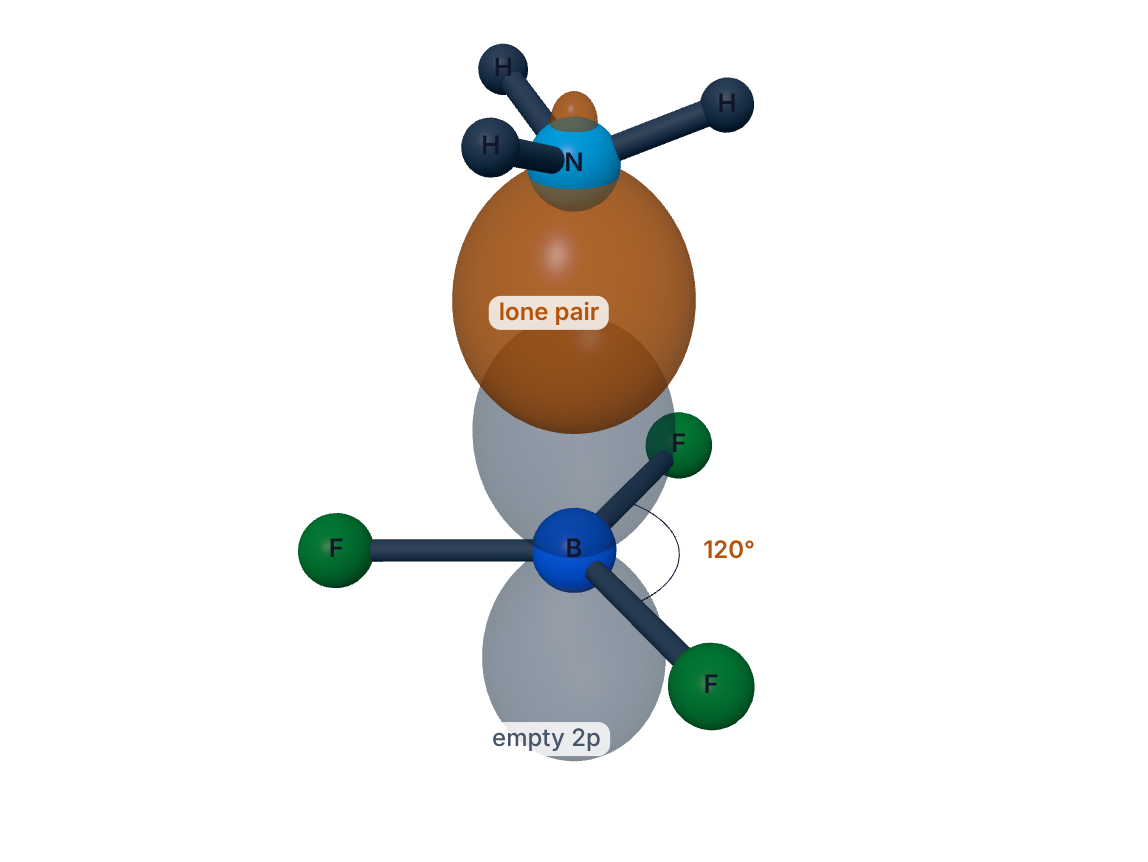
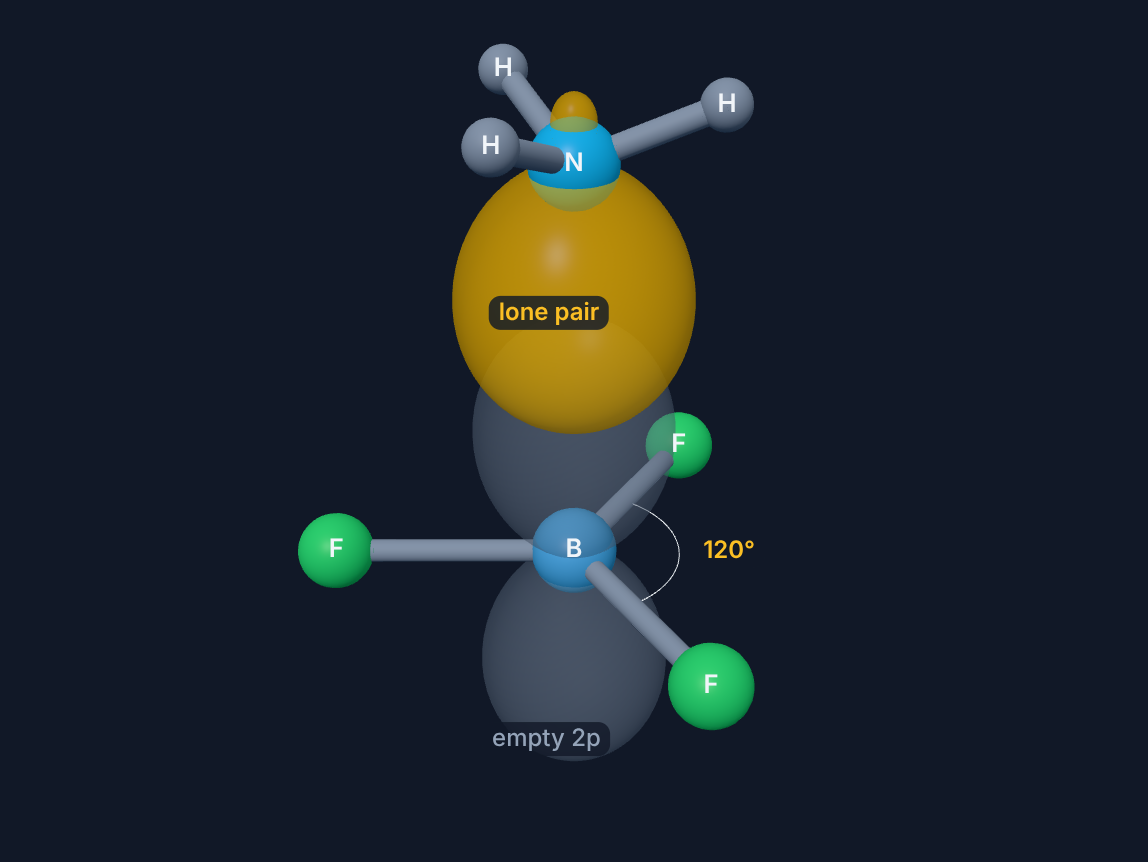
BF₃ + NH₃ in 3D — In BF₃, boron uses three sp² hybrids for its three B–F bonds (trigonal planar, 120°). That leaves 6 electrons round boron and its remaining 2p orbital, at right angles to the plane, empty. NH₃’s lone pair, in an sp³ hybrid, points straight at that empty orbital: nitrogen gives both electrons of the new N→B bond (a coordinate bond), so NH₃ acts as a Lewis base and BF₃ as a Lewis acid. In BF₃·NH₃ boron has four bonds and 8 electrons round it, so it becomes sp³ and the three B–F bonds fold back to the tetrahedral angle (109.5°). Bond lengths are not to scale.
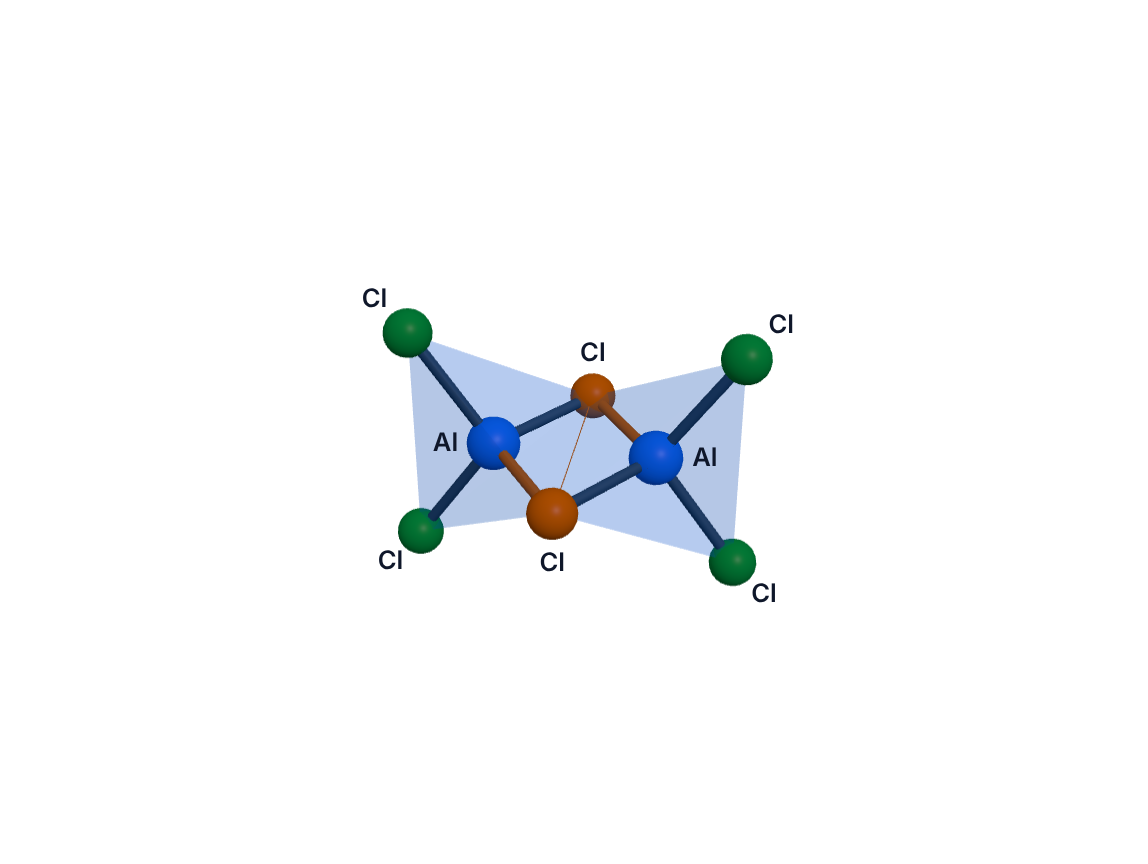
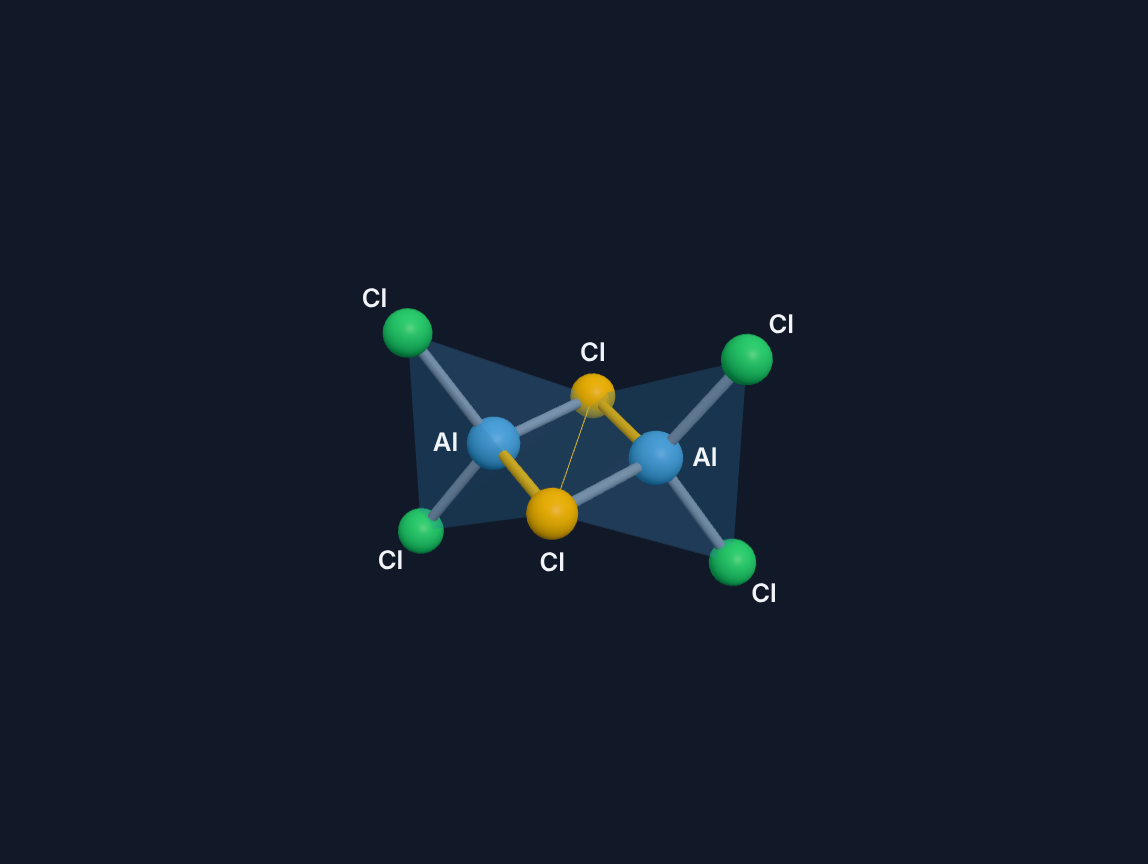
AlCl₃ and its dimer Al₂Cl₆ in 3D — In AlCl₃ each Al has 3 Cl round it (trigonal planar, 120°) and only 3 bond pairs, 6 electrons: 2 short of an octet, with an empty orbital. Two molecules join when a Cl of each gives a lone pair to the other Al (a coordinate bond). In Al₂Cl₆, 2 Cl bridge the two Al and 4 are terminal; each Al now has 4 Cl and 8 electrons round it, at the centre of a tetrahedron, and the two AlCl₄ tetrahedra share an edge (the 2 bridging Cl). Once formed, the four bridge bonds are alike. The tetrahedra are drawn regular; the real angles differ, so none is shown. Bond lengths are not to scale.

Group 14 — Carbon Family (ns²np²)

  • Carbon allotropes: Diamond (sp³, 3D network, hardest natural substance), Graphite (sp², layered, conductor due to delocalised π electrons), Fullerene C₆₀ (sp², soccer-ball, 20 hexagons + 12 pentagons).
  • CO vs CO₂: CO is a ligand (strong field via C lone pair), toxic (binds Hb). CO₂ is linear (sp), acidic oxide.
  • Silicon: SiO₂ is giant covalent solid (each Si tetrahedral, high mp). Silicones are polymers (Si–O backbone).
  • Inert pair: Pb prefers +2 (PbO, PbCl₂) over +4; Sn shows both +2 and +4 (SnCl₂ reducing agent, SnCl₄ Lewis acid).
  • C–C multiple bonding readily; Si cannot (d-orbital back bonding instead).
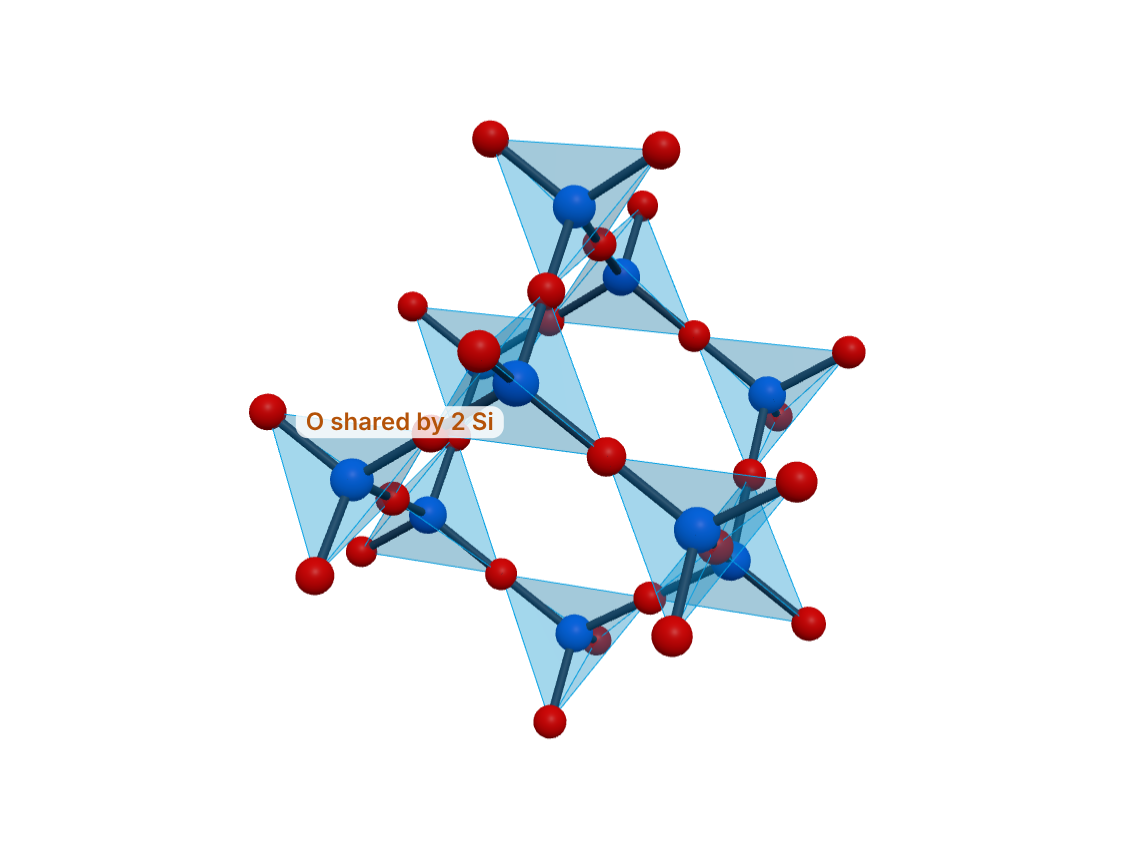
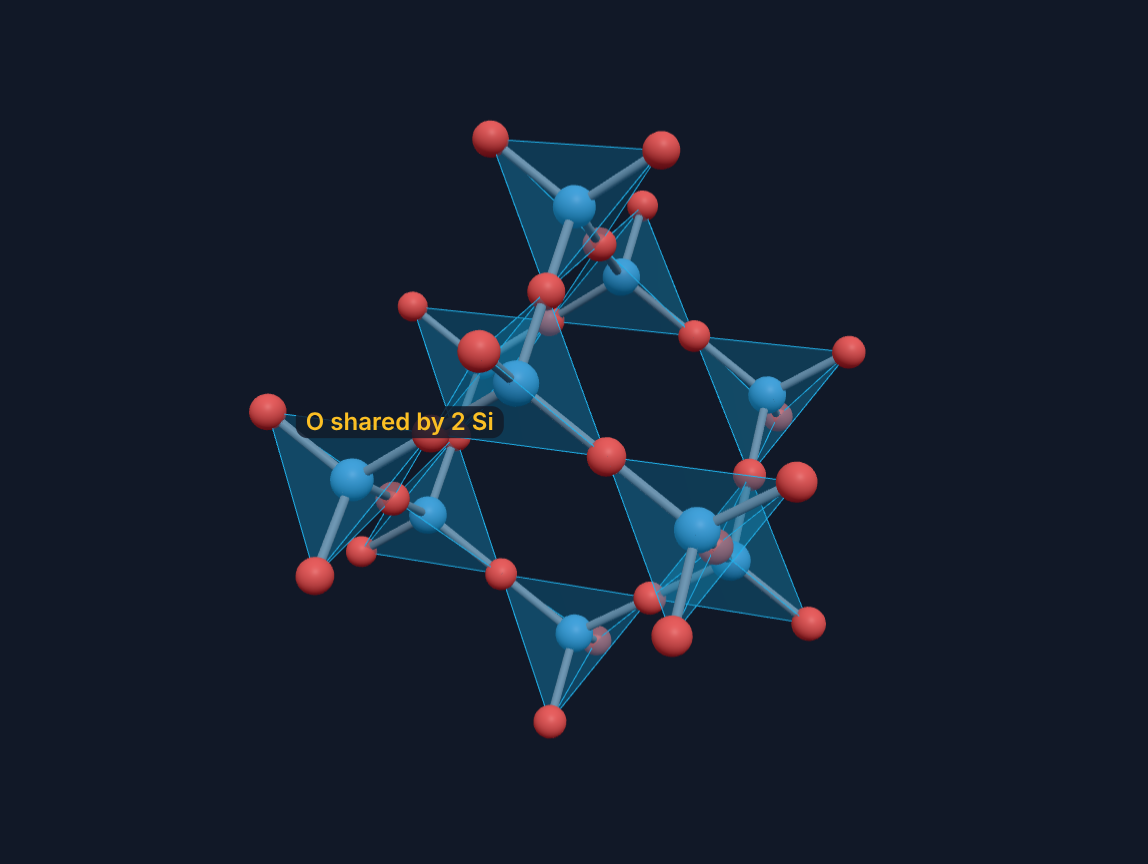
Silicates: SiO₄ tetrahedra sharing corners — Each Si sits at the centre of a tetrahedron of 4 O, with O–Si–O 109.5°. A corner O shared by two tetrahedra counts half to each Si. With no corner shared the unit is SiO₄⁴⁻, charge (+4) + 4 × (−2) = −4; two tetrahedra sharing one corner give Si₂O₇⁶⁻, charge 2 × (+4) + 7 × (−2) = −6. When all four corners are shared, every O is shared by 2 Si, so there are 4 × 1/2 = 2 O per Si: SiO₂, a three-dimensional network. In silicones two corners of each tetrahedron carry CH₃ groups instead of O, so only two are shared and the tetrahedra form chains with the repeat unit (CH₃)₂SiO. Si–O–Si is drawn straight; in quartz it is bent, about 144°.

Group 15 — Nitrogen Family (ns²np³)

  • N₂ is very stable (triple bond, BE = 945 kJ/mol). P₄ (white phosphorus) — tetrahedral, strained 60° angles, highly reactive.
  • Hydrides: NH₃ > PH₃ > AsH₃ > SbH₃ — basicity decreases down (less lone pair availability); NH₃ has H-bonding, highest bp.
  • Oxides of nitrogen: N₂O (laughing gas), NO (radical), NO₂ (brown, acidic), N₂O₄ (dimer of NO₂), N₂O₅ (anhydride of HNO₃).
  • Oxoacids of P: H₃PO₃ (phosphorous acid) — diprotic (one H on P is non-ionisable); H₃PO₄ (phosphoric) — triprotic.
  • Nitric acid: Dilute HNO₃ + metal → NO; Concentrated HNO₃ + metal → NO₂. Passivation: Fe, Cr, Al with conc. HNO₃.
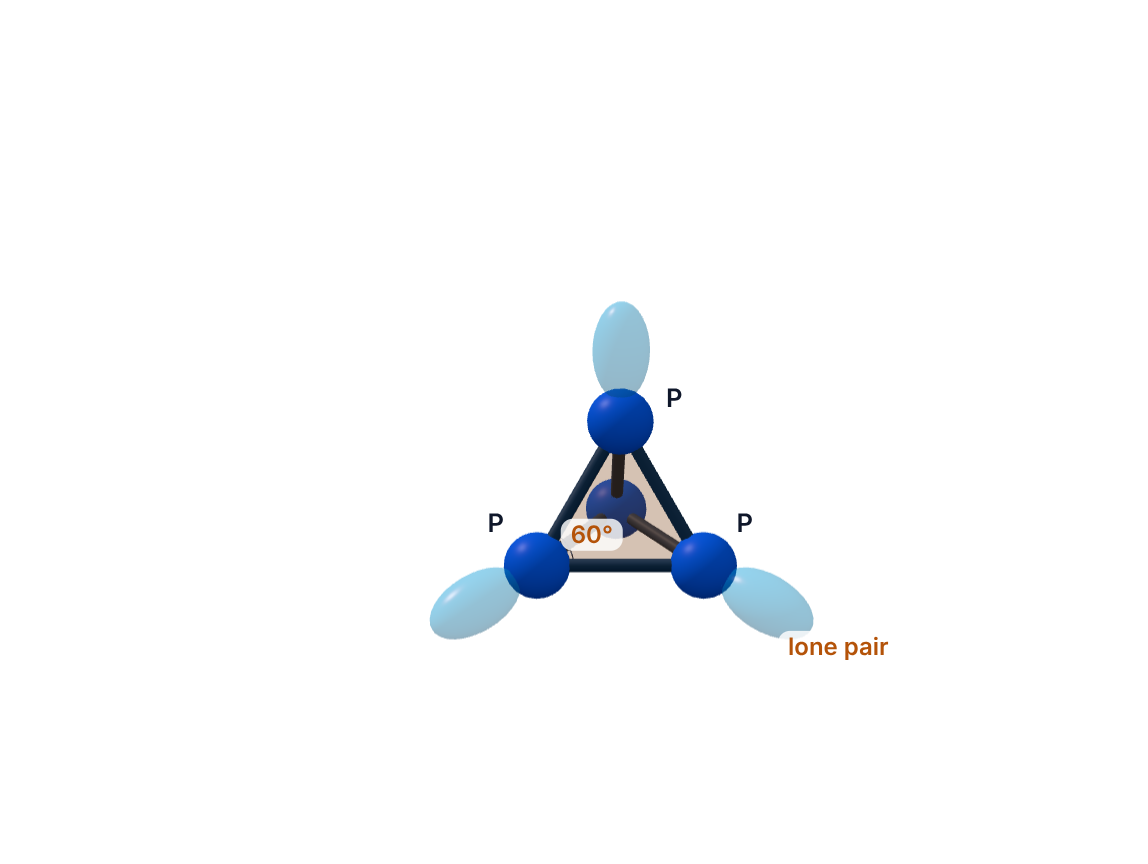
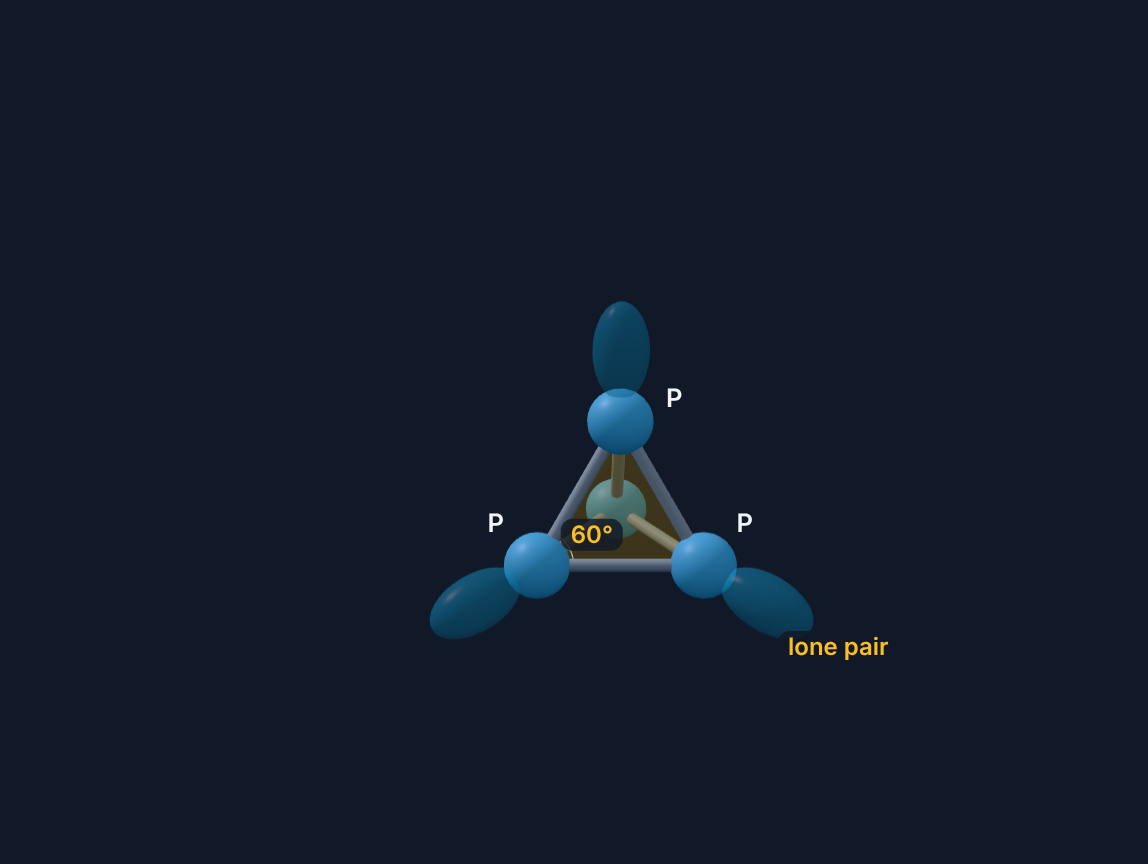
White phosphorus, P₄, in 3D — Four P atoms sit at the corners of a tetrahedron and every pair is bonded: 6 P–P bonds, 3 on each P. Each of the 4 faces is an equilateral triangle, so all 12 P–P–P angles are 60°. Bonds bent to only 60° are strained, which is why white phosphorus is so reactive. Each P has 5 valence electrons: 3 bonds and 1 lone pair, so the molecule has 4 lone pairs, each pointing out from the centre. Bond lengths are not to scale.
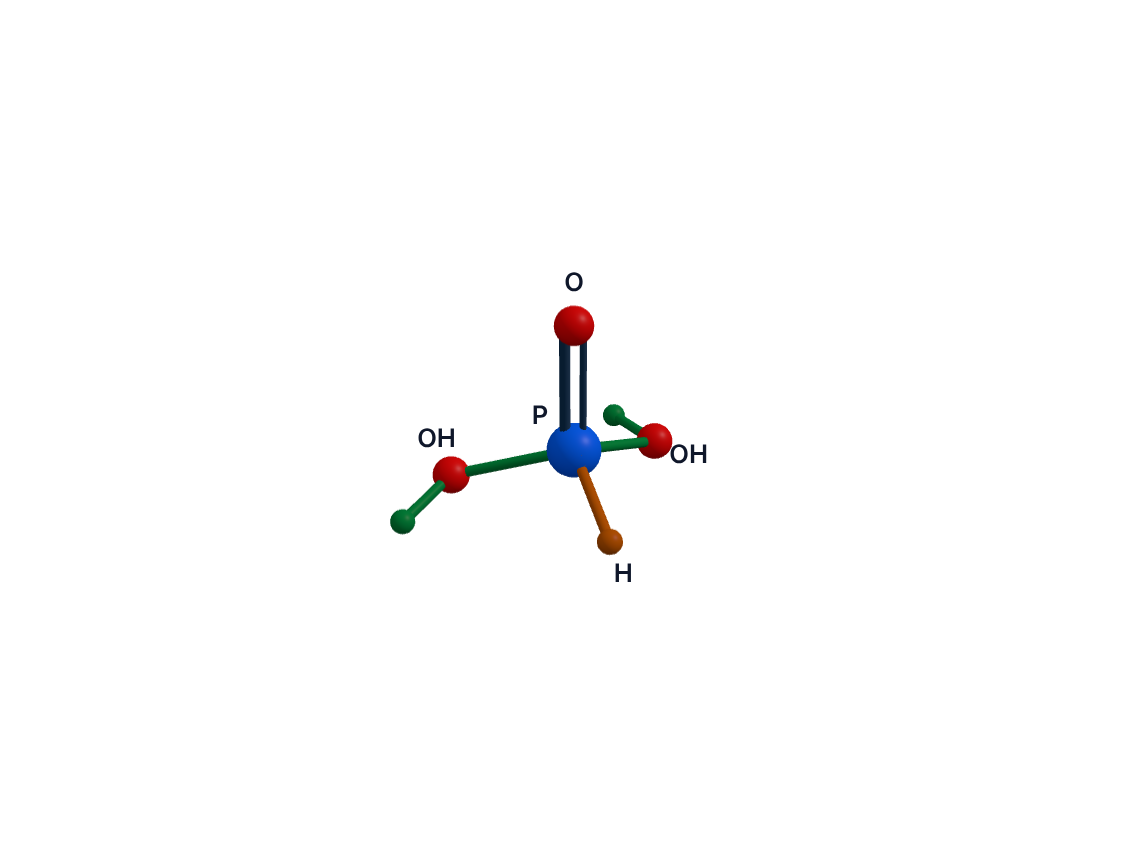
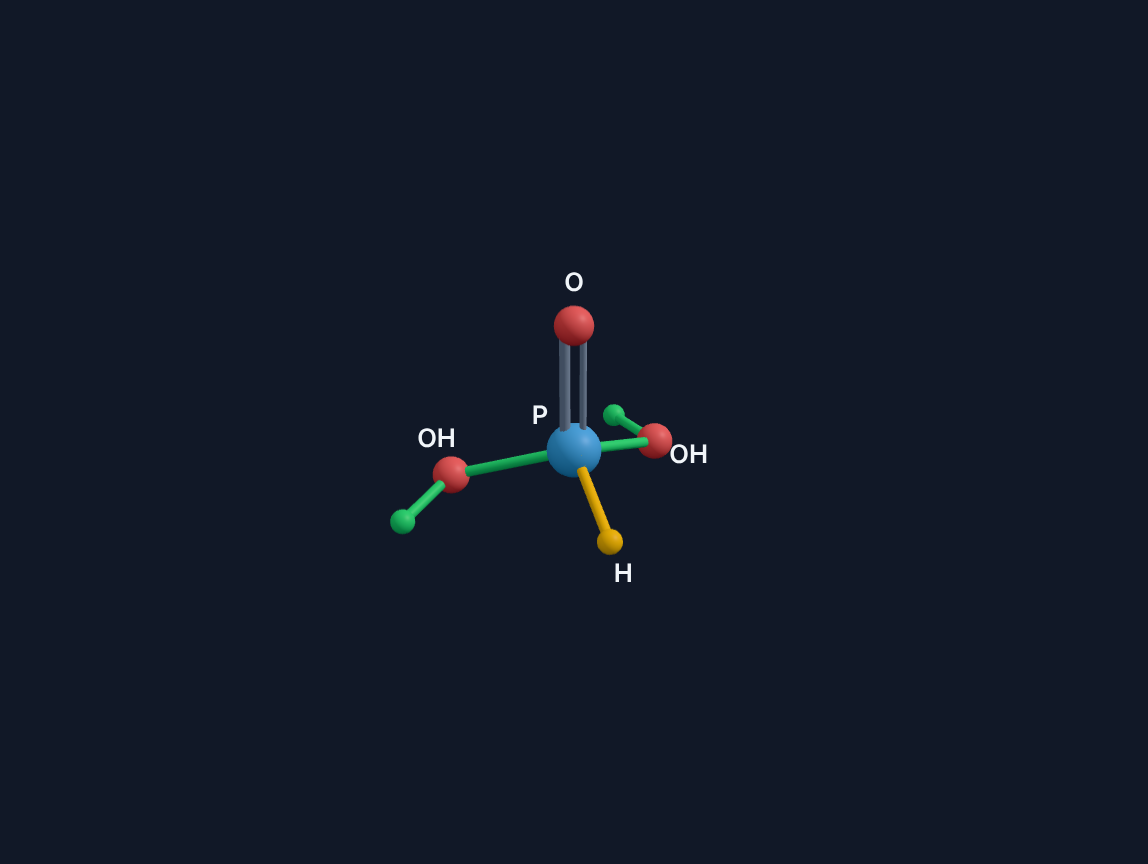
Oxoacids of phosphorus in 3D — In each acid P is tetrahedral, with 4 groups round it, one of them a P=O. Only an H bonded to O can leave as H⁺, so the basicity is the number of P–OH bonds; an H bonded directly to P does not ionise. H₃PO₄ (orthophosphoric acid) has 3 P–OH: tribasic, with P +5 from 3(+1) + x + 4(−2) = 0. In H₃PO₃ (phosphorous acid) one P–OH is replaced by a P–H: 2 P–OH, dibasic, P +3. In H₃PO₂ (hypophosphorous acid) two are: 1 P–OH and 2 P–H, monobasic, P +1. A P–H bond makes the acid a reducing agent. H₄P₂O₇ (pyrophosphoric acid) is two acids joined through one O, 2H₃PO₄ → H₄P₂O₇ + H₂O: one P–O–P bridge and 4 P–OH, tetrabasic, P +5. The tetrahedra are drawn ideal and bond lengths are not to scale.

Group 16 — Chalcogens (ns²np⁴)

  • Oxygen: Allotropes O₂ and O₃ (ozone — angular, sp², bent). O₃ is a better oxidising agent than O₂.
  • Sulphur allotropes: Rhombic S₈ (stable <96°C), Monoclinic S₈ (stable 96–119°C), Plastic sulphur (supercooled). All contain puckered S₈ rings.
  • Acidic character: H₂O < H₂S < H₂Se < H₂Te — increases down (weaker H–X bond, more stable conjugate base anion).
  • SO₂: V-shape, reducing agent, acidic oxide; forms H₂SO₃ with water. SO₃ (Lewis acid) + H₂O → H₂SO₄.
  • Oleum: H₂SO₄ + SO₃ → H₂S₂O₇ (pyrosulphuric acid); Contact process for H₂SO₄ uses V₂O₅ catalyst.
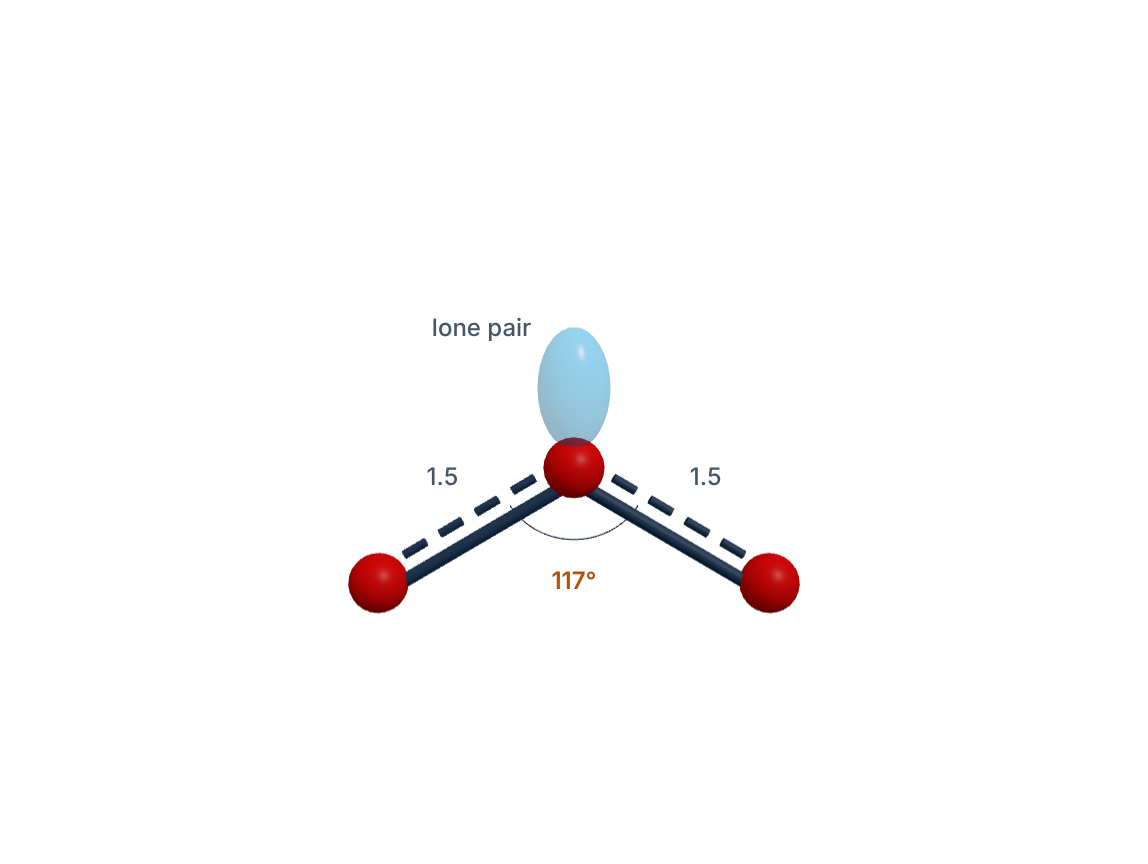
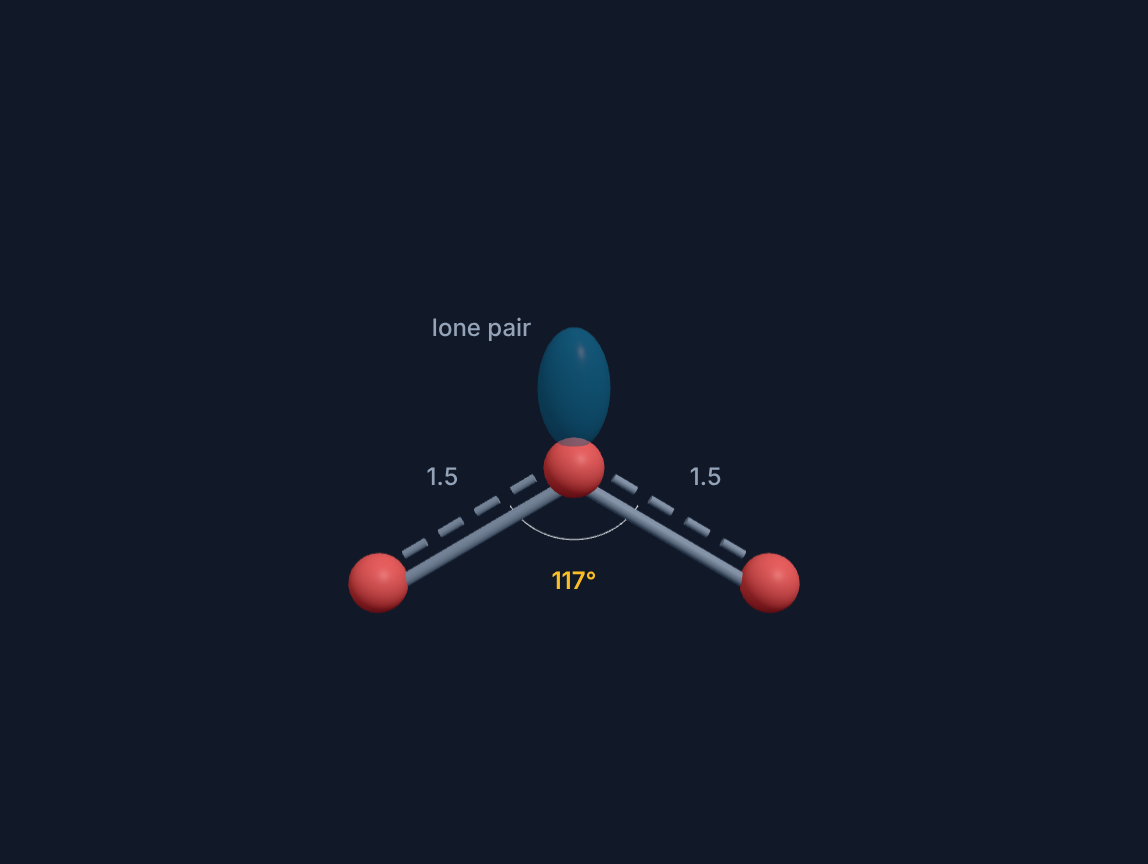
Ozone, O₃, in 3D: resonance — The central O has 2 bonds and 1 lone pair, 3 electron pairs, so O₃ is bent. One resonance structure has O=O on one side and O–O on the other (bond orders 2 and 1; formal charges 0, +1, −1, where formal charge = 6 − lone-pair electrons − bonds); the other has them the other way round. Neither is the real molecule: in the resonance hybrid each O–O bond has order (2 + 1)/2 = 1.5, so the two bonds are the same length. O–O–O is 117° (NCERT), under the 120° of 3 electron pairs. Bond lengths are not to scale.
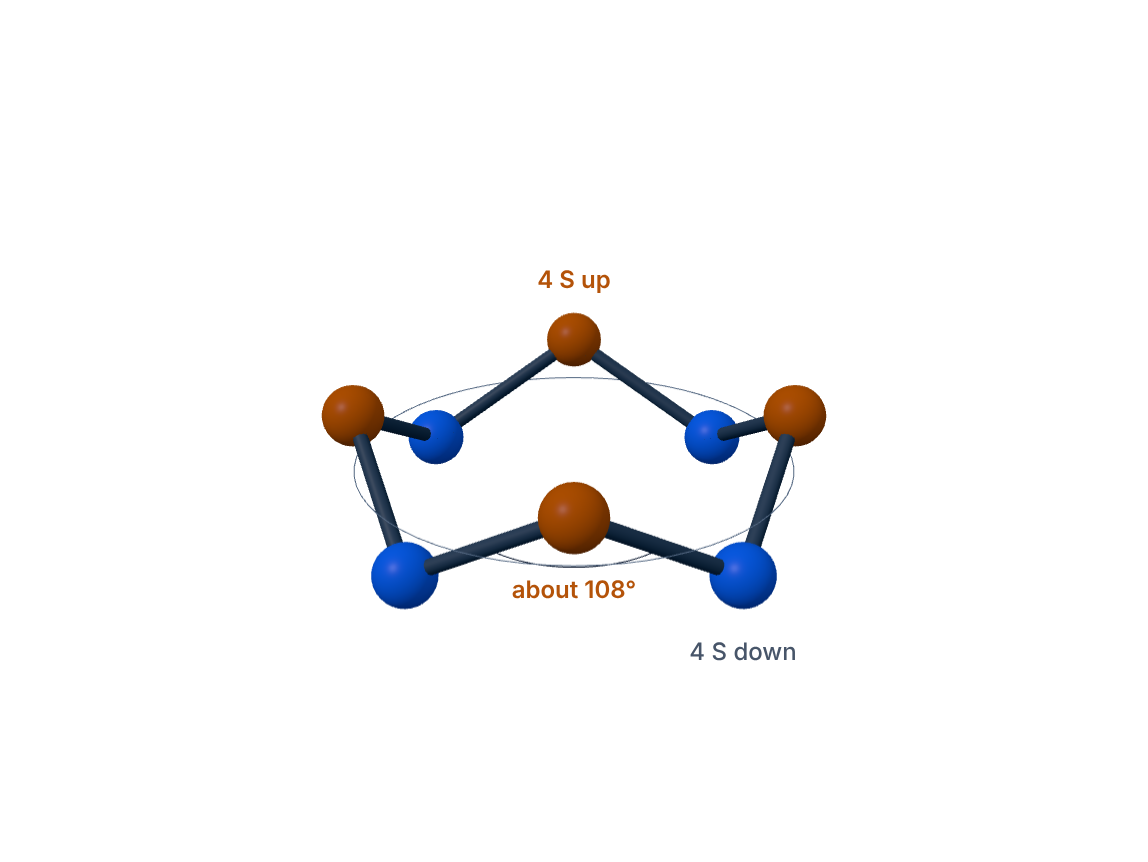
S₈: the crown ring in 3D — Rhombic and monoclinic sulphur are both made of S₈ rings: 8 S atoms and 8 S–S bonds, each S with 2 bonds and 2 lone pairs. A flat ring would open every S–S–S angle to 135°, a regular octagon's angle, far wider than the 109.5° that 4 electron pairs round each S allow. The real S–S–S angle is about 108° (measured 107.8°), so the ring puckers into a crown: 4 S above the ring's mean plane and 4 below. Bond lengths are not to scale.

Group 17 — Halogens (ns²np⁵)

PropertyFClBrI
ColourPale yellowGreenish-yellowRed-brownViolet (vapour)
State (25°C)GasGasLiquidSolid
Oxidising powerF₂ > Cl₂ > Br₂ > I₂Decreases down
Bond dissociation EF₂: 158 kJ/mol (weakest!)Cl₂: 243 (strongest)Br₂: 193I₂: 151
HX acid strengthHF (weak acid)HCl < HBr < HIIncreases (weaker H–X)
  • F₂ anomaly: Weakest X–X bond (small size → lone pair repulsion). Only −1 oxidation state (no d orbitals to expand valence).
  • Interhalogen compounds: XX′ type (ICl, IBr), XX′₃ (ICl₃), XX′₅ (BrF₅ — square pyramidal), XX′₇ (IF₇ — pentagonal bipyramidal).
  • Bleaching powder: Ca(OCl)Cl — formed by Cl₂ + slaked lime.
  • Oxoacids: HOCl < HOClO < HOClO₂ < HOClO₃ — acid strength increases with more O atoms (more electronegative, weakens O–H bond).

Group 18 — Noble Gases

  • All ns²np⁶ configuration (He: 1s²). High ionisation energy, chemically inert.
  • Xenon compounds: XeF₂ (linear, sp³d), XeF₄ (square planar, sp³d²), XeF₆ (distorted octahedral, sp³d³), XeO₃ (pyramidal), XeOF₄ (square pyramidal).
  • Kr also forms KrF₂. Rn is radioactive (½-life 3.8 days).
  • He: lightest noble gas, used in airships (non-flammable), cryogenics (bp 4.2 K). Ar: most abundant noble gas in atmosphere (0.93%).
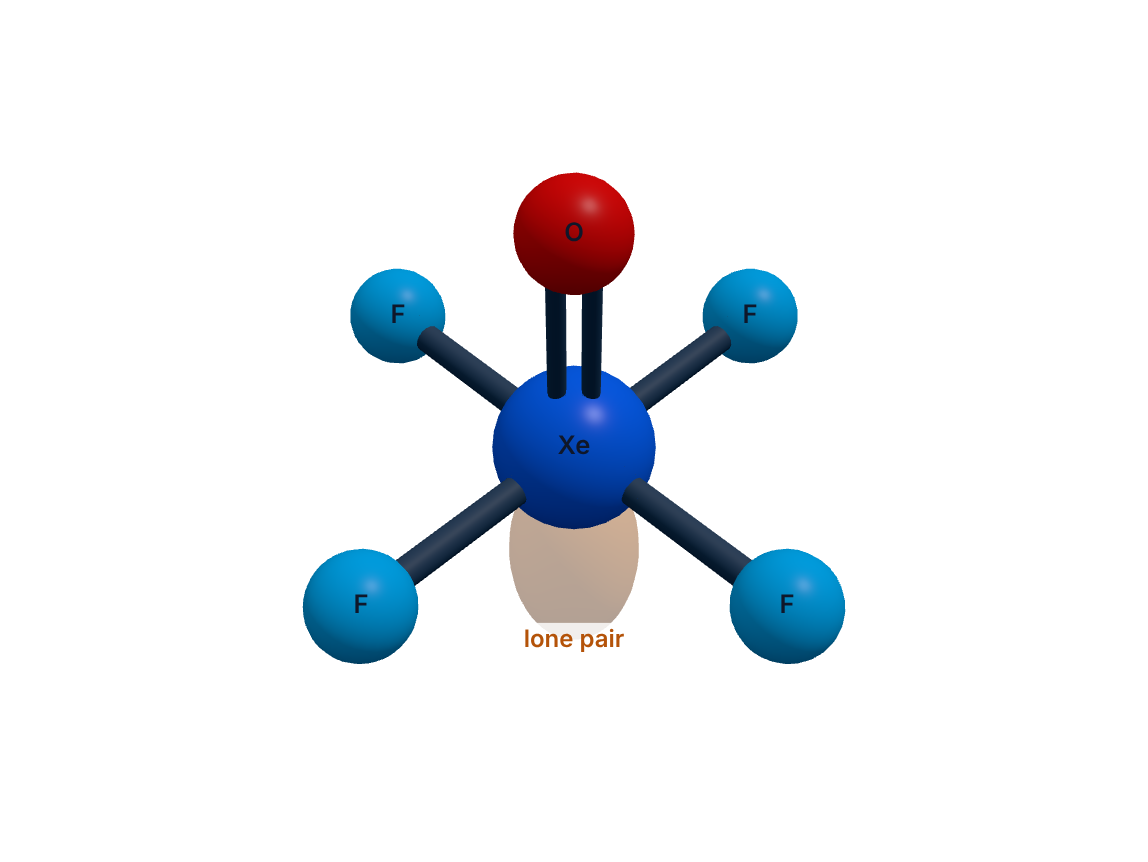
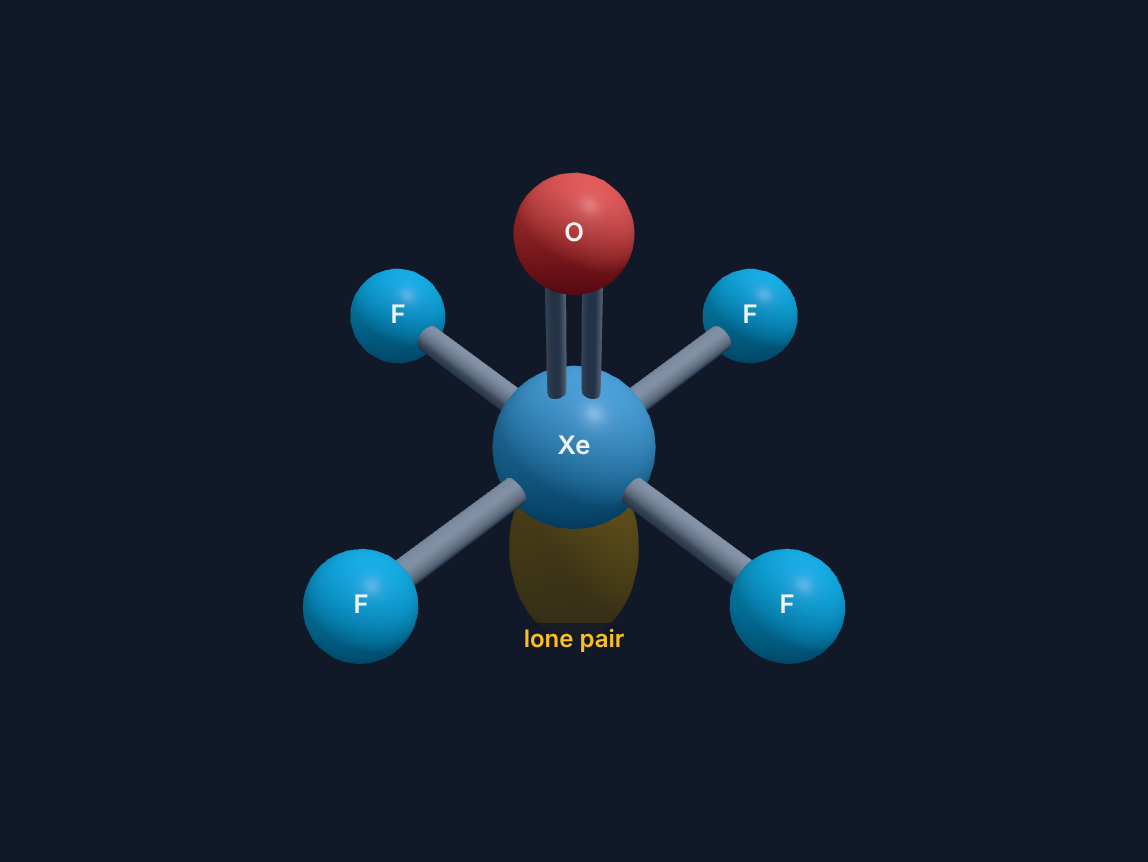
Xenon compounds and interhalogens in 3D — Count the electron pairs round the central atom; a Xe=O double bond counts as one. XeF₂: 2 bond pairs + 3 lone pairs = 5, with the lone pairs equatorial, so the molecule is linear (180°). XeF₄: 4 + 2 = 6, with the lone pairs opposite each other, so it is square planar (90°). XeF₆: 6 + 1 = 7, a distorted octahedron; the 3D view does not draw it, because VSEPR does not fix how far it is distorted. XeO₃: 3 + 1 = 4, a trigonal pyramid like NH₃. XeOF₄: 5 + 1 = 6, square pyramidal, with the O at the apex, 180° from the lone pair. Among the interhalogens (Group 17), BrF₅ (5 + 1 = 6) is square pyramidal and IF₇ (7 + 0 = 7) pentagonal bipyramidal, 72° round the ring and 90° to the axial F. XeO₃, XeOF₄ and BrF₅ are drawn at the ideal angles; their real angles differ a little. Bond lengths and lone-pair clouds are not to scale.
💡 JEE Tip: F₂ has the WEAKEST bond among halogens (not the strongest!) due to lone-pair repulsion in the small F₂ molecule. Cl₂ has the strongest X–X bond. Also: HF is a weak acid (strong H-bonding), while HCl, HBr, HI are strong acids — HI is the strongest.
⚠ Common Error: H₃PO₃ appears to be triprotic (3 H atoms) but is only diprotic — the H directly bonded to P is non-acidic. Similarly H₃PO₂ is monoprotic. Count only H atoms bonded to O (not to P) for basicity of phosphorus oxoacids.
📐
p-Block Elements — Formula Sheet
Key Reactions
4HNO₃(conc) + Cu → Cu(NO₃)₂ + 2NO₂ + 2H₂O
Concentrated HNO₃ oxidises Cu to give NO₂ (brown gas)
8HNO₃(dil) + 3Cu → 3Cu(NO₃)₂ + 2NO + 4H₂O
Dilute HNO₃ gives NO (colourless gas, turns brown in air → NO₂)
2SO₂ + O₂ ⇌ 2SO₃  (V₂O₅, 450°C)
Contact process step 2; then SO₃ + H₂SO₄ → H₂S₂O₇ → H₂SO₄ + H₂O
2Cl₂ + 2Ca(OH)₂ → Ca(OCl)Cl + CaCl₂ + H₂O
Formation of bleaching powder; active component is Ca(OCl)Cl
Oxidation States & Trends
Inert pair effect: stability of +2 > +4 for heavier Group 14/15/16
Pb²⁺ more stable than Pb⁴⁺; Tl⁺ more stable than Tl³⁺; Bi³⁺ more stable than Bi⁵⁺
Halogen oxidising power: F₂ > Cl₂ > Br₂ > I₂
F₂ can oxidise Cl⁻ to Cl₂; Cl₂ can oxidise Br⁻ to Br₂ and I⁻ to I₂; Br₂ can only oxidise I⁻
Oxoacid strength: HClO < HClO₂ < HClO₃ < HClO₄
More O atoms → higher oxidation state on Cl → more electron withdrawal → weaker O–H → stronger acid
Bond Dissociation Energies — Halogens
F₂: 158 < I₂: 151 < Br₂: 193 < Cl₂: 243 kJ/mol
F₂ is weakest (lone-pair repulsion in tiny F atom). Cl₂ is strongest dihalogen bond. Order (increasing): F₂ ≈ I₂ < Br₂ < Cl₂
🧮
p-Block Elements — Solved Examples
Example 1 Easy Allotropes and Structures
Compare: (a) diamond vs graphite (properties and hybridisation); (b) O₂ vs O₃ (structure and oxidising ability); (c) rhombic vs monoclinic sulphur.
  1. Diamond: Each C is sp³, tetrahedral network solid. Hardest natural substance, non-conductor (no free e⁻). Graphite: Each C is sp², layered. Unhybridised p electrons form delocalised π system → conducts electricity. Layers held by weak van der Waals → soft, lubricant.
  2. O₂: BO=2, paramagnetic. O₃: Bent (sp²), resonance hybrid BO=1.5. O₃ is stronger oxidising agent (decomposes readily to give nascent O: O₃ → O₂ + [O]). Both are allotropes of oxygen.
  3. Both are S₈ rings (crown-shaped). Rhombic: stable <96°C (transition temperature), orthorhombic crystal. Monoclinic: stable 96–119°C, needle-like crystals. At 119°C both melt (mp of S).
Example 2 Medium Halogen Displacement and Reactions
(a) Will Cl₂ displace Br⁻ from NaBr(aq)? Will I₂ displace Cl⁻ from NaCl(aq)? (b) Why is HF a weak acid while HCl is strong? (c) Name the products when excess Cl₂ reacts with NH₃.
  1. Cl₂ + 2NaBr → 2NaCl + Br₂ ✓ (Cl₂ stronger oxidiser than Br₂, displaces Br⁻). I₂ + NaCl → No reaction ✗ (I₂ is weaker than Cl₂, cannot oxidise Cl⁻). Displacement: stronger halogen displaces weaker halide.
  2. HF has a very strong H–F bond (BE = 568 kJ/mol) and extensive H-bonding in solution (F⁻···HF → HF₂⁻). This makes it only partially dissociate: HF ⇌ H⁺ + F⁻, Ka ≈ 6.8×10⁻⁴. HCl bond is much weaker (BE = 432 kJ/mol) and fully dissociates.
  3. Excess Cl₂ + NH₃ → NCl₃ + 3HCl (trichloride). With excess NH₃: 8NH₃ + 3Cl₂ → N₂ + 6NH₄Cl (nitrogen and ammonium chloride). Remember: excess Cl₂ gives NCl₃; excess NH₃ gives N₂.
Example 3 Hard Phosphorus Oxoacids — Basicity
Determine the basicity (number of ionisable protons) of: H₃PO₄, H₃PO₃, H₃PO₂, H₄P₂O₇. Write the structural formula for each.
  1. Rule: Only H atoms bonded to O (as –OH groups) are ionisable. H atoms bonded directly to P are NOT ionisable.
  2. H₃PO₄ (orthophosphoric acid): Structure: (HO)₃P=O. All 3 H atoms on O → triprotic (basicity 3).
  3. H₃PO₃ (phosphorous acid): Structure: (HO)₂P(=O)H. One H directly on P → only 2 ionisable H → diprotic (basicity 2). P is in +3 state.
  4. H₃PO₂ (hypophosphorous acid): Structure: (HO)P(=O)H₂. Two H directly on P → only 1 ionisable H → monoprotic (basicity 1). P is in +1 state.
  5. H₄P₂O₇ (pyrophosphoric acid): Two PO₄ units sharing one O. 4 –OH groups → tetraprotic (basicity 4). P in +5 state.
✓ Summary: H₃PO₄ (3) > H₄P₂O₇ (4 but 2 P) > H₃PO₃ (2) > H₃PO₂ (1). H₃PO₃ and H₃PO₂ are reducing agents (P–H bonds are oxidised); H₃PO₄ is not a reducing agent.
📊
p-Block Elements — Visual Concepts
Click any diagram to zoom
⚡
p-Block Elements — Quick Quiz
Question 1
The bond dissociation energy of F₂ is lower than that of Cl₂ because:
F is smaller than Cl, so the three lone pairs on each F atom are very close, causing significant repulsion even in the bonded F₂ molecule. This weakens the F–F bond (158 kJ/mol vs Cl–Cl 243 kJ/mol). F has the highest electronegativity (3.98), not lowest. Answer: B ✓
Question 2
H₃PO₃ is diprotic (basicity 2) because:
H₃PO₃ structure: (HO)₂P(=O)H. The H directly attached to P (P–H bond) is not ionisable. Only the two –OH groups give H⁺. So basicity = 2. Answer: C ✓. Similarly H₃PO₂ has 2 P–H bonds → monoprotic.
Question 3
Which of the following noble gas compounds has a square planar structure?
XeF₄: Xe has 4 BP + 2 LP = SN 6 → sp³d². 2 LPs in axial positions (trans) → square planar molecular shape. XeF₂: linear (3 equatorial LPs). XeF₆: distorted octahedral (1 LP). XeO₃: pyramidal (1 LP on Xe). Answer: D ✓
⚙
d & f Block Elements
Transition metals · Variable oxidation state · Colour · Magnetism · Lanthanide contraction

d-Block: Electronic Configuration

  • General configuration: [noble gas] (n−1)d¹⁻¹⁰ ns⁰⁻². First row: Sc (3d¹4s²) to Zn (3d¹⁰4s²).
  • Exceptions: Cr: [Ar] 3d⁵4s¹ (half-filled d, more stable). Cu: [Ar] 3d¹⁰4s¹ (fully filled d). Similar for Mo, W, Ag, Au.
  • When forming ions: ns electrons are lost first (ns is higher in energy for the cation), then nd. Fe²⁺: [Ar] 3d⁶; Fe³⁺: [Ar] 3d⁵.
  • Zn, Cd, Hg (Group 12) are sometimes excluded as transition metals because they have completely filled d¹⁰ in all oxidation states.

Characteristic Properties of Transition Metals

PropertyExplanationExample
Variable oxidation statesSimilar energies of (n−1)d and ns; multiple states accessibleFe: +2, +3; Mn: +2 to +7; Cr: +2, +3, +6
Coloured compoundsd–d transitions absorb visible light; complementary colour observedCu²⁺ (blue), Cr³⁺ (violet), MnO₄⁻ (purple)
ParamagnetismUnpaired d electrons; \(\mu = \sqrt n(n+2) BM\)Fe³⁺: 5 unpaired → μ=5.92 BM (highest)
Catalytic activityVariable OS + surface adsorptionFe (Haber), V₂O₅ (Contact), Ni (hydrogenation)
Complex formationSmall size, high charge, vacant d orbitals[Fe(CN)₆]³⁻, [Cu(NH₃)₄]²⁺
Interstitial compoundsSmall atoms (H, C, N) in d-metal lattice gapsSteel (Fe + C), TiH₂
Alloy formationSimilar atomic radii; mix freelyBronze (Cu+Sn), Brass (Cu+Zn)
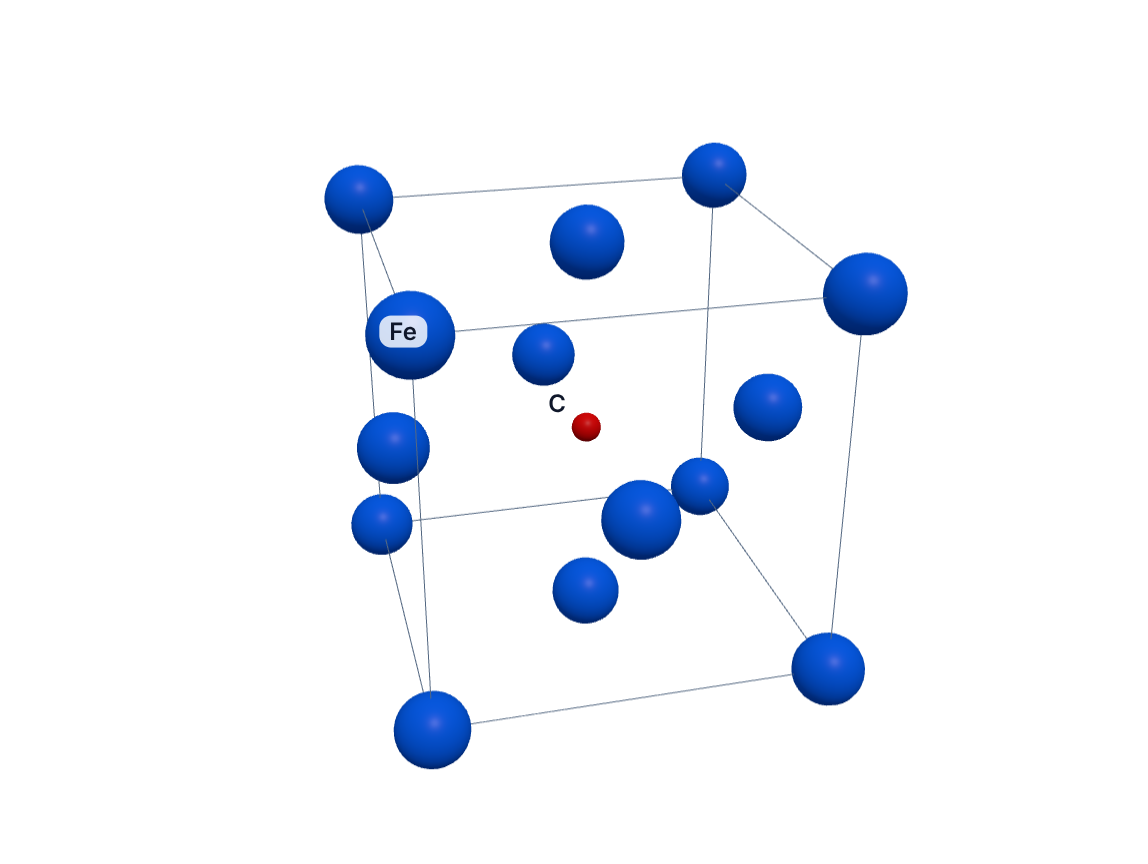
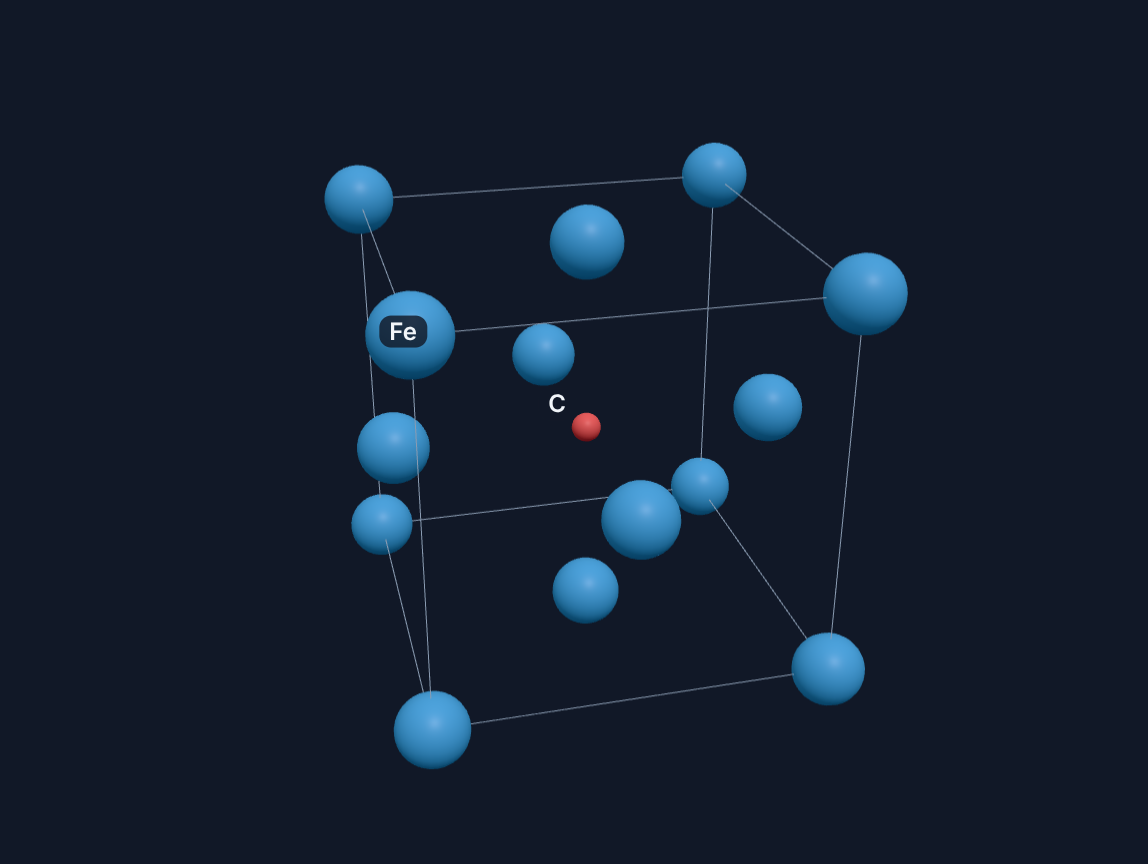
Interstitial compounds: small atoms in the voids — An fcc metal has N = 8 × 1/8 + 6 × 1/2 = 4 atoms per cell. Its octahedral voids, at the body centre and the 12 edge centres, number 12 × 1/4 + 1 × 1 = 4 = N, one per atom; each is surrounded by 6 atoms and holds a sphere of radius up to 0.414 r, where r is the metal atom's radius. Its tetrahedral voids, all 8 inside the cell, number 2N; each is surrounded by 4 atoms and holds up to 0.225 r. In an interstitial compound small atoms such as H, C and N sit in these voids (C in an octahedral void of iron, for example), so every lattice site keeps its metal atom: nothing is substituted. Filling every octahedral void gives MX (TiC); filling every tetrahedral void would give MX₂. These compounds are hard, high-melting and still conduct, and are often non-stoichiometric (TiH₁.₇, VH₀.₅₆). By contrast, in a substitutional alloy such as brass a Zn atom takes a Cu site.

Colour and d–d Transitions

  • When ligands surround a metal, they split d orbitals into groups of different energy (crystal field splitting).
  • Electrons absorb photons to jump to higher d level. The frequency absorbed determines the colour seen (complementary).
  • Sc³⁺, Ti⁴⁺, Cu⁺, Zn²⁺ are colourless — either no d electrons or fully filled d¹⁰ (no d–d transition possible).
  • MnO₄⁻ is intensely purple due to charge-transfer (not d–d) — LMCT (ligand to metal charge transfer).

Important Oxoanions of Transition Metals

IonColourMetal OSOxidising?
MnO₄⁻ (permanganate)Purple/violetMn +7Strong (acidic > basic)
Cr₂O₇²⁻ (dichromate)OrangeCr +6Strong (acidic medium)
CrO₄²⁻ (chromate)YellowCr +6Moderate
MnO₄²⁻ (manganate)GreenMn +6Moderate

Cr₂O₇²⁻ + H₂O ⇌ 2CrO₄²⁻ + 2H⁺: Dichromate (orange, acidic) ⇌ Chromate (yellow, basic) — pH-dependent equilibrium.

KMnO₄ in acidic medium: MnO₄⁻ + 8H⁺ + 5e⁻ → Mn²⁺ + 4H₂O (Mn: +7 → +2). In basic medium: MnO₄⁻ + 2H₂O + 3e⁻ → MnO₂ + 4OH⁻ (Mn: +7 → +4).
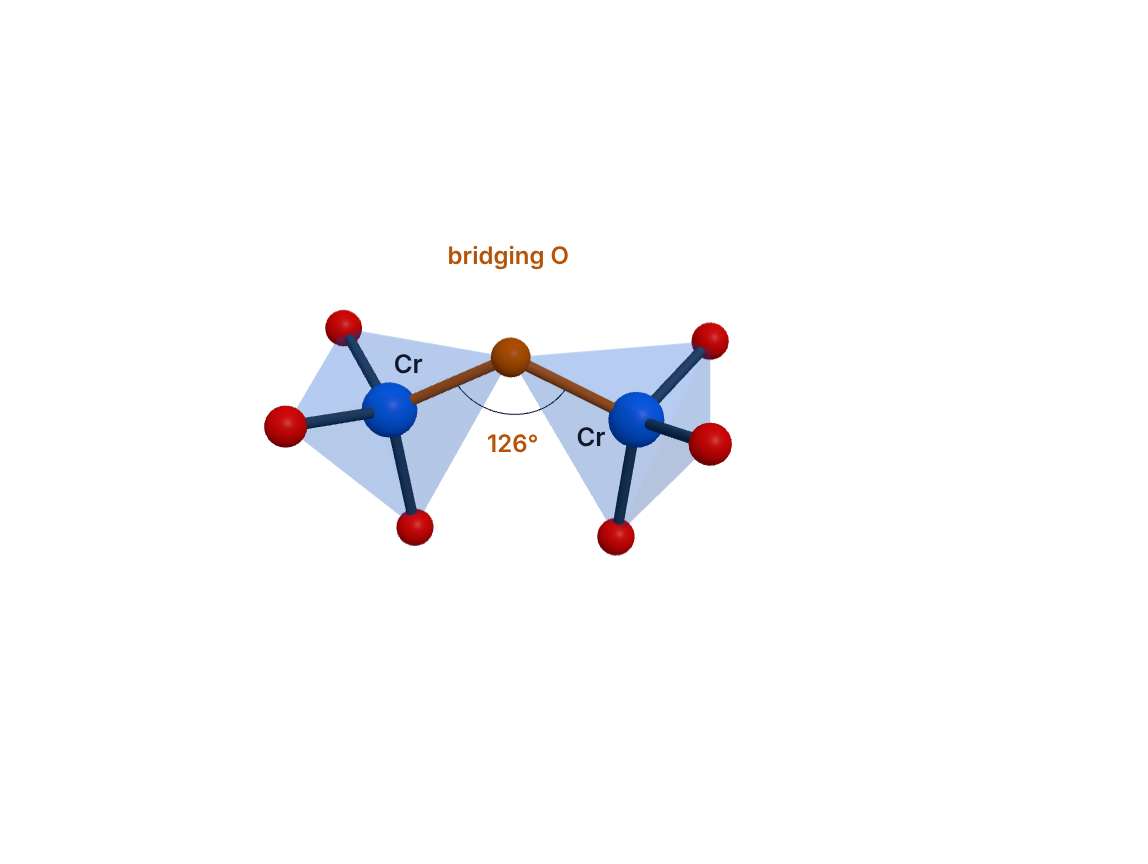
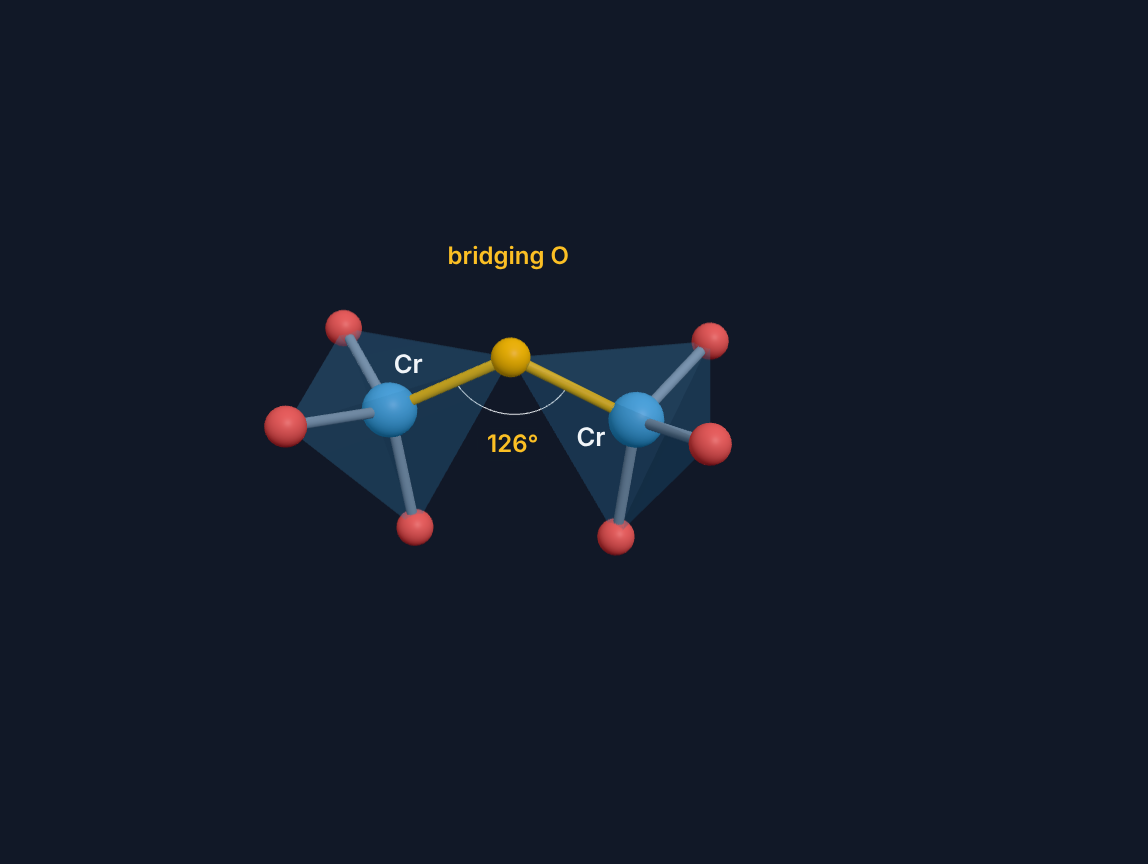
Chromate, dichromate and permanganate in 3D — CrO₄²⁻ is tetrahedral, every O–Cr–O 109.5°, with Cr +6 from x + 4(−2) = −2. In acid two chromate ions join, 2CrO₄²⁻ + 2H⁺ → Cr₂O₇²⁻ + H₂O, and a base reverses it. Cr₂O₇²⁻ is two CrO₄ tetrahedra sharing one corner O: 6 terminal and 2 bridging Cr–O bonds, Cr–O–Cr 126° (NCERT), and Cr still +6, from 2x + 7(−2) = −2. MnO₄⁻ is tetrahedral too, with Mn +7 from x + 4(−2) = −1. Cr (group 6) at +6 and Mn (group 7) at +7 have no d electrons left (d⁰), so their strong colours cannot come from d–d transitions: they come from charge transfer from O to the metal. The tetrahedra are drawn regular and bond lengths are not to scale.

f-Block: Lanthanides and Actinides

  • Lanthanides (Ce–Lu): Fill 4f orbitals. Common oxidation state +3 (due to extra stability of [Xe] core). Ce also shows +4; Eu and Yb show +2.
  • Lanthanide contraction: As 4f electrons are added, nuclear charge increases but 4f electrons are poor shielders → Z_eff increases → ionic radius contracts steadily from La³⁺ to Lu³⁺.
  • Consequences of lanthanide contraction:
    — 4d and 5d elements have nearly identical radii (e.g., Zr ≈ Hf, Nb ≈ Ta) → similar properties, hard to separate.
    — Basicity of Ln(OH)₃ decreases from La(OH)₃ to Lu(OH)₃ (smaller ion, more charge density, less hydroxide).
  • Actinides (Th–Lr): Fill 5f orbitals. Show much wider range of oxidation states (+2 to +6 or +7) because 5f, 6d, and 7s energies are close. Many are radioactive.
  • Actinide contraction is slightly larger than lanthanide contraction (5f electrons even poorer shielders).
💡 JEE Tip: Magnetic moment formula \(\mu = \sqrt{n(n+2)}\) BM where n = number of unpaired electrons. Fe³⁺/Mn²⁺ both have 5 unpaired d electrons → \(\mu = \sqrt{35} \approx 5.92\) BM (highest). Zn²⁺ has 0 unpaired → μ = 0 (diamagnetic). Learn: Cr³⁺ (3 unpaired, 3.87 BM), Fe²⁺ (4 unpaired, 4.90 BM).
⚠ Common Error: Cu²⁺ is blue-coloured (NOT Cu⁺ which is colourless — d¹⁰). Similarly, Zn²⁺ is colourless (d¹⁰), Sc³⁺ is colourless (d⁰). Don't confuse Cu metal (reddish) with Cu²⁺ ion (blue in aqueous solution = [Cu(H₂O)₄]²⁺).
📐
d & f Block — Formula Sheet
Magnetic Moment
\(\mu = \sqrt{n(n+2)}\)   BM (Bohr Magnetons)
n = number of unpaired electrons. Only spin magnetic moment (spin-only formula). Orbital contribution neglected for 3d metals.
$$ n=1: \mu=1.73 | n=2: \mu=2.83 | n=3: \mu=3.87 | n=4: \mu=4.90 | n=5: \mu=5.92 BM $$
Ti³⁺(1), V³⁺(2), Cr³⁺/Co²⁺(3), Fe²⁺/Co³⁺LS(4 or 0), Fe³⁺/Mn²⁺(5)
Redox Half-Reactions
MnO₄⁻ + 8H⁺ + 5e⁻ → Mn²⁺ + 4H₂O   (acidic)
KMnO₄ in acidic medium: purple → colourless. Gain of 5e⁻. E° = +1.51 V (very strong oxidant)
MnO₄⁻ + 2H₂O + 3e⁻ → MnO₂ + 4OH⁻   (basic)
KMnO₄ in neutral/basic medium: purple → brown precipitate MnO₂
Cr₂O₇²⁻ + 14H⁺ + 6e⁻ → 2Cr³⁺ + 7H₂O   (acidic)
K₂Cr₂O₇: orange → green (Cr³⁺). Gain of 6e⁻. E° = +1.33 V. Only used in acidic medium.
2CrO₄²⁻ + 2H⁺ ⇌ Cr₂O₇²⁻ + H₂O
Chromate (yellow, basic) ⇌ dichromate (orange, acidic). Interconversion via pH.
Electronic Configurations (Key)
Cr: [Ar] 3d⁵ 4s¹  |  Cu: [Ar] 3d¹⁰ 4s¹
Half-filled (Cr) and fully filled (Cu) d subshells are extra stable → anomalous 4s¹ instead of 4s²
For ions: remove ns first, then (n−1)d
Fe²⁺: [Ar]3d⁶ (remove 4s² from Fe: [Ar]3d⁶4s²). Fe³⁺: [Ar]3d⁵. Mn²⁺: [Ar]3d⁵.
🧮
d & f Block — Solved Examples
Example 1 Easy Magnetic Moment Calculation
Calculate the spin-only magnetic moment of: (a) Fe³⁺, (b) Cu²⁺, (c) Zn²⁺, (d) Ti³⁺. State whether each is paramagnetic or diamagnetic.
  1. Fe³⁺: Fe is [Ar]3d⁶4s². Remove 4s²4d¹ → wait, Fe³⁺ loses 3e⁻. Fe: [Ar]3d⁶4s² → Fe³⁺: [Ar]3d⁵. Five 3d electrons, all unpaired (d⁵ high spin). n=5 → \(\mu = \sqrt{5\times7} = \sqrt{35}\) = 5.92 BM. Paramagnetic.
  2. Cu²⁺: Cu: [Ar]3d¹⁰4s¹ → Cu²⁺: [Ar]3d⁹. One unpaired electron in d⁹. n=1 → \(\mu = \sqrt{1\times3} = \sqrt{3}\) = 1.73 BM. Paramagnetic. (Blue colour in solution.)
  3. Zn²⁺: Zn: [Ar]3d¹⁰4s² → Zn²⁺: [Ar]3d¹⁰. All paired. n=0 → μ = 0. Diamagnetic. Colourless compounds.
  4. Ti³⁺: Ti: [Ar]3d²4s² → Ti³⁺: [Ar]3d¹. One unpaired. n=1 → \(\mu = \sqrt{3}\) = 1.73 BM. Paramagnetic. (Ti³⁺ is violet — single d electron makes one d–d transition possible.)
Example 2 Medium KMnO₄ Titration Calculations
10 mL of 0.1 M KMnO₄ (acidified) is used to titrate FeSO₄ solution. What volume of 0.5 M FeSO₄ is required? [MnO₄⁻ + 5Fe²⁺ (acidic) → Mn²⁺ + 5Fe³⁺]
  1. Moles of KMnO₄ = 0.1 × 10/1000 = 10⁻³ mol.
  2. From stoichiometry: 1 mol MnO₄⁻ reacts with 5 mol Fe²⁺ (MnO₄⁻ gains 5e⁻; Fe²⁺→Fe³⁺ loses 1e⁻ each).
  3. Moles of Fe²⁺ required = 5 × 10⁻³ = 5×10⁻³ mol.
  4. Volume of 0.5 M FeSO₄ = (5×10⁻³)/0.5 = 0.01 L = 10 mL.
✓ Method: n-factor of KMnO₄ in acid = 5 (Mn: +7→+2). n-factor of FeSO₄ = 1 (Fe: +2→+3). Milliequivalents must be equal: (0.1×5)×10 = (0.5×1)×V → V = 10 mL ✓.
Example 3 Hard Lanthanide Contraction — Consequences
Explain why: (a) Zr and Hf have almost identical atomic radii despite Hf being in period 6. (b) The 5d metals (W, Re, Os, Ir, Pt, Au) are denser than 4d metals. (c) Au is less reactive than Ag despite being below it in the group.
  1. Going from 4d (Zr, Period 5) to 5d (Hf, Period 6), 14 lanthanide elements are inserted. Their poor 4f shielding causes steady Z_eff increase → ionic/atomic radii contract. By the time we reach Hf, the lanthanide contraction has nearly cancelled the expected increase in radius due to adding a new shell. Result: Zr (160 pm) ≈ Hf (159 pm).
  2. 5d metals have similar atomic radii to 4d metals (due to lanthanide contraction) but much higher nuclear masses (more protons + neutrons). Density = mass/volume. Similar radius + greater mass → significantly higher density.
  3. Au (5d) has smaller radius than expected → stronger nucleus-electron attraction → higher ionisation energy and electronegativity. Also, relativistic effects compress 6s orbital in heavy elements like Au, making it harder to lose electrons. Ag has lower IE and is more easily oxidised to Ag⁺. Thus Au is less reactive (nobility of gold).
📊
d & f Block — Visual Concepts
Click any diagram to zoom
⚡
d & f Block — Quick Quiz
Question 1
The electronic configuration of Cu is [Ar] 3d¹⁰ 4s¹ and not [Ar] 3d⁹ 4s² because:
Fully filled (d¹⁰) and half-filled (d⁵) subshells have extra stability due to symmetrical charge distribution and exchange energy. Cu promotes one 4s electron to 3d to achieve 3d¹⁰ 4s¹ configuration. Similarly Cr achieves 3d⁵ 4s¹. Answer: C ✓
Question 2
Which of the following transition metal ions is COLOURLESS?
Sc³⁺: [Ar] — completely empty d⁰ configuration. No d electrons to undergo d–d transitions → no visible light absorbed → colourless. Cu²⁺ (d⁹) = blue; Fe³⁺ (d⁵) = pale yellow/brown; Mn²⁺ (d⁵) = very pale pink. Answer: B ✓. Also Zn²⁺ (d¹⁰) and Ti⁴⁺ (d⁰) are colourless.
Question 3
Lanthanide contraction is primarily due to:
4f electrons are in inner orbitals with diffuse radial distribution — they shield poorly. As Z increases by 1 and one 4f electron is added across the lanthanides, Z_eff felt by outer electrons increases steadily → ionic radius contracts steadily from La³⁺ (106.1 pm) to Lu³⁺ (86.1 pm). Answer: A ✓
🔗
Coordination Compounds
Werner's theory · IUPAC naming · Isomerism · Crystal Field Theory

Werner's Theory

  • Primary valence (ionisable): Satisfied by negative ions; equals oxidation state of metal.
  • Secondary valence (non-ionisable): Satisfied by ligands; equals coordination number (CN).
  • Secondary valences are directed in space → determines geometry of the complex.
  • Example: [Co(NH₃)₆]Cl₃ — Co has OS +3 (primary valence = 3), CN = 6 (secondary valence = 6), 3 Cl⁻ are counter-ions.
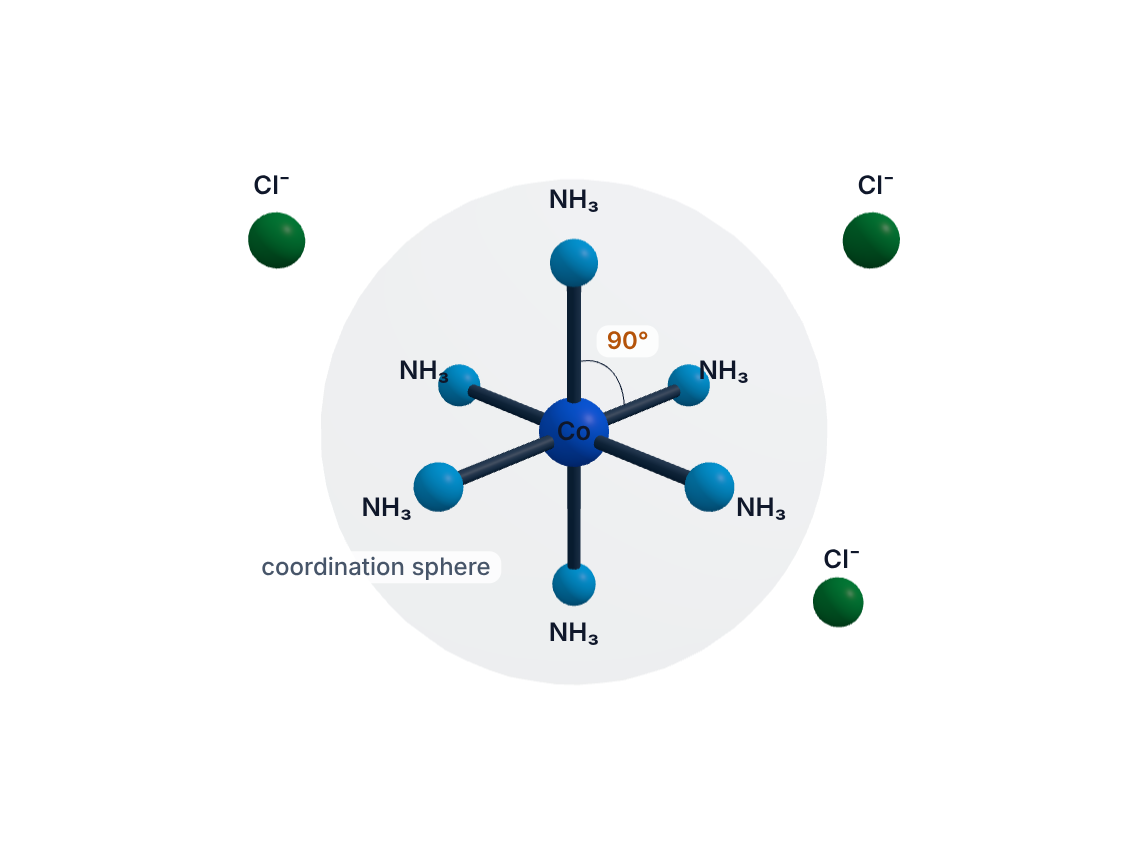
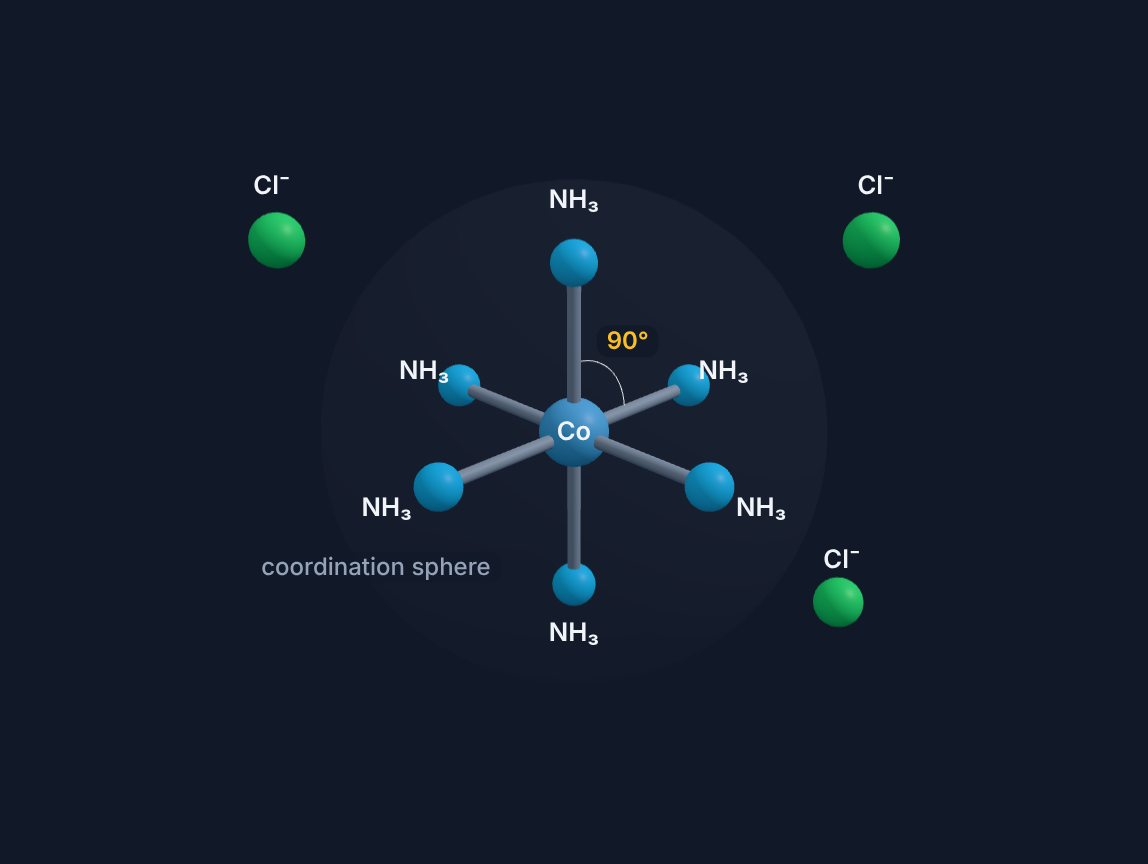
Coordination geometries in 3D — In [Co(NH₃)₆]Cl₃ the six NH₃ ligands sit inside the coordination sphere at the corners of an octahedron, 90° apart: coordination number 6, Werner’s secondary valence, which points in fixed directions and so fixes the shape. The 3 Cl⁻ ions sit outside the sphere. They are ionisable, so one mole of the complex gives 3 mol AgCl with AgNO₃, and they balance cobalt’s oxidation state, +3 (the primary valence; Co³⁺ is d⁶). In [CoCl(NH₃)₅]Cl₂ one Cl⁻ has moved inside: it counts towards both valences and is no longer ionisable, so only 2 AgCl precipitate. Coordination number 4 has two shapes: [Ni(CN)₄]²⁻ (Ni²⁺, d⁸) is square planar, ligands 90° apart, while [Ni(CO)₄] (nickel in oxidation state 0, d¹⁰) is tetrahedral, 109.5°; folding the square turns one into the other. Bond lengths are not to scale.

Key Terminology

TermDefinitionExample
Central metalLewis acid (accepts electron pairs)Fe in [Fe(CN)₆]³⁻
LigandLewis base (donates electron pairs) attached to metalCN⁻, NH₃, Cl⁻, H₂O
MonodentateLigand donates 1 lone pairCl⁻, NH₃, H₂O, CN⁻
BidentateDonates 2 lone pairs via 2 donor atomsen (ethylenediamine), ox²⁻, acac⁻
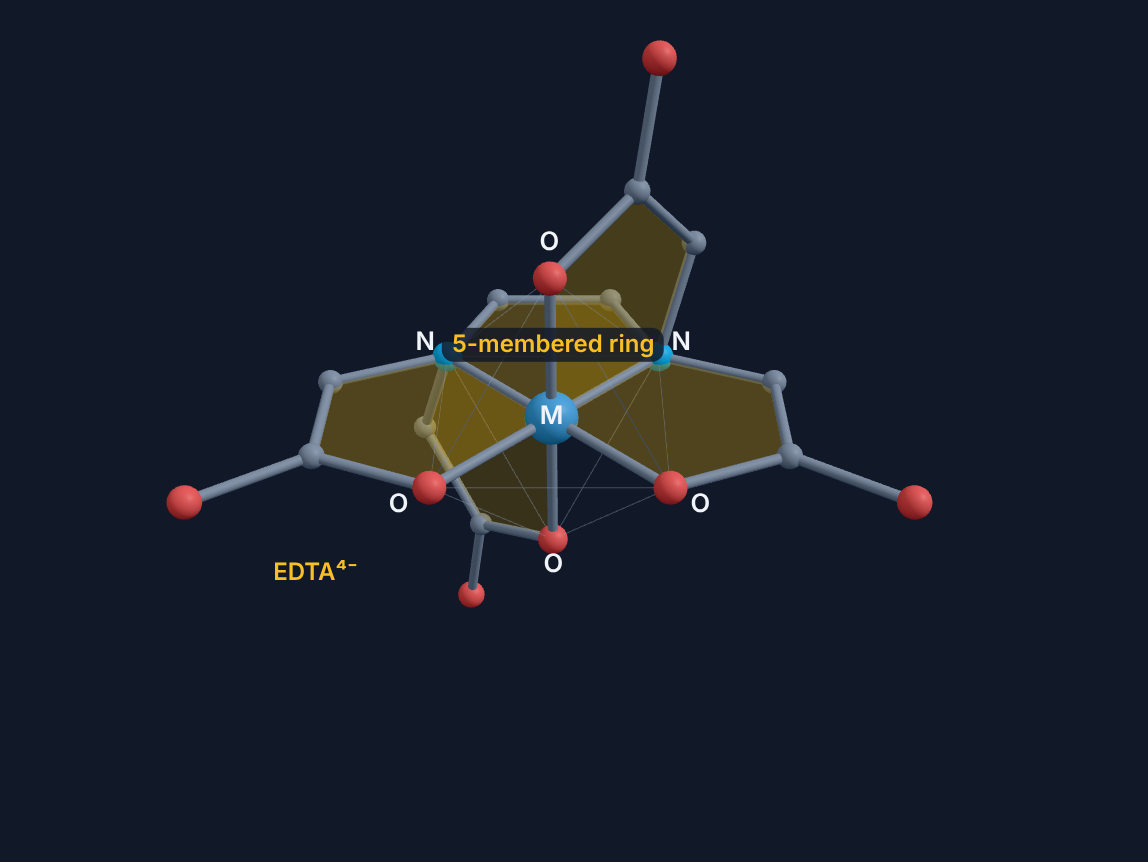
PolydentateDonates multiple pairsEDTA⁴⁻ (hexadentate, 6 donor atoms)
ChelateComplex with ring formed by polydentate ligand[Cu(en)₂]²⁺
AmbidentateCan bond through different donor atomsNO₂⁻ (via N: nitro; via O: nitrito), SCN⁻ (via S or N)
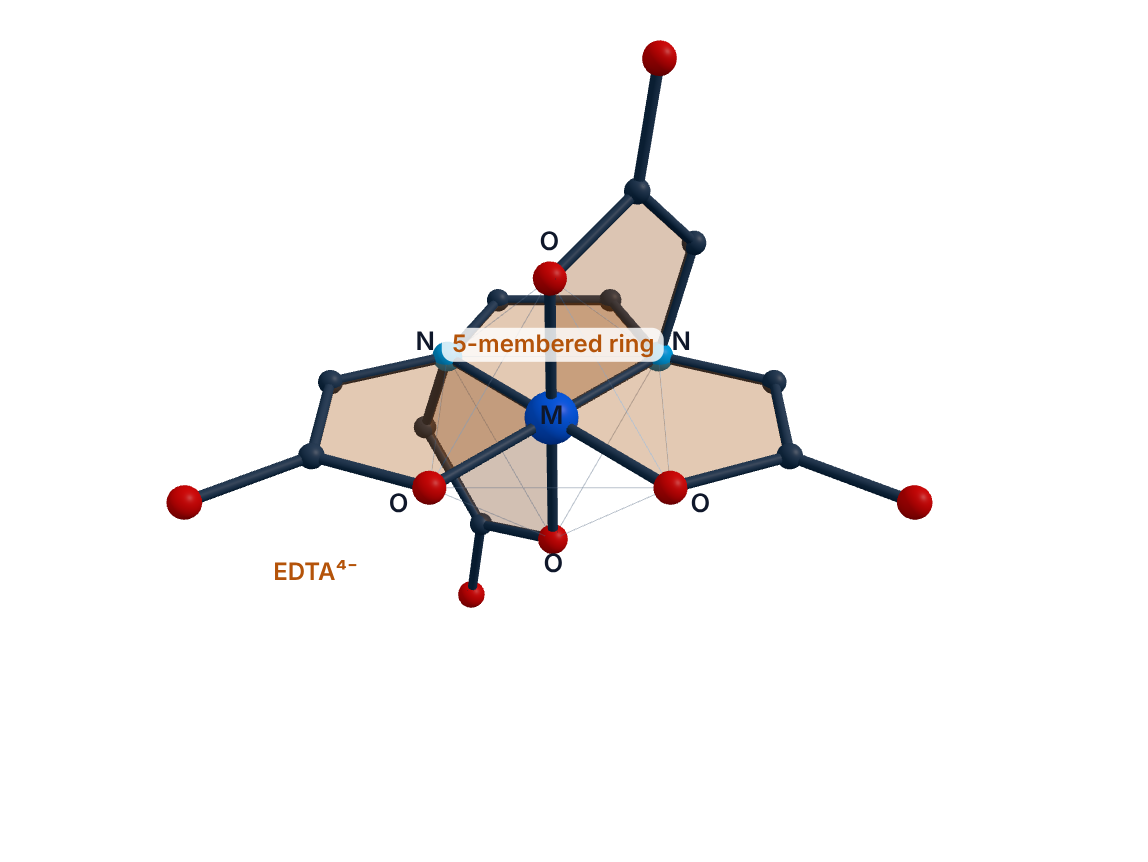
Chelate rings in 3D — A chelating ligand bonds through two or more donor atoms and closes a ring with the metal. en (ethane-1,2-diamine) is bidentate: its 2 N take two cis sites, 90° apart, and with the metal and the two CH₂ carbons make a 5-membered ring, M–N–C–C–N. ox²⁻ (oxalate) is bidentate through 2 O and also makes a 5-membered ring, M–O–C–C–O. EDTA⁴⁻ is hexadentate: its 2 N and 4 O fill all six octahedral sites, wrapping round the metal and closing 5 rings, each 5-membered. The rings are counted from the bonds (rings = bonds − atoms + 1). Bond lengths are not to scale, the rings are drawn flat and H atoms are not shown.

IUPAC Nomenclature Rules

  • Name the cation first, then the anion (as in ionic nomenclature).
  • Within the complex ion: ligands are named alphabetically before the metal.
  • Anionic ligands end in -o: Cl⁻ = chlorido, CN⁻ = cyanido, OH⁻ = hydroxido, NO₂⁻ = nitrito, O²⁻ = oxido.
  • Neutral ligands retain their names (with exceptions): NH₃ = ammine, H₂O = aqua, CO = carbonyl, NO = nitrosyl.
  • Multiplying prefixes: di, tri, tetra, penta, hexa (for simple); bis, tris, tetrakis (for ligands containing a number).
  • Metal oxidation state given in Roman numerals in parentheses after metal name.
  • If complex is an anion, metal name gets suffix -ate (e.g., ferrate, cuprate, platinate).

Types of Isomerism in Coordination Compounds

IsomerismDescriptionExample
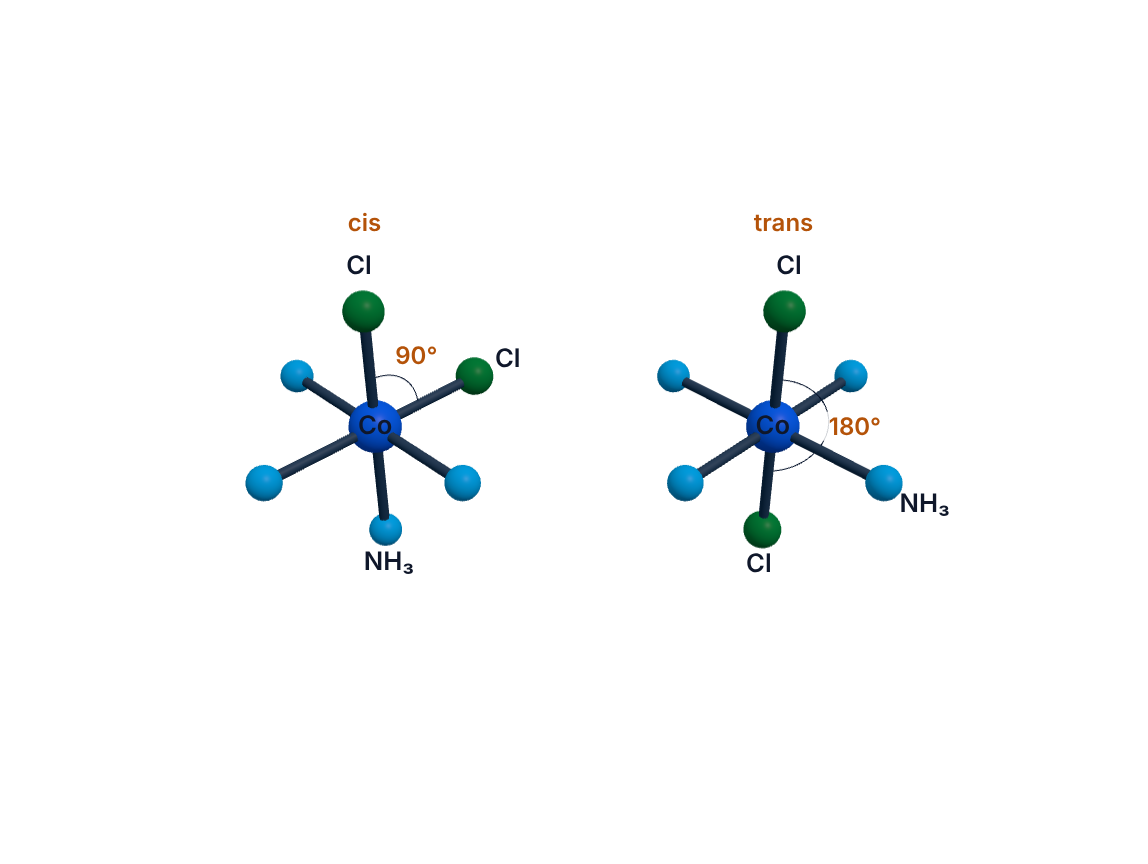
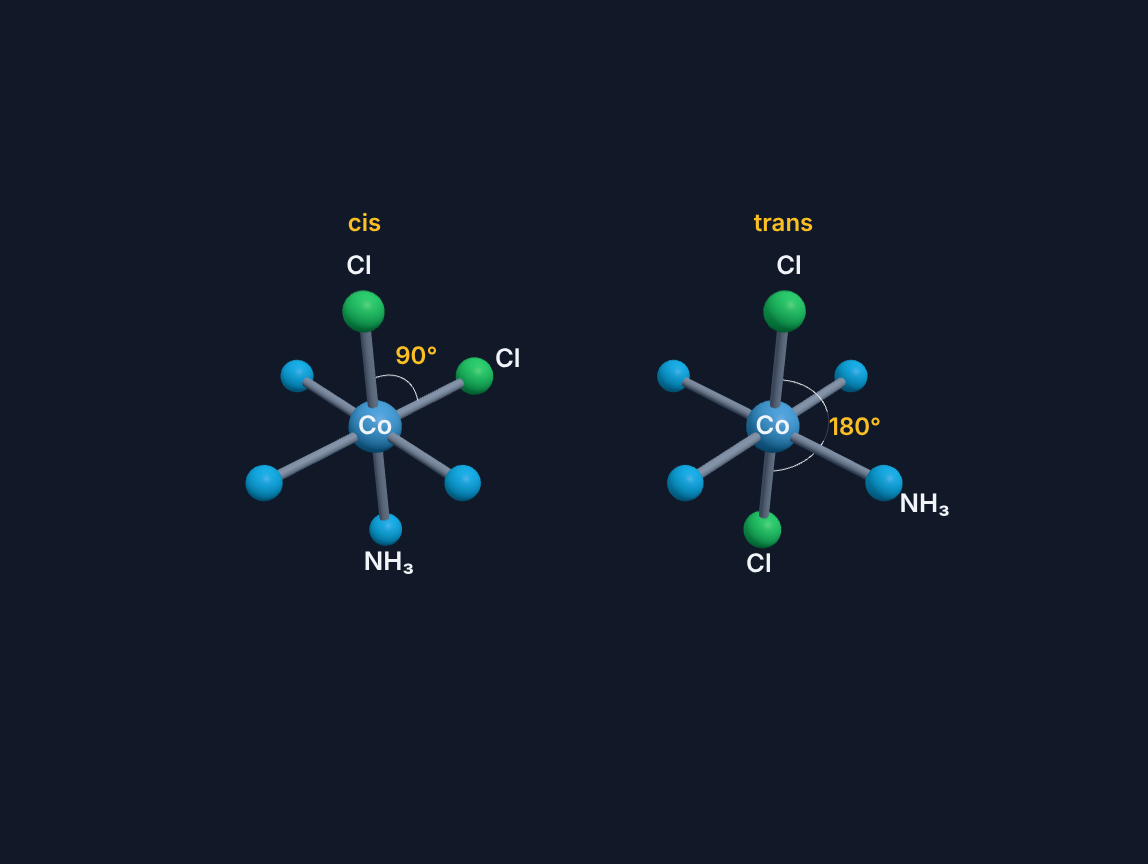
Geometric (cis/trans)Different spatial arrangement of ligandscis-[Pt(NH₃)₂Cl₂] (anticancer) vs trans-[Pt(NH₃)₂Cl₂]
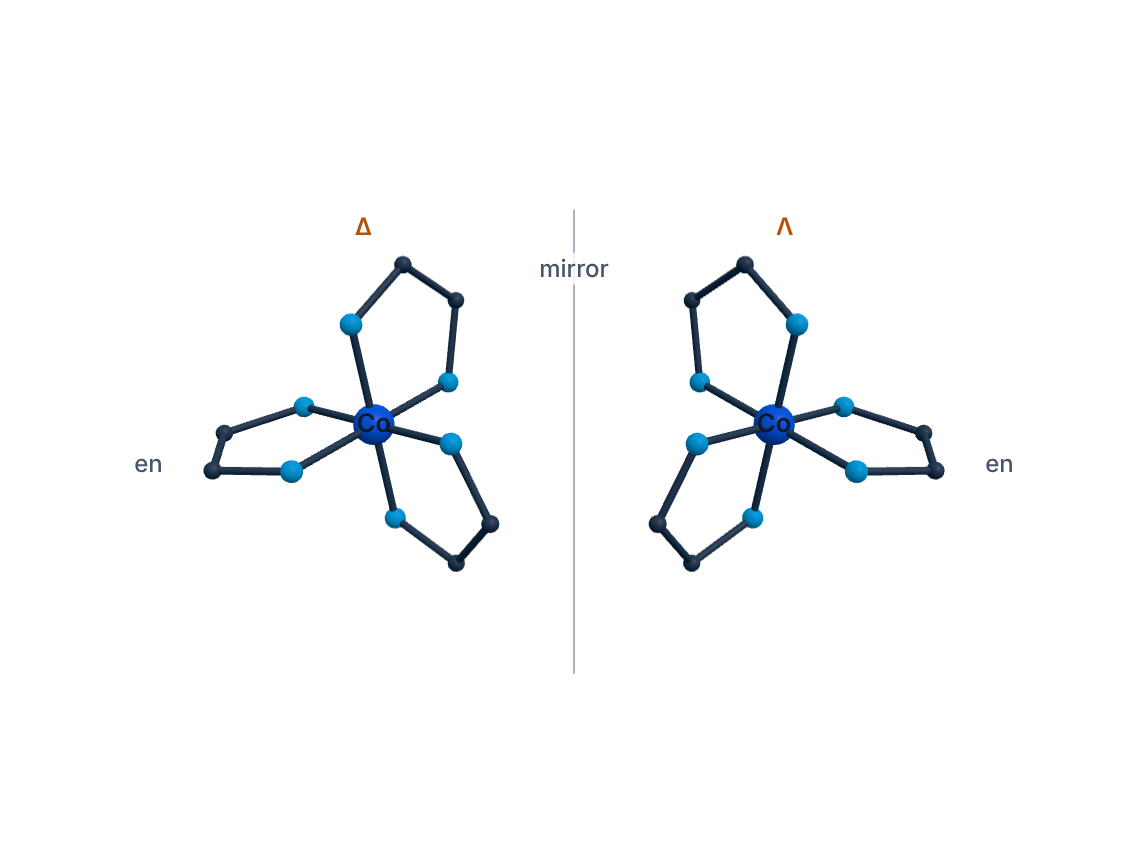
Optical (Δ/Λ)Non-superimposable mirror images (chiral)[Co(en)₃]³⁺ Δ and Λ forms
LinkageAmbidentate ligand bonded through different atoms[Co(NH₃)₅(NO₂)]²⁺ vs [Co(NH₃)₅(ONO)]²⁺
IonisationDifferent ions in coordination sphere vs outside[Co(NH₃)₅Br]SO₄ vs [Co(NH₃)₅SO₄]Br
Hydrate/SolvateH₂O inside vs outside coordination sphere[Cr(H₂O)₆]Cl₃ vs [Cr(H₂O)₅Cl]Cl₂·H₂O
CoordinationExchange of ligands between cation and anion complexes[Co(NH₃)₆][Cr(CN)₆] vs [Cr(NH₃)₆][Co(CN)₆]
Geometric isomers in 3D — Two Cl can be placed on the six sites of octahedral [CoCl₂(NH₃)₄]⁺ (type MA₄B₂) in 15 ways, but turning the ion shows that most are the same. Grouping the placements that one of the octahedron’s 24 rotations maps onto each other leaves 2 isomers: cis, Cl–Co–Cl 90° (12 placements), and trans, 180° (3 placements). In the figure a 120° turn about the centres of two opposite faces lays one cis placement exactly on another. No turn makes cis into trans, because a turn keeps every angle. For MA₃B₃, [Co(NH₃)₃(NO₂)₃], the 20 placements make 2 isomers: fac, with the three NO₂ on one face of the octahedron, all 90° apart (8 placements, one per face), and mer, with the three on a meridian, 90°, 90° and 180° apart (12 placements). None of these is chiral. The same count gives 5 geometric isomers for MA₂B₂C₂, one of them chiral, so 6 stereoisomers in all. Bond lengths are not to scale.
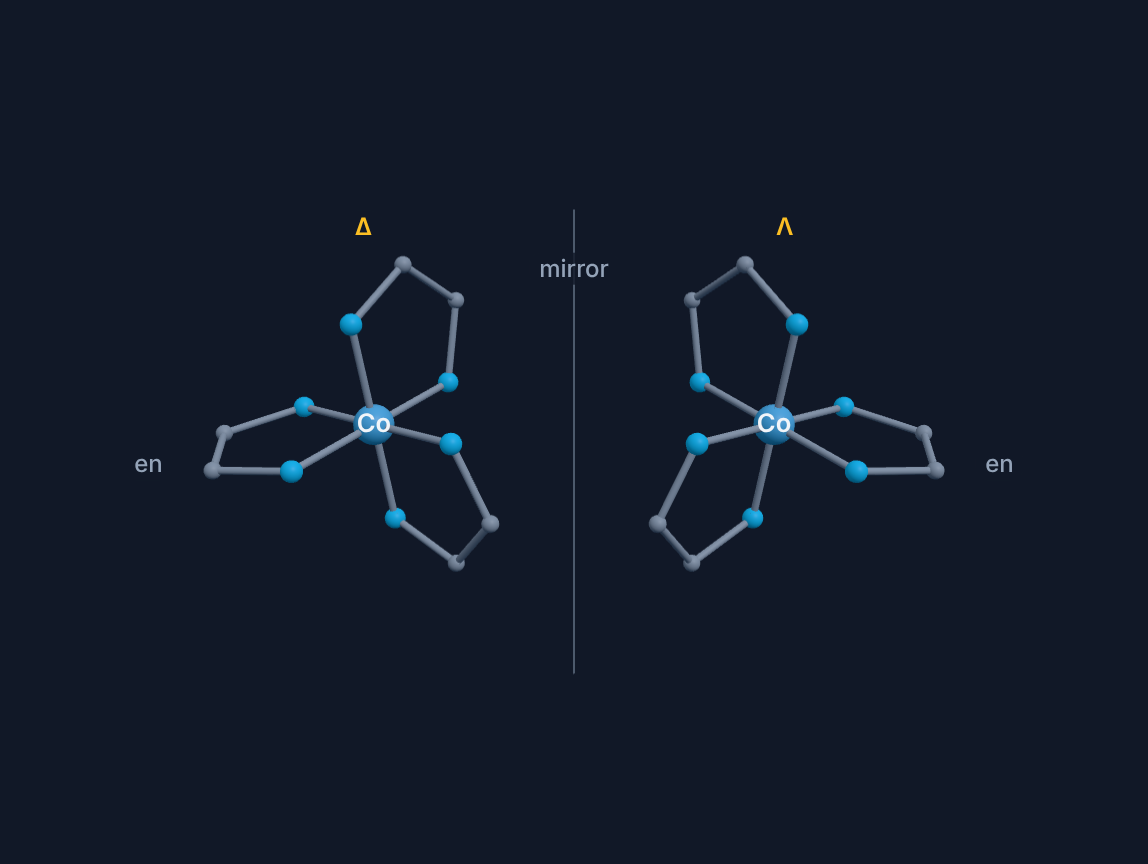
Optical isomers in 3D — [Co(en)₃]³⁺ and its mirror image cannot be superimposed. Each en bridges two cis sites, 90° apart, and the three chelates twist like the blades of a propeller: right-handed in Δ, left-handed in its mirror image Λ (IUPAC names the twist by how any two chelates, seen as skew lines, wind round each other). Of all 24 turns, the best lays only 1 of the 3 en of Λ on an en of Δ, so the ion is chiral: Δ and Λ are enantiomers, and optically active. The 8 ways to place three en make just these 2 isomers, 4 each. cis-[CoCl₂(en)₂]⁺ (often written [Co(en)₂Cl₂]⁺) is chiral too: the best turn lays both Cl of its mirror image on Cl, but 0 of the 2 en on an en. trans-[CoCl₂(en)₂]⁺, with its Cl 180° apart, is achiral: a 90° turn about the Cl–Co–Cl axis lays its mirror image exactly on it. So [CoCl₂(en)₂]⁺ has 3 stereoisomers: trans, and a cis pair of enantiomers (Δ and Λ). Bond lengths are not to scale and H atoms are not shown.

Crystal Field Theory (CFT)

  • Ligands are treated as point negative charges; they repel metal d electrons, splitting the degenerate d orbitals.
  • Octahedral field: Splits d orbitals into t₂g (dxy, dyz, dxz — lower energy, 3 orbitals) and eg (dx²−y², dz² — higher energy, 2 orbitals). Splitting energy = Δo. t₂g = −0.4Δo; eg = +0.6Δo.
  • Tetrahedral field: e (dx²−y², dz²) lower, t₂ (dxy, dyz, dxz) higher. Δt = 4/9 Δo (smaller because only 4 ligands).
  • Strong vs weak field ligands:
    Spectrochemical series (increasing Δo):
    I⁻ < Br⁻ < Cl⁻ < F⁻ < OH⁻ < H₂O < SCN⁻ < NH₃ < en < CN⁻ < CO
  • Low spin (strong field): Large Δo > pairing energy → electrons pair in t₂g first → fewer unpaired e⁻.
  • High spin (weak field): Small Δo < pairing energy → electrons obey Hund's rule → more unpaired e⁻.
  • CFSE (Crystal Field Stabilisation Energy) = contribution of t₂g electrons (each −0.4Δo) + eg electrons (each +0.6Δo).
💡 JEE Tip: cis-platin [PtCl₂(NH₃)₂] is the anticancer drug — ONLY the cis form is active (it can cross-link DNA strands within one strand). trans-platin is inactive. Also: CN⁻ and CO are strong field → low spin; Cl⁻, F⁻ are weak field → high spin for most metals.
⚠ Common Error: In IUPAC naming, ligands go in ALPHABETICAL order, not by charge or denticity. "Tetraamminedichloridocobalt(III)" — ammine (a) before chlorido (c) ✓. Also the complex ion is named as one word with no spaces between ligand names and the metal name.
📐
Coordination Compounds — Formula Sheet
Crystal Field Stabilisation Energy (CFSE)
Octahedral CFSE = (−0.4 × n_t₂g + 0.6 × n_eg) × Δo − P × (extra pairs)
n_t₂g = electrons in t₂g; n_eg = electrons in eg. Subtract pairing energy P for each extra pair compared to free ion.
d⁶ (low spin, octahedral): t₂g⁶ eg⁰ → CFSE = 6(−0.4Δo) = −2.4Δo
Maximum CFSE for octahedral. Examples: [Fe(CN)₆]⁴⁻, [Co(NH₃)₆]³⁺. Strongly stabilised.
$$ \Delta t = \frac{4}{9} \times \Delta o $$
Tetrahedral splitting is 4/9 of octahedral (fewer ligands, no direct overlap). Most tetrahedral complexes are high spin.
Oxidation State Calculation
OS of metal = charge of complex − Σ(charges of ligands)
For [Fe(CN)₆]³⁻: OS(Fe) = −3 − 6(−1) = −3 + 6 = +3. For [Cu(NH₃)₄]²⁺: OS(Cu) = +2 − 4(0) = +2.
EAN = Z − OS + 2 × CN   (Effective Atomic Number)
Stable complexes often have EAN = noble gas configuration (18-electron rule for transition metals). EAN = atomic number − electrons lost + electrons donated by ligands.
Common Ligands Quick Reference
en: H₂N–CH₂–CH₂–NH₂ (bidentate, chelates via 2 N donors)
Ethylenediamine — most common bidentate amine ligand; forms 5-membered chelate rings.
EDTA⁴⁻: hexadentate (4 O + 2 N donors) — forms 5 rings, very stable chelate
Ethylenediaminetetraacetate; sequesters metal ions; used in analytical chemistry and medicine.
🧮
Coordination Compounds — Solved Examples
Example 1 Easy IUPAC Naming
Name the following: (a) [Co(NH₃)₄Cl₂]⁺, (b) [Fe(CN)₆]⁴⁻, (c) [Pt(en)₂]²⁺, (d) [CrCl₂(H₂O)₄]⁺.
  1. [Co(NH₃)₄Cl₂]⁺: Ligands alphabetically: chlorido (×2) before ammine (×4)? No — 'a' before 'c' → ammine first! Tetraamminedichloridocobalt(III). [OS: x + 4(0) + 2(−1) = +1 → x = +3.]
  2. [Fe(CN)₆]⁴⁻: Complex anion → metal gets -ate suffix → ferrate. OS: x + 6(−1) = −4 → x = +2. Name: hexacyanidoferrate(II).
  3. [Pt(en)₂]²⁺: en is a bidentate neutral ligand; use 'bis' (not 'di') for ligands containing numerals. OS: x + 2(0) = +2 → x = +2. Name: bis(ethylenediamine)platinum(II).
  4. [CrCl₂(H₂O)₄]⁺: aqua (a) before chlorido (c)? No — 'a'<'c' → aqua comes first. OS: x + 2(−1) + 4(0) = +1 → x = +3. Name: tetraaquadichloridochromium(III).
Example 2 Medium CFT — Low Spin vs High Spin
For a d⁶ octahedral complex, determine: (a) electron configuration, number of unpaired electrons, CFSE for [Fe(H₂O)₆]²⁺ (weak field); (b) same for [Fe(CN)₆]⁴⁻ (strong field). Which has higher magnetic moment?
  1. Fe²⁺ is d⁶. In octahedral field: 6 electrons to distribute between t₂g (lower) and eg (higher).
  2. (a) [Fe(H₂O)₆]²⁺ — H₂O is weak field: Δo < pairing energy → high spin. Fill by Hund's: t₂g³ eg² first, 6th e⁻ pairs in t₂g → t₂g⁴ eg². Unpaired: 4. \(\mu = \sqrt{4\times6} = \sqrt{24}\) = 4.90 BM. CFSE = 4(−0.4Δo) + 2(+0.6Δo) = −0.4Δo (low).
  3. (b) [Fe(CN)₆]⁴⁻ — CN⁻ is strong field: Δo > pairing energy → low spin. All 6 electrons pair up in t₂g → t₂g⁶ eg⁰. Unpaired: 0. μ = 0 BM (diamagnetic). CFSE = 6(−0.4Δo) = −2.4Δo (very high stabilisation).
✓ [Fe(H₂O)₆]²⁺ has higher μ (4.90 vs 0 BM). CN⁻ causes larger splitting → all electrons pair → diamagnetic. This is why [Fe(CN)₆]⁴⁻ is yellow (large Δo → absorbs UV edge into violet, transmits yellow), while [Fe(H₂O)₆]²⁺ is pale green.
Example 3 Hard Geometric and Optical Isomers — MA₂B₂ Octahedral
How many geometric and optical isomers exist for [Co(en)₂Cl₂]⁺? Draw and name them. Which ones are optically active?
  1. [Co(en)₂Cl₂]⁺: Co³⁺, 2 bidentate en ligands, 2 Cl⁻ ligands. Octahedral. The 2 Cl can be cis (90° apart) or trans (180° apart).
  2. trans isomer: 2 Cl directly opposite each other. All en ligands occupy equatorial-ish positions symmetrically. This isomer is superimposable on its mirror image (has C₂ axis + σh plane) → optically inactive. 1 geometric isomer.
  3. cis isomer: 2 Cl adjacent (90° apart). The molecule is chiral (no plane of symmetry). Gives 2 optical isomers: Δ (right-handed, d) and Λ (left-handed, l) forms — non-superimposable mirror images.
✓ Total: 3 isomers — 1 trans (optically inactive) + 2 cis (Δ and Λ, both optically active). All complexes with 3 bidentate ligands [M(AA)₃] are also chiral → 2 optical isomers, e.g., [Co(en)₃]³⁺.
📊
Coordination Compounds — Visual Concepts
Click any diagram to zoom
⚡
Coordination Compounds — Quick Quiz
Question 1
The IUPAC name of [Co(NH₃)₅Cl]²⁺ is:
Ligands in alphabetical order: ammine (a) before chlorido (c). OS: x + 5(0) + (−1) = +2 → x = +3. Name: pentaamminechloridocobalt(III). Note: modern IUPAC uses 'chlorido' not 'chloro'. Answer: C ✓
Question 2
In Crystal Field Theory, which set of d orbitals is lower in energy in an octahedral field?
In an octahedral field, 6 ligands approach along ±x, ±y, ±z axes. The dx²−y² and dz² (eg) orbitals point directly at ligands → greater repulsion → higher energy. The dxy, dyz, dxz (t₂g) point between axes → lower repulsion → lower energy. Answer: B ✓
Question 3
Which of the following pairs represents linkage isomers?
Linkage isomers: same molecular formula but ambidentate ligand (NO₂⁻) bonded through different atoms — N (nitro: Co–NO₂) vs O (nitrito: Co–ONO). A = ionisation isomers; B = coordination isomers; C = geometric isomers. Answer: D ✓
⛏
Metallurgy
Ores · Concentration · Extraction · Refining · Alloys

Occurrence of Metals — Ores

MetalImportant OresFormula
IronHaematite, Magnetite, SideriteFe₂O₃, Fe₃O₄, FeCO₃
CopperCopper pyrites, Malachite, CupriteCuFeS₂, Cu₂(OH)₂CO₃, Cu₂O
AluminiumBauxite, Corundum, CryoliteAl₂O₃·2H₂O, Al₂O₃, Na₃AlF₆
ZincZinc blende, Zincite, CalamineZnS, ZnO, ZnCO₃
LeadGalena, CerrusitePbS, PbCO₃
SilverArgentite, Horn silverAg₂S, AgCl
GoldNative gold, CalaveriteAu, AuTe₂
MercuryCinnabarHgS

Concentration of Ores

MethodPrincipleUsed for
Gravity separation (levigation)Difference in specific gravityOxide/carbonate ores (haematite)
Froth flotationPreferential wetting by oil; ore particles attach to frothSulphide ores (ZnS, PbS, CuFeS₂)
Magnetic separationMagnetic properties of ore/gangueMagnetite, chromite; removes non-magnetic gangue
Leaching (chemical)Selective dissolution of ore in reagentAl (NaOH), Au/Ag (NaCN), Ag (dilute H₂SO₄)

Extraction of Metals

Thermodynamic basis — Ellingham diagram: plots ΔG° vs T for metal oxide formation. A metal can reduce another metal's oxide if its ΔG° line lies below the other at that temperature. Carbon and CO are powerful reducing agents at high temperatures.

MethodPrincipleExamples
CalcinationHeating ore in absence of air; decomposes carbonate/hydroxideZnCO₃→ZnO+CO₂; Al₂O₃·2H₂O→Al₂O₃
RoastingHeating ore in excess air; converts sulphide to oxide2ZnS+3O₂→2ZnO+2SO₂
SmeltingReduction of oxide with coke (C or CO) at high TFe₂O₃+3CO→2Fe+3CO₂ (blast furnace)
Self-reductionSulphide partially roasted then heated; sulphide reduces oxideCu₂S+2Cu₂O→6Cu+SO₂
Electrolytic reductionElectrolysis of molten ore/solutionAl from molten Al₂O₃ (Hall-Héroult); Na from NaCl
HydrometallurgyLeaching + displacement or electrolysisCu from CuSO₄ by Fe; Au by NaCN then Zn

Blast Furnace — Iron Extraction

Charge: haematite (Fe₂O₃) + coke (C) + limestone (CaCO₃). Temperature zones (bottom to top): tuyere zone (~1500°C), fusion zone, reduction zone, absorption zone.

  • CaCO₃ → CaO + CO₂ (flux formation)
  • C + O₂ → CO₂; CO₂ + C → 2CO (reducing agent)
  • Fe₂O₃ + 3CO → 2Fe + 3CO₂ (main reduction)
  • CaO + SiO₂ → CaSiO₃ (slag — removes gangue)
  • Pig iron (~4% C) tapped from bottom; slag floats above

Hall-Héroult Process — Aluminium

Al₂O₃ dissolved in molten cryolite (Na₃AlF₆) at ~950°C; electrolysed in carbon-lined cell.

  • Cathode: Al³⁺ + 3e⁻ → Al (liquid, sinks to bottom)
  • Anode (carbon): 2O²⁻ → O₂ + 4e⁻; O₂ burns anode → CO₂
  • Anodes must be replaced periodically (consumed)
  • Cryolite lowers melting point and increases conductivity

Refining of Metals

MethodPrincipleMetal
LiquationLow-mp metal melts and flows away from gangueSn, Bi, Pb
DistillationVolatile metal distilled, collected on coolingZn, Hg
Electrolytic refiningImpure metal = anode; pure metal = cathode; same salt solutionCu, Ag, Au, Al
Zone refiningImpurities more soluble in melt; heater moves along rodSi, Ge (semiconductors)
Van Arkel methodVolatile iodide formed then thermally decomposed on hot filamentTi, Zr (ultra-pure)
Mond's processNi + 4CO → Ni(CO)₄ (volatile); decomposed at 180°CNi

Important Alloys

AlloyCompositionUse
SteelFe + C (0.1–1.5%)Construction
Stainless steelFe + Cr (12–18%) + NiCutlery, utensils
BrassCu (70%) + Zn (30%)Instruments, fittings
BronzeCu (90%) + Sn (10%)Statues, coins
DuraluminAl + Cu (4%) + Mg + MnAircraft bodies
SolderPb (50%) + Sn (50%)Joining metals
German silverCu + Zn + NiUtensils, jewellery
💡 JEE Tip: Froth flotation is for sulphide ores — the pine oil makes ore particles hydrophobic so they attach to air bubbles. Gravity separation is for oxide/carbonate ores. Leaching with NaCN is for Au: 4Au + 8NaCN + 2H₂O + O₂ → 4Na[Au(CN)₂] + 4NaOH; gold recovered by: 2Na[Au(CN)₂] + Zn → Na₂[Zn(CN)₄] + 2Au.
⚠ Common Error: Calcination vs Roasting — calcination is in limited/no air (carbonates → oxides); roasting is in excess air (sulphides → oxides + SO₂). Both are pyrometallurgy steps before reduction, not the reduction step itself.
📐
Metallurgy — Key Reactions
Roasting & Reduction
ZnS Roasting
2ZnS + 3O₂ → 2ZnO + 2SO₂
ZnO + C → Zn + CO (reduction)
Blast Furnace (Fe)
Fe₂O₃ + 3CO → 2Fe + 3CO₂
CaO + SiO₂ → CaSiO₃ (slag)
Cu Self-reduction
2Cu₂S + 3O₂ → 2Cu₂O + 2SO₂
2Cu₂O + Cu₂S → 6Cu + SO₂
Gold — Cyanide Process
4Au + 8NaCN + 2H₂O + O₂ → 4Na[Au(CN)₂] + 4NaOH
2Na[Au(CN)₂] + Zn → Na₂[Zn(CN)₄] + 2Au
Mond's Process (Ni)
Ni + 4CO → Ni(CO)₄ (at 60°C)
Ni(CO)₄ → Ni + 4CO (at 180°C)
🧮
Metallurgy — Solved Examples
Example 1
Example 1: Which method is used to concentrate copper pyrites (CuFeS₂)? Explain the principle.
  1. Froth flotation is used for sulphide ores like copper pyrites.
  2. Principle: Pine oil (collector) is added along with water and the crushed ore. Air is blown through. The ore particles become hydrophobic (water-repelling) due to pine oil, attach to air bubbles, rise to the surface as froth, and are skimmed off. The gangue (rocky material) remains hydrophilic and settles.
  3. Key reagents: Pine oil (collector); frothers (to stabilise froth); depressants (e.g., NaCN to depress ZnS when separating ZnS from PbS).
Example 2
Example 2: Why is cryolite used in the Hall-Héroult process for extraction of aluminium?
  1. Pure Al₂O₃ has a very high melting point (~2050°C), making direct electrolysis impractical and very costly.
  2. Cryolite (Na₃AlF₆) is added because it: (1) lowers the melting point of the mixture to ~950°C, and (2) increases electrical conductivity of the melt, making the electrolysis efficient. Fluorspar (CaF₂) is also added to further lower the melting point.
Example 3
Example 3: In electrolytic refining of copper, what happens at the anode and cathode?
  1. Setup: Impure copper = anode; pure copper = cathode; CuSO₄ (aq) = electrolyte.
  2. Anode: Cu → Cu²⁺ + 2e⁻ (anode dissolves). Impurities less reactive than Cu (Au, Ag, Pt) fall as anode mud below the anode.
  3. Cathode: Cu²⁺ + 2e⁻ → Cu (pure copper deposits). More reactive impurities (Zn, Fe) stay in solution as ions.
  4. Net effect: copper transfers from impure anode to pure cathode; precious metals collected as anode mud.
Example 4
Example 4: Using the Ellingham diagram, explain why aluminium can reduce Cr₂O₃ but not vice versa at 1000°C.
  1. The Ellingham diagram shows ΔG° (formation of metal oxide) vs temperature.
  2. At 1000°C, ΔG° for Al₂O₃ formation ≈ −850 kJ/mol O₂ (more negative than Cr₂O₃ ≈ −500 kJ/mol O₂).
  3. A more negative ΔG° means Al has a stronger affinity for oxygen than Cr. Therefore:
    • Al can reduce Cr₂O₃: 2Al + Cr₂O₃ → Al₂O₃ + 2Cr (thermite-type reaction, ΔG° negative → spontaneous)
    • Cr cannot reduce Al₂O₃ (would require energy input)
  4. General rule: the metal whose oxide line is lower on the Ellingham diagram can reduce the other metal's oxide.
📊
Metallurgy — Diagrams
Click any diagram to zoom
⚡
Metallurgy — Quick Quiz
Question 1
Which concentration method is used for sulphide ores like ZnS and PbS?
Froth flotation exploits the hydrophobic nature of sulphide ore particles — they attach to pine oil-coated air bubbles and rise as froth. Magnetic separation is for magnetic ores (magnetite). Gravity separation is for oxide/carbonate ores. Leaching uses chemical reagents.
Question 2
In Mond's process for nickel purification, nickel tetracarbonyl Ni(CO)₄ is formed at 60°C and decomposed at:
Mond's process: Ni + 4CO → Ni(CO)₄ at 60°C (volatile compound forms). On heating to 180°C: Ni(CO)₄ → Ni + 4CO. Pure nickel deposits on a heated surface; CO is recycled. The CO is toxic — this distinguishes Mond's from other refining methods.
Question 3
Zone refining is used to obtain ultra-pure samples of:
Zone refining is used for semiconductor metals (Si, Ge) that require extremely high purity (parts per billion). A moving heater sweeps impurities along the rod. Copper/silver use electrolytic refining; Ni uses Mond's process; Zn/Hg use distillation.
🧫
Practical Chemistry — Salt Analysis
Cation groups · group reagents · anion tests · flame tests
○ Not Started

1. Qualitative Analysis of Cations

In systematic salt analysis, cations (basic radicals) are precipitated in a fixed order by adding group reagents, so that each group separates out before the next:

GroupGroup reagentCations
Idil. HClPb²⁺
IIH₂S in presence of dil. HClCu²⁺, Pb²⁺ (and others)
IIINH₄Cl + NH₄OHAl³⁺, Fe³⁺
IVH₂S in presence of NH₄OHZn²⁺, Ni²⁺
V(NH₄)₂CO₃Ca²⁺, Ba²⁺
VIno group reagentMg²⁺, NH₄⁺

2. Anion Tests & Flame Tests

Anions (acid radicals) are detected with specific reagents — e.g. a carbonate (CO₃²⁻) gives brisk effervescence with dilute acid; a chloride (Cl⁻) gives a white AgCl precipitate with AgNO₃ (soluble in NH₃); a sulphate (SO₄²⁻) gives a white BaSO₄ precipitate insoluble in acid. Some metals impart a characteristic flame colour:

ElementFlame colour
Sodium (Na)Golden yellow
Potassium (K)Lilac / violet
Calcium (Ca)Brick red
Barium (Ba)Apple green
Copper (Cu)Bluish green
💡 Cation groups I–VI with reagents dil.HCl → H₂S/HCl → NH₄Cl+NH₄OH → H₂S/NH₄OH → (NH₄)₂CO₃ → (none). Flame: Na golden-yellow, K lilac, Ca brick-red, Ba apple-green, Cu bluish-green.
🧫
Practical Chemistry — Quick Quiz
tap an option to reveal the answer
Question 1
The group reagent used to precipitate Group III cations (Al³⁺, Fe³⁺) is:
Group III cations are precipitated as hydroxides by NH₄OH in the presence of NH₄Cl (which controls the hydroxide-ion concentration so only Group III precipitates).
Question 2
A salt imparts a golden-yellow colour to a flame. The cation is likely:
Sodium gives a persistent golden-yellow flame; potassium is lilac, calcium brick-red and barium apple-green.
Question 3
Brisk effervescence of a gas that turns lime water milky, on adding dilute acid to a salt, indicates the anion:
A carbonate releases CO₂ with dilute acid — brisk effervescence of a gas that turns lime water milky is the classic carbonate test.
🎉 All Inorganic Chemistry topics mastered! Next: Organic Chemistry →