Physical Chemistry — Chemistry
1. Matter, Elements & Compounds
Matter is anything with mass that occupies space. An element cannot be broken into simpler substances by chemical means; a compound is two or more elements chemically combined in a fixed ratio (H₂O is always 2 H : 1 O); a mixture combines substances in variable ratio, separable physically.
2. Laws of Chemical Combination
- Conservation of Mass (Lavoisier): mass of reactants = mass of products.
- Definite Proportions (Proust): a given compound always has the same elements in the same mass ratio.
- Multiple Proportions (Dalton): for two elements forming several compounds, the masses of one combining with a fixed mass of the other are in a simple whole-number ratio (CO and CO₂ → 16 g : 32 g = 1 : 2).
- Gay-Lussac's Law of gaseous volumes and Avogadro's Law (equal volumes of gases at the same T and P contain equal numbers of molecules).
3. The Mole Concept
Atoms are too small to count, so chemists use the mole — exactly \(6.022\times10^{23}\) entities (the Avogadro constant \(N_A\)), just as "a dozen" always means 12. The mole is defined so the mass of one mole in grams (the molar mass) numerically equals the atomic/molecular mass in \(u\). This links the atomic world to the weighable world:
$$ n = \frac{\text{given mass}}{\text{molar mass}} = \frac{N}{N_A} = \frac{V}{22.4\ \text{L}}\ (\text{gas at STP}) $$
One mole of any gas occupies \(22.4\ \text{L}\) at STP — a direct consequence of Avogadro's law.
4. Empirical & Molecular Formula · Stoichiometry
The empirical formula is the simplest whole-number atom ratio; the molecular formula \(= \text{empirical} \times n\), where \(n = \dfrac{\text{molecular mass}}{\text{empirical formula mass}}\). In a reaction, the limiting reagent is found by comparing (moles ÷ coefficient) for each reactant — the smallest value runs out first and caps the product.
5. Significant Figures (measurement)
Non-zero digits and zeros between them are significant; leading zeros never are; trailing zeros count only after a decimal point. For addition/subtraction the result keeps the fewest decimal places; for multiplication/division it keeps the fewest significant figures.
- \(n = \dfrac{4.4}{44} = 0.1\) mol
- \(N = n\,N_A = 0.1 \times 6.022\times10^{23} = 6.022\times10^{22}\) molecules
- Assume 100 g → moles: C = 40/12 = 3.33, H = 6.7/1 = 6.7, O = 53.3/16 = 3.33
- Divide by smallest (3.33): C = 1, H ≈ 2, O = 1 → empirical formula CH₂O (mass 30)
- \(n = \dfrac{180}{30} = 6\) → molecular formula \(= \text{CH}_2\text{O} \times 6 = \text{C}_6\text{H}_{12}\text{O}_6\)
- Moles \(= \dfrac{5.6}{22.4} = 0.25\) mol
- Molar mass \(= \dfrac{11}{0.25} = 44\) g/mol
- CO₂ has molar mass \(12 + 32 = 44\) → matches
Early Atomic Models
| Model | Scientist | Key Feature | Limitation |
|---|---|---|---|
| Plum-pudding | Thomson (1904) | Electrons embedded in positive sphere | Couldn't explain α-scattering |
| Nuclear model | Rutherford (1911) | Tiny dense nucleus; electrons orbit | Couldn't explain atomic stability or line spectra |
| Planetary (quantised) | Bohr (1913) | Fixed circular orbits; energy quantised | Only valid for H-like atoms; ignored wave nature |
Bohr's Model (Hydrogen-like atoms)
- Radius of nth orbit: \(r_{n} = 0.529 \times \dfrac{n^{2}}{Z} Å\) (a₀ = 0.529 Å = Bohr radius)
- Velocity of electron: \(v_{n} = 2.18\times10^{6} \times \dfrac{Z}{n} m/s\)
- Energy of nth level: \(E_{n} = -13.6 \times \dfrac{Z^{2}}{n^{2}} eV\)
- Frequency of emitted photon: \(h\nu = E_i - E_f = 13.6Z^{2}(\dfrac{1}{n_f^{2}} - \dfrac{1}{n_i^{2}}) eV\)
- Wave number of spectral line: \(\nũ = RZ^{2}(\dfrac{1}{n_f^{2}} - \dfrac{1}{n_i^{2}})\); \(R = 1.097\times10^{7} m^{-1}\) (Rydberg constant)
Hydrogen Spectral Series
| Series | \(n_f\) | \(n_i\) | Region | First line (\(n_i = n_f+1\)) |
|---|---|---|---|---|
| Lyman | 1 | 2,3,4… | UV | n=2→1 (121.6 nm) |
| Balmer | 2 | 3,4,5… | Visible | n=3→2 (656.3 nm, red) |
| Paschen | 3 | 4,5,6… | Near IR | n=4→3 |
| Brackett | 4 | 5,6,7… | IR | n=5→4 |
| Pfund | 5 | 6,7,8… | Far IR | n=6→5 |
Wave-Particle Duality and Uncertainty
- de Broglie wavelength: \(\lambda = \dfrac{h}{mv} = \dfrac{h}{p}\); for electron accelerated through V volts: \(\lambda = \dfrac{12.27}{\sqrt V} Å\)
- Heisenberg's uncertainty principle: Δx·Δp ≥ h/4π; ΔE·Δt ≥ h/4π
- Consequence: electrons cannot have defined orbits — described by wave functions (orbitals)
- Photoelectric effect: \(KE_{max} = h\nu - \phi\) (φ = work function); threshold ν₀ = φ/h
Quantum Numbers
| QN | Symbol | Values | Describes |
|---|---|---|---|
| Principal | \(n\) | 1, 2, 3, … | Shell, energy level, size |
| Azimuthal | \(l\) | \(0\) to \(n-1\) | Sub-shell, shape (s,p,d,f) |
| Magnetic | \(m_l\) | \(-l\) to \(+l\) | Orientation in space |
| Spin | \(m_s\) | \(+\tfrac{1}{2}\) or \(-\tfrac{1}{2}\) | Spin of electron |
- l = 0 (s), 1 (p), 2 (d), 3 (f); number of orbitals in subshell = \(2l+1\)
- Maximum electrons per subshell = \(2(2l+1)\): s=2, p=6, d=10, f=14
- Total orbitals in nth shell = \(n^2\); maximum electrons = \(2n^2\)
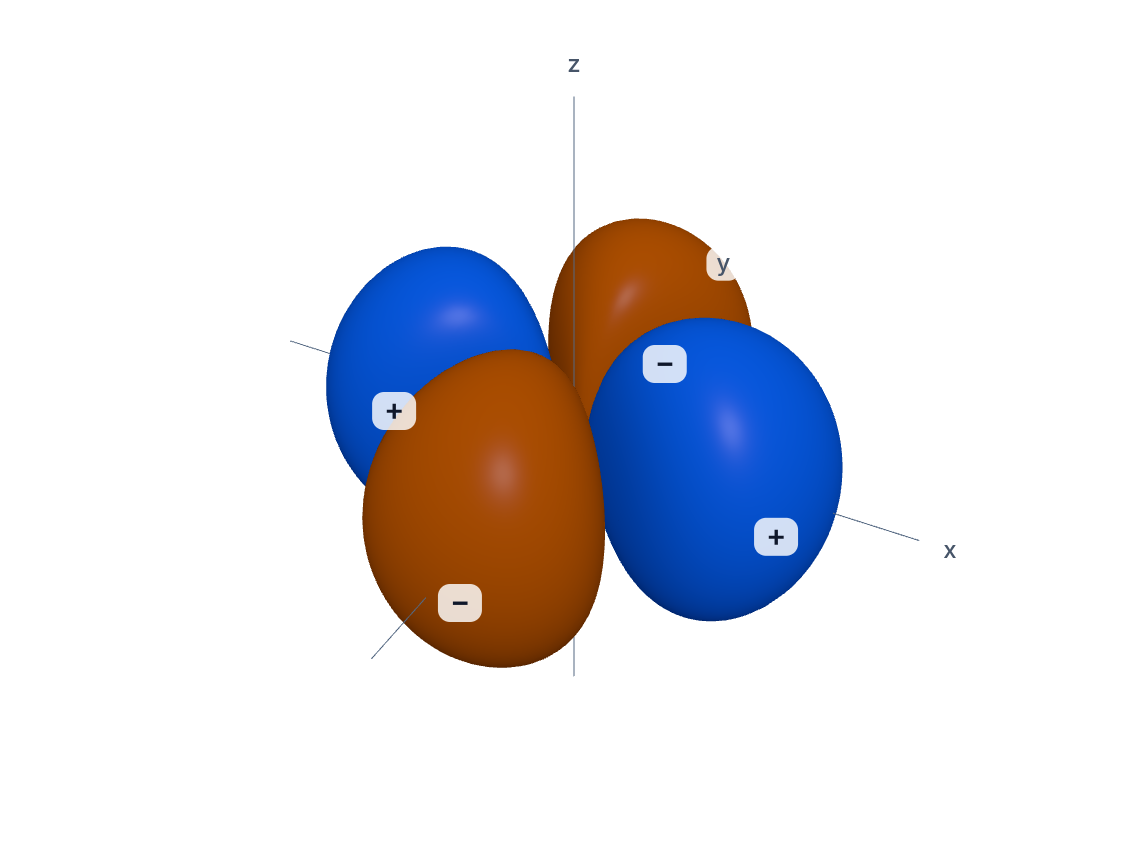
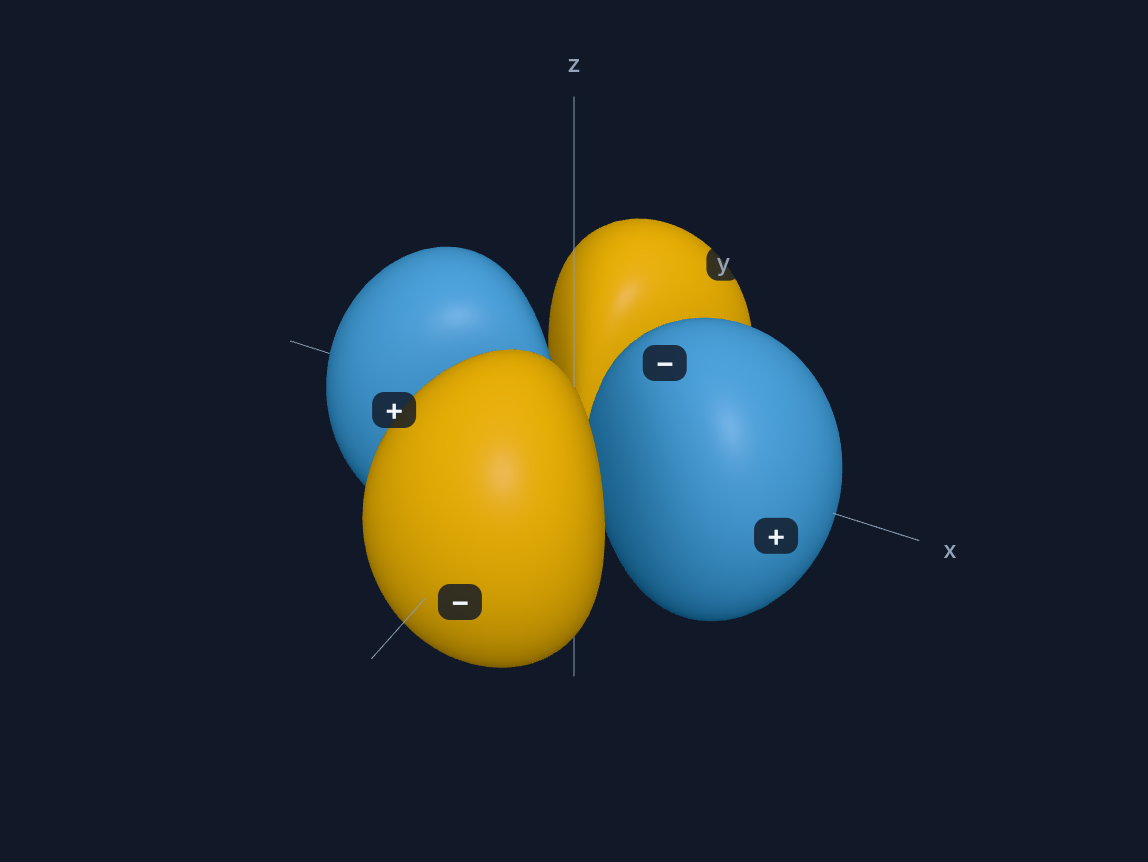
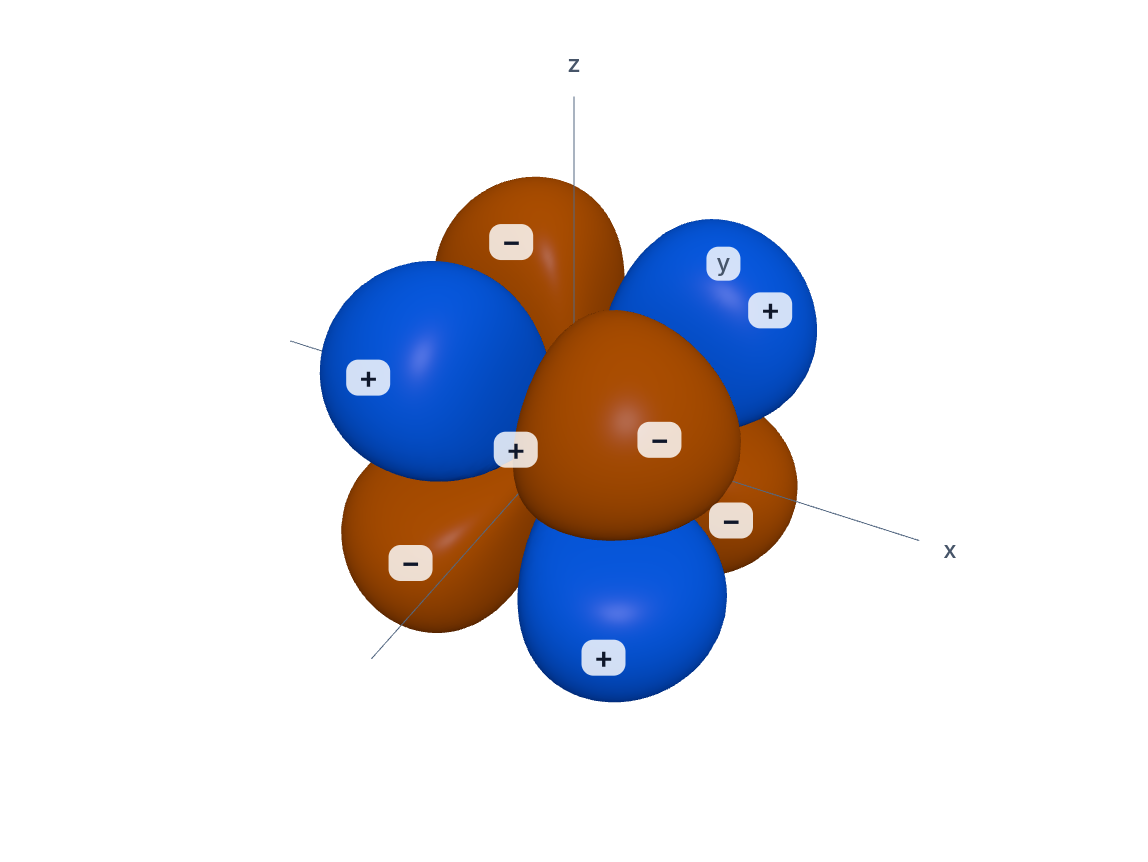
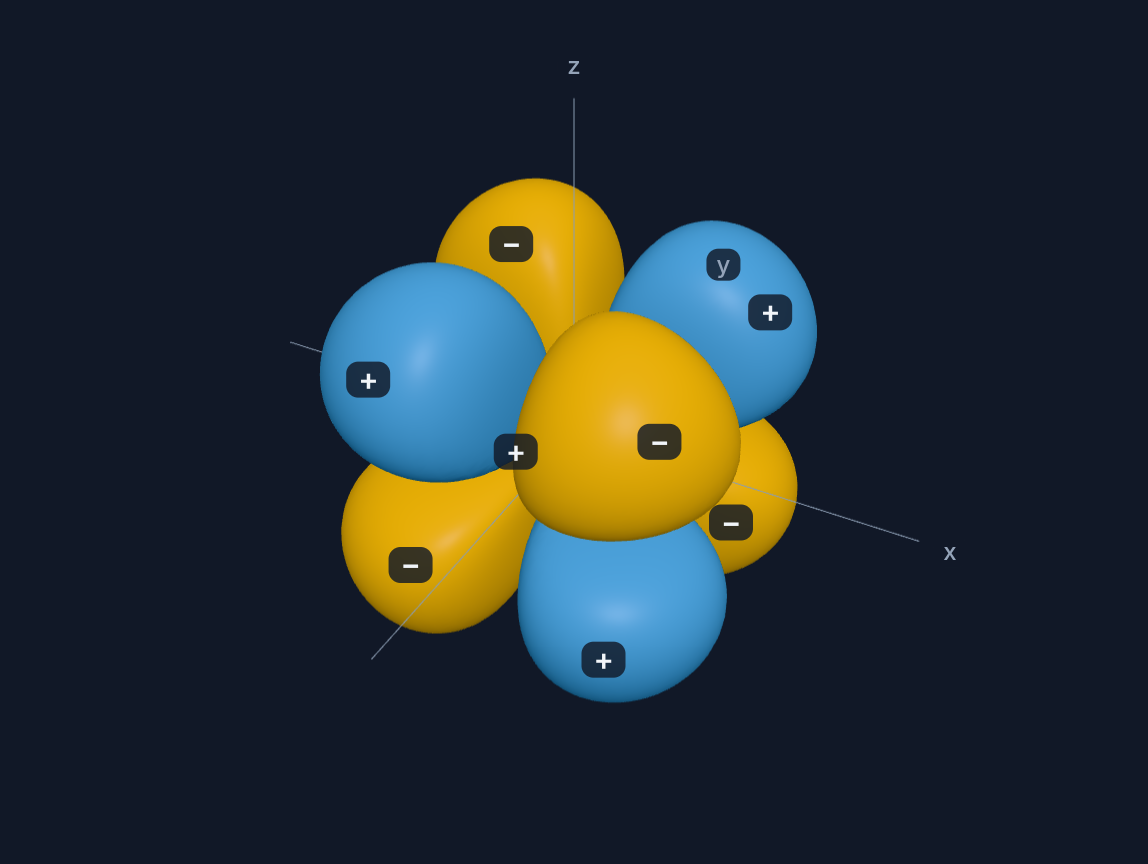
Electronic Configuration Rules
- Aufbau principle: Fill orbitals in order of increasing energy — 1s, 2s, 2p, 3s, 3p, 4s, 3d, 4p, 5s, 4d, 5p…
- Pauli exclusion: No two electrons in an atom can have identical set of all four quantum numbers — max 2 e⁻ per orbital, with opposite spins
- Hund's rule: Electrons occupy degenerate orbitals singly before pairing; singly occupied orbitals have parallel spins
- Exceptions: Cr = [Ar] 3d⁵ 4s¹; Cu = [Ar] 3d¹⁰ 4s¹ (extra stability of half-filled and fully-filled d)
- (a) r₂ (He⁺, Z=2): \(r = 0.529 \times \dfrac{n^{2}}{Z} = 0.529 \times \dfrac{4}{2} =\) 1.058 Å
- (b) E₃ (He⁺): \(E = -13.6 \times \dfrac{Z^{2}}{n^{2}} = -13.6 \times \dfrac{4}{9} = -\dfrac{6.04}{1} =\) −6.04 eV
- (c) Ionisation energy from ground state: \(IE = |E_{1}| = 13.6 \times \dfrac{Z^{2}}{1^{2}} = 13.6 \times 4 =\) 54.4 eV
- (d) Wavelength (n=3→2): \(\Delta E = 13.6 \times 4 \times (\dfrac{1}{4} - \dfrac{1}{9}) = 54.4 \times \frac{5}{36} = 7.56 eV\)
- \(\lambda = \dfrac{hc}{\Delta} E = \dfrac{6.626\times10^{-34} \times 3\times10^{8}}{7.56 \times 1.6\times10^{-19}} = 1.988\dfrac{\times10^{-25}}{1.21}\times10^{-18} =\) 164 nm (UV region)
- (a) de Broglie λ: \(\lambda = \dfrac{12.27}{\sqrt V} = \dfrac{12.27}{\sqrt{100}} = \dfrac{12.27}{10}\) = 1.227 Å
- (b) Energy of photon (λ=300 nm): \(E = \dfrac{hc}{\lambda} = \dfrac{6.626\times10^{-34} \times 3\times10^{8}}{300\times10^{-9}} = 6.626\times10^{-19} J = 6.626\dfrac{\times10^{-19}}{1.6}\times10^{-19} =\) 4.14 eV
- KE_max: \(= h\nu - \phi = 4.14 - 2.0 =\) 2.14 eV
- Stopping potential \(V_0\): \(eV_0 = KE_{max} \to V_0 = 2.14\) V (stopping potential = \(KE_{max}\) in eV numerically)
- (a) Identification: \(n=4, l=2\) → 4d subshell; \(m_l=-1\) → one of the five 4d orbitals (valid: \(-2\) to \(+2\)); \(m_s=+\tfrac{1}{2}\) → spin up. Valid — 4d orbital, spin up.
- (b) Cr (Z=24) expected: [Ar] 3d⁴ 4s². Actual: [Ar] 3d⁵ 4s¹ — half-filled 3d⁵ is extra stable (symmetric distribution of electrons); one electron from 4s migrates to 3d.
- Cu (Z=29) expected: [Ar] 3d⁹ 4s². Actual: [Ar] 3d¹⁰ 4s¹ — fully-filled 3d¹⁰ is extra stable; one electron from 4s moves to complete 3d.
- (c) Fe (Z=26): Configuration = [Ar] 3d⁶ 4s². Electrons with \(l=2\) are all d-electrons → only in 3d subshell = 6 electrons.
Basic Concepts
System: part under study. Surroundings: everything else. Universe = system + surroundings.
Types: Open (exchange mass+energy), Closed (energy only), Isolated (neither).
State functions: H, S, G, U, T, P, V — depend only on current state, not path. q and w are path functions.
ΔU = q + w (IUPAC sign: w = −PₑₓₜΔV for expansion)
For ideal gas: ΔU = nCᵥΔT (depends only on T).
Enthalpy: H = U + PV; ΔH = ΔU + ΔngRT for reactions involving gases (Δng = moles of gaseous products − reactants).
Enthalpy Changes
| Term | Symbol | Definition |
|---|---|---|
| Standard enthalpy of formation | ΔH°f | For 1 mol compound from elements in standard states; ΔH°f(elements) = 0 |
| Combustion | ΔH°c | Complete combustion of 1 mol in excess O₂ (always negative) |
| Atomisation | ΔH°at | 1 mol gaseous atoms from element in standard state (always +ve) |
| Bond dissociation | BE | Energy to break 1 mol bonds homolytically in gas phase (always +ve) |
| Lattice enthalpy | ΔH°L | 1 mol ionic solid → gaseous ions (always +ve; Born-Haber cycle) |
| Solution | ΔH°soln | ΔH°soln = ΔH°L + ΔH°hydration |
Hess's Law & Bond Enthalpy
ΔH of a reaction is independent of the path — only depends on initial and final states.
ΔH°rxn = Σ ΔH°f(products) − Σ ΔH°f(reactants)
Flip a reaction → change sign of ΔH. Multiply by n → multiply ΔH by n.
ΔH°rxn = Σ BE(bonds broken) − Σ BE(bonds formed)
Bonds broken = reactants; bonds formed = products.
Breaking bonds requires energy (+); forming bonds releases energy (−). Used when ΔH°f data is unavailable.
Second Law — Entropy & Spontaneity
Entropy (S): measure of disorder/randomness. \(\Delta S = \dfrac{q_{rev}}{T}\). For universe: \(\Delta S_{univ} = \Delta S_{sys} + \Delta S_{surr} \ge 0\) (always for spontaneous processes).
- S(gas) >> S(liquid) > S(solid)
- Dissolution usually increases S
- More complex molecules have higher S
- Higher temperature → higher S
- Δng > 0 → ΔS > 0 for gas-phase reactions
G = H − TS; ΔG = ΔH − TΔS (at constant T, P)
ΔG < 0: spontaneous; ΔG = 0: equilibrium; ΔG > 0: non-spontaneous.
ΔG° = −RT ln K = −nFE°cell
Standard free energy of formation: ΔG°rxn = Σ ΔG°f(products) − Σ ΔG°f(reactants)
| ΔH | ΔS | ΔG = ΔH−TΔS | Spontaneity |
|---|---|---|---|
| − | + | Always − | Spontaneous at all T |
| + | − | Always + | Non-spontaneous at all T |
| − | − | − at low T | Spontaneous at low T only |
| + | + | − at high T | Spontaneous at high T only |
- ΔH°rxn = [ΔH°f(CO₂) + 2×ΔH°f(H₂O)] − [ΔH°f(CH₄) + 2×ΔH°f(O₂)]
- $$ = [-393.5 + 2\times(-285.8)] - [-74.8 + 0] = [-393.5 - 571.6] - [-74.8] $$
- = −965.1 + 74.8 = −890.3 kJ/mol
- ΔG = ΔH − TΔS. Reaction is spontaneous when ΔG < 0.
- $$ \Delta G = -100\times10^{3} - T\times(-200) = -100000 + 200T $$
- ΔG = 0 at T = 100000/200 = 500 K
- For T < 500 K: ΔG < 0 (spontaneous). For T > 500 K: ΔG > 0 (non-spontaneous). This is the ΔH−,ΔS− case — spontaneous only at low T.
- Target: C(s)+2H₂(g)→CH₄(g) ΔH=−74.8 kJ … use atomisation
- C(s)→C(g): +718; 2H₂→4H: \(+436\times2=+872\); C(g)+4H(g)→CH₄: ΔH=?
- By Hess: −74.8 = 718 + 872 + ΔH(formation from atoms) → ΔH = −1664.8 kJ for 4 C–H bonds
- Average C–H BE = 1664.8/4 = ~416 kJ/mol
- $$ \Delta G^{\circ} = -RT \ln K \to \ln K = -\Delta \frac{G^{\circ}}{RT} = -\frac{-33000}{8.314\times298} = \frac{33000}{2477.6} = 13.32 $$
- \(K = e^{13}.32 \approx\) 6×10⁵
- Large K >> 1 confirms the reaction strongly favours products at 298 K.
Chemical Equilibrium
At equilibrium: rate of forward = rate of reverse reaction. Concentrations are constant (not necessarily equal).
For aA+bB ⇌ cC+dD:
Kc = [C]ᶜ[D]^d / [A]ᵃ[B]^b (concentrations)
Kp \(= (pC)ᶜ(pD)^d / (pA)ᵃ(pB)^b\) (partial pressures)
\(Kp = Kc(RT)^\Delta ng\) where Δng = (c+d)−(a+b) for gases only
Pure solids and liquids excluded from K expression.
Q has same form as K but uses non-equilibrium concentrations.
Q < K: reaction proceeds forward (→)
Q > K: reaction proceeds reverse (←)
Q = K: system is at equilibrium
System at equilibrium subjected to a stress shifts to partially relieve that stress.
- Add reactant/remove product: shifts forward
- Increase P: shifts to fewer moles of gas
- Increase T: shifts in endothermic direction (K changes)
- Catalyst: no shift in equilibrium (reaches equilibrium faster)
- Inert gas at constant V: no shift
ΔG° = −RT ln K
K > 1 → ΔG° < 0 (products favoured)
K < 1 → ΔG° > 0 (reactants favoured)
K = 1 → ΔG° = 0
Ionic Equilibrium — Acids & Bases
\(K_w = [\mathrm{H}^+][\mathrm{OH}^-] = 10^{-14}\) at 25°C; pH + pOH = 14
\(\text{pH} = -\log[\mathrm{H}^+]\); \(\text{pOH} = -\log[\mathrm{OH}^-]\)
Acid: pH < 7; Base: pH > 7; Neutral: pH = 7 (at 25°C)
For weak acid HA ⇌ H⁺+A⁻: \(K_a = [\mathrm{H}^+]\dfrac{\mathrm{A}^-}{\mathrm{HA}}\)
\([\mathrm{H}^+] = \sqrt{K_a \cdot C}\) (if \(\alpha \ll 1\))
\(\text{pH} = \tfrac{1}{2}(\text{p}K_a - \log C)\)
Degree of dissociation: \(\alpha = \sqrt{K_a/C}\)
\(K_a\times K_b = K_w\) for conjugate pair
Henderson-Hasselbalch: \(\text{pH} = \text{p}K_a + \log(\dfrac{\mathrm{A}^-}{\mathrm{HA}})\)
Maximum buffer capacity when \([\mathrm{A}^-]=[\mathrm{HA}]\), i.e. \(\text{pH} = \text{p}K_a\).
Acidic buffer: weak acid + its salt. Basic buffer: weak base + its salt.
For \(A_m B_n\)(s) ⇌ \(m\mathrm{A}^{n+} + n\mathrm{B}^{m-}\):
\(K_{sp} = [\mathrm{A}^{n+}]^m [\mathrm{B}^{m-}]^n\)
Solubility s: \(K_{sp} = m^m \cdot n^n \cdot s^{m+n}\)
Common ion effect: adding common ion decreases solubility (shifts equilibrium left).
\([\mathrm{H}^+] = \sqrt{K_a\cdot C}\) | \(\text{pH} = \tfrac{1}{2}(\text{p}K_a - \log C)\) for weak acid
- Δng = 2−(1+3) = −2
- \(K_p = K_c(RT)^{\Delta n_g} = 0.5\times(50)^{-2} = \dfrac{0.5}{2500} =\) 2×10⁻⁴
- \([\mathrm{H}^+] = \sqrt{K_a\times C} = \sqrt{1.8\times10^{-5}\times 0.1} = \sqrt{1.8\times10^{-6}} = 1.34\times10^{-3}\) M
- \(\text{pH} = -\log(1.34\times10^{-3}) = 3 - \log(1.34) \approx 3 - 0.127 =\) 2.87
- Check \(\alpha = 1.34\dfrac{\times10^{-3}}{0.1} = 0.0134\) (1.34% \(\ll\) 100% → approximation valid ✓)
- BaSO₄ ⇌ Ba²⁺ + SO₄²⁻. Common ion: [SO₄²⁻] from Na₂SO₄ = 0.1 M.
- \(K_{sp} = [\mathrm{Ba}^{2+}][\mathrm{SO}_4^{2-}] = s\times(0.1+s) \approx s\times 0.1\) (since \(s \ll 0.1\))
- \(s = \dfrac{K_{sp}}{0.1} = 1\dfrac{\times10^{-10}}{0.1} =\) 10⁻⁹ M
- Compare pure water: \(s = \sqrt{10^{-10}} = 10^{-5}\) M. Common ion reduces solubility 10000-fold.
- Initial pH: \(\text{pH} = \text{p}K_a + \log(\dfrac{0.3}{0.2}) = 4.74 + \log(1.5) = 4.74 + 0.176 =\) 4.92
- After HCl: HCl reacts with CH₃COO⁻: [A⁻] = 0.3 − 0.05 = 0.25 M; [HA] = 0.2 + 0.05 = 0.25 M
- \(\text{pH} = 4.74 + \log(\dfrac{0.25}{0.25}) = 4.74 + 0 =\) 4.74 (equals \(\text{p}K_a\), maximum buffer capacity)
Electrochemical Cells
Galvanic: spontaneous redox → electrical energy. Anode (oxidation, −ve), Cathode (reduction, +ve). E°cell = E°cathode − E°anode.
Electrolytic: electrical energy → non-spontaneous redox. External EMF applied. Anode = +ve, Cathode = −ve.
Measured against SHE (Standard Hydrogen Electrode, E° = 0 V by convention).
More positive E° → stronger oxidising agent (reduced at cathode). More negative E° → stronger reducing agent.
E°cell = E°cathode(reduction) − E°anode(reduction)
Spontaneous cell: E°cell > 0 (ΔG° = −nFE°cell < 0).
Nernst Equation
E = E° − (RT/nF)ln Q = E° − (0.0592/n)log Q (at 25°C)
E = 0 when Q = K (cell has fully discharged).
$$ ∴ E^{\circ} = (\frac{0.0592}{n})\log K = \frac{RT}{nF} \times \ln K $$
Combined: ΔG° = −nFE° = −RT ln K
Both electrodes same metal but different concentrations: E° = 0.
E = (0.0592/n)log([higher]/[lower])
Reaction proceeds until concentrations equalise.
The Electrochemical Series
Arranging electrodes by their standard reduction potential (E°) gives the electrochemical series. A more positive E° means a stronger oxidising agent (readily reduced); a more negative E° means a stronger reducing agent (readily oxidised).
- Top (most negative E°, e.g. Li, K, Ca, Na): strong reducing agents; most reactive metals; displace metals below them.
- Bottom (most positive E°, e.g. Ag, Pt, Au, F₂): strong oxidising agents; least reactive.
- A metal higher in the series displaces a metal lower down from its salt solution (e.g. Zn displaces Cu²⁺). Metals above hydrogen liberate H₂ from dilute acids.
- Cell EMF \(= E^{\circ}_{cathode} - E^{\circ}_{anode}\); a positive EMF means the reaction is spontaneous.
Faraday's Laws of Electrolysis
Mass deposited ∝ charge passed: m = ZQ = ZIt
Z = electrochemical equivalent (g/C) = M/nF where M = molar mass, n = electrons.
Same charge deposits masses in ratio of their equivalent weights (M/n).
m = (M/nF)×Q | 1 Faraday = 96500 C ≈ 1 mol electrons.
Conductance
| Term | Formula | Units |
|---|---|---|
| Resistance \(R\) | \(R = \rho\cdot \dfrac{l}{A}\) | Ω |
| Conductance \(G\) | \(G = \dfrac{1}{R}\) | S (siemens) |
| Specific conductance \(\kappa\) | \(\kappa = \dfrac{1}{\rho} = G\cdot(\dfrac{l}{A})\) | S·m⁻¹ |
| Molar conductance \(\Lambda_m\) | \(\Lambda_m = \dfrac{\kappa}{C}\) (C in mol/m³) | S·m²·mol⁻¹ |
| Kohlrausch's law | \(\Lambda^\circ_m = \Sigma\, \lambda^\circ(\text{ions})\) (at infinite dilution) | additive |
- Zn is oxidised (anode), Cu²⁺ is reduced (cathode). \(E^\circ_{cell} = E^\circ_{cathode} - E^\circ_{anode} = 0.34 - (-0.76) =\) +1.10 V
- \(E^\circ_{cell} > 0 \to \Delta G^\circ < 0 \to\) spontaneous ✓
- Charge Q = I×t = 2×(30×60) = 3600 C
- \(m = \frac{M}{nF}\times Q = (\dfrac{63.5}{2}\times96500)\times3600 = \dfrac{63.5\times3600}{193000} = \dfrac{228600}{193000} \approx\) 1.18 g
- Zn + Cu²⁺ → Zn²⁺ + Cu. \(n=2\). \(Q = \dfrac{\mathrm{Zn}^{2+}}{\mathrm{Cu}^{2+}} = \dfrac{0.1}{0.01} = 10\)
- \(E = E^{\circ} - (\dfrac{0.0592}{n})\log Q = 1.10 - (\dfrac{0.0592}{2})\log 10 = 1.10 - 0.0296\times1 =\) 1.0704 V
Rate of Reaction
For aA+bB→cC+dD: Rate = −(1/a)d[A]/dt = −(1/b)d[B]/dt = +(1/c)d[C]/dt = +(1/d)d[D]/dt
Rate = k[A]^m[B]^n (determined experimentally, not from stoichiometry)
Order = m+n (overall); m = order w.r.t A; n w.r.t B.
Units of k: \((\mathrm{mol/L})^{1-n}\cdot s^{-1}\) where n = overall order.
One reactant in large excess → its concentration is effectively constant.
Hydrolysis of ester in dilute acid: Rate = k'[ester] — pseudo first-order (water in excess).
k' = k[H₂O] — pseudo rate constant.
Integrated Rate Laws
| Order | Rate law | Integrated form | Half-life t½ | Units of k |
|---|---|---|---|---|
| Zero | \(\text{Rate} = k\) | \([A] = [A]_0 - kt\) | \(t_{1/2} = [A]\dfrac{_0}{2k}\) | mol·L⁻¹·s⁻¹ |
| First | \(\text{Rate} = k[A]\) | \(\ln[A] = \ln[A]_0 - kt\) or \([A]=[A]_0 e^{-kt}\) | \(t_{1/2} = \ln 2/k = \dfrac{0.693}{k}\) | s⁻¹ |
| Second | \(\text{Rate} = k[A]^2\) | \(\dfrac{1}{A} = \dfrac{1}{[A]_0} + kt\) | \(t_{1/2} = \dfrac{1}{k[A]_0}\) | L·mol⁻¹·s⁻¹ |
Arrhenius Equation & Activation Energy
\(k = A\cdot e^{-E_a/RT}\)
ln k = ln A − Ea/RT
$$ \ln(\frac{k_{2}}{k_{1}}) = \frac{Ea}{R}(\frac{1}{T_{1}} - \frac{1}{T_{2}}) $$
A = frequency factor (pre-exponential); Ea = activation energy (J/mol)
Rule of thumb: rate doubles for every 10°C rise (temperature coefficient \(\mu \approx 2\)).
Higher \(E_a\) → rate more sensitive to temperature.
Catalyst lowers \(E_a\) → increases \(k\) (doesn't change \(\Delta H\) or equilibrium).
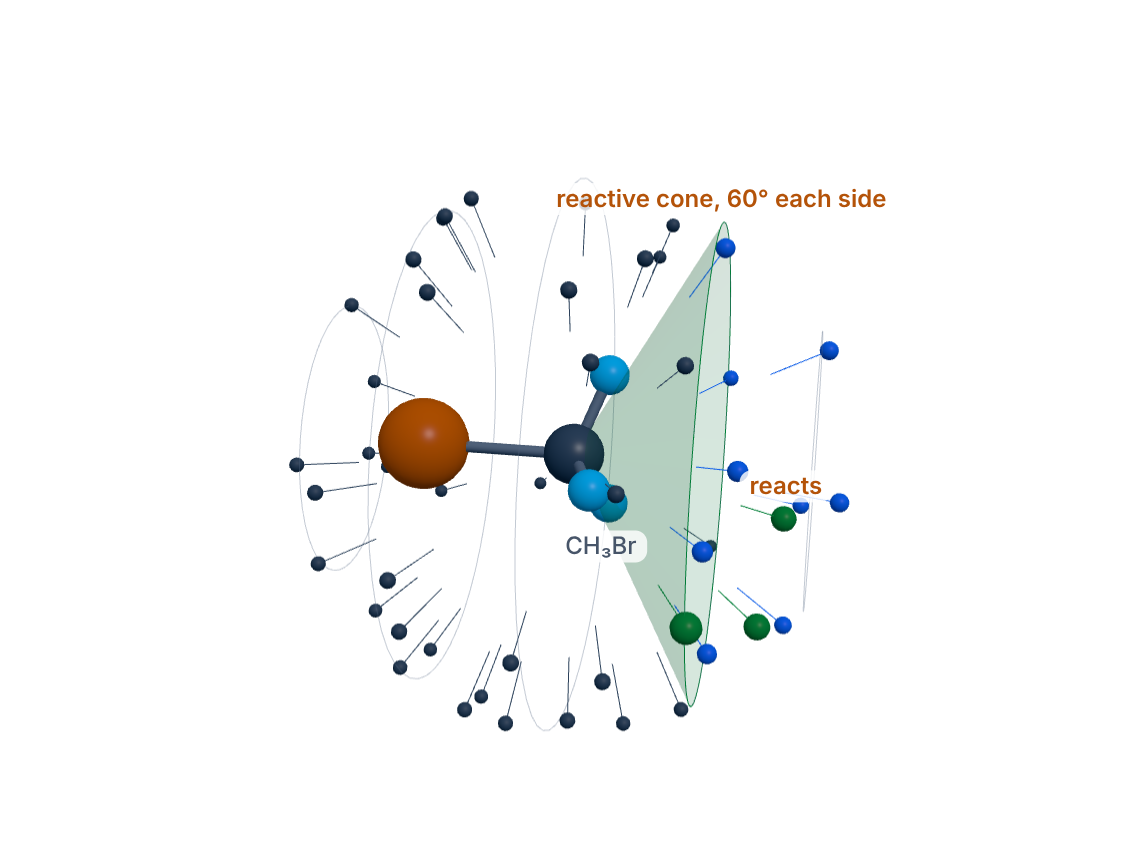
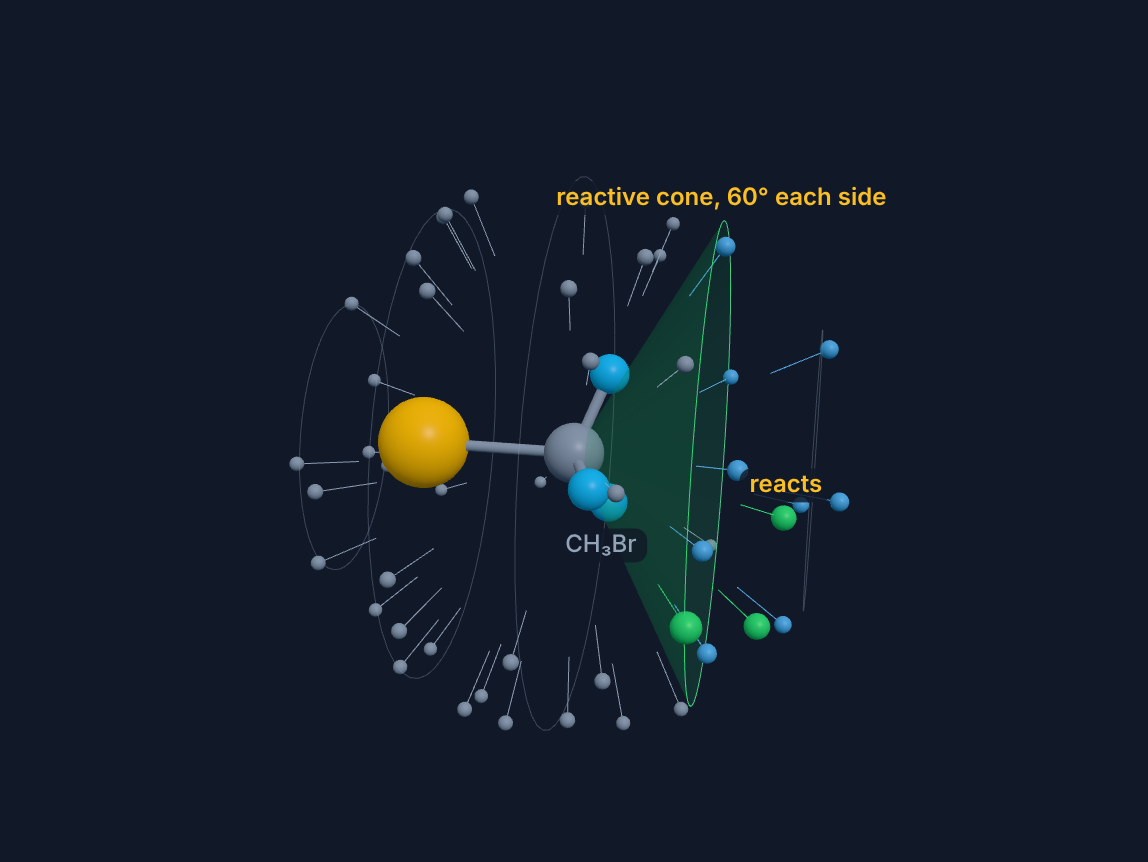
Rate = Z_AB·f·p where Z_AB = collision frequency, \(f = e^{-E_a/RT}\) (fraction with enough energy), p = steric factor.
Not all collisions are effective — need correct orientation AND energy ≥ Ea.
Rate-determining step (RDS) = slowest step → determines overall rate law.
Intermediates cancel out; only species present before RDS appear in rate law.
Molecularity = number of species in elementary step (1, 2, or 3). Order = from experiment.
Second: 1/[A]=1/[A]₀+kt; t½=1/(k[A]₀)
n=0: mol·L⁻¹·s⁻¹ | n=1: s⁻¹ | n=2: L·mol⁻¹·s⁻¹
- \(t_{1/2} = \dfrac{0.693}{k} = \dfrac{0.693}{0.0693} =\) 10 min
- 75% complete → [A] = 25% of [A]₀ = [A]₀/4 — reached after 2 half-lives
- \(t = 2\times t_{1/2} =\) 20 min
- \(k = \dfrac{\text{rate}}{[A]^2[B]} = 2\dfrac{\times10^{-6}}{(0.1)^2\times 0.2} = 2\dfrac{\times10^{-6}}{0.01\times 0.2} = 2\dfrac{\times10^{-6}}{2\times10^{-3}} =\) \(10^{-3}\) L²·mol⁻²·s⁻¹
- Order = 2+1 = 3 (third order). Units check: \((\mathrm{mol/L})^{1-3}\cdot s^{-1} = L^2\cdot mol^{-2}\cdot s^{-1}\) ✓
- $$ \ln(\frac{k_{2}}{k_{1}}) = \frac{Ea}{R}(\frac{1}{T_{1}}-\frac{1}{T_{2}}) = (\frac{50000}{8.314})(\frac{1}{300}-\frac{1}{310}) $$
- $$ = 6013\frac{\times(310-300)}{300\times310} = 6013\frac{\times10}{93000} = \frac{60130}{93000} = 0.6466 $$
- \(\dfrac{k_{2}}{k_{1}} = e^0.6466 \approx\) 1.91 (~double, consistent with the rule of thumb)
Concentration Terms
| Term | Formula | Units |
|---|---|---|
| Molarity (M) | moles of solute / volume of solution (L) | mol L⁻¹ |
| Molality (m) | moles of solute / mass of solvent (kg) | mol kg⁻¹ |
| Mole fraction (\(\chi\)) | \(n_A / (n_A + n_B)\); \(\chi_A + \chi_B = 1\) | dimensionless |
| Mass fraction (w) | mass of solute / total mass | dimensionless |
| ppm | mass of solute / total mass \(\times 10^6\) | mg kg⁻¹ |
Raoult's Law and Ideal Solutions
For a volatile solute in a volatile solvent:
\(p_A = \chi_A \cdot p_A^\circ\) (partial pressure = mole fraction × vapour pressure of pure component)
Total pressure: \(P = p_A + p_B = \chi_A p_A^\circ + \chi_B p_B^\circ\)
For a non-volatile solute: \(p_{solution} = \chi_{solvent} \cdot p^\circ_{solvent}\)
\((p^\circ - p) / p^\circ = \chi_{solute} = n_2 / (n_1 + n_2)\)
For dilute solutions: \(\approx \dfrac{n_{2}}{n_{1}} = w_{2}M_{1} / (w_{1}M_{2})\)
RLVP is a colligative property — depends only on number of solute particles, not their nature.
Ideal: \(\Delta H_{mix} = 0\), \(\Delta V_{mix} = 0\); obeys Raoult's law at all concentrations. A-B interactions = A-A = B-B.
Positive deviation: A-B < A-A/B-B; p > Raoult prediction. Examples: ethanol-water, acetone-CS₂.
Negative deviation: A-B > A-A/B-B; p < Raoult prediction. Examples: HCl-water, acetone-chloroform.
\(p = K_H \cdot \chi\) where \(K_H\) = Henry's law constant (large \(K_H\) → low solubility).
Solubility of gas ↑ with ↑ pressure and ↓ temperature.
Applications: carbonated drinks (CO₂ under pressure), scuba diving (N₂ narcosis), oxygen in blood.
Colligative Properties
Depend only on the number of solute particles in solution, not their identity.
| Property | Formula | Key point |
|---|---|---|
| Relative lowering of VP | \(\dfrac{p^{\circ}-p}{p^{\circ}} = \chi_{2}\) | χ₂ = mole fraction of solute |
| Elevation of boiling point | \(\Delta T_b = K_b \cdot m\) | \(K_b\) = ebullioscopic constant (solvent property) |
| Depression of freezing point | \(\Delta T_f = K_f \cdot m\) | \(K_f\) = cryoscopic constant; larger than \(K_b\) |
| Osmotic pressure | \(\pi = CRT = \frac{n}{V}RT\) | Van't Hoff equation; C in mol/L |
Abnormal Molar Masses and Van't Hoff Factor
i = observed colligative property / expected colligative property = actual moles / formula moles
| Case | i value | Example |
|---|---|---|
| No association/dissociation | i = 1 | Glucose, urea in water |
| Dissociation (electrolytes) | i > 1 | NaCl → Na⁺ + Cl⁻ → i = 2 (ideal); KCl, MgCl₂ |
| Association | i < 1 | Acetic acid in benzene: 2CH₃COOH ⇌ (CH₃COOH)₂ → i = 0.5 |
Modified formula: ΔT_f = i · K_f · m; \(\pi = i \cdot CRT\)
For α degree of dissociation into n ions: \(i = 1 + \alpha(n - 1)\)
\(\dfrac{p^\circ - p}{p^\circ} = \chi_{solute}\) (RLVP for non-volatile solute)
\(\pi = CRT\) (C in mol/L, R = 0.0821 L·atm/mol·K)
Water: \(K_f = 1.86\), \(K_b = 0.52\) K·kg·mol⁻¹
$$ \Delta T_f = i\cdot K_f\cdot m \quad|\quad \pi = i\cdot CRT $$
\(i = 1 + \alpha(n - 1)\) (\(\alpha\) = degree of dissociation, \(n\) = ions formed)
Solubility of gas ↑ with ↑ pressure, ↓ temperature
$$ m = (1000\cdot M) / (1000\rho - M\cdot M_{2}) $$
ρ = density (g/mL), M₂ = molar mass of solute (g/mol)
- Moles of glucose = 18/180 = 0.1 mol. Mass of solvent = 0.1 kg.
- m = 0.1/0.1 = 1 mol kg⁻¹
- $$ \Delta T_b = K_b \times m = 0.52 \times 1 = 0.52 K $$
- Boiling point = 100 + 0.52 = 100.52°C
- n(glucose) = 36/180 = 0.2 mol; n(water) = 180/18 = 10 mol
- χ(water) = 10/(10+0.2) = 10/10.2 = 0.9804
- p = χ(water) × p° = 0.9804 × 23.8 = 23.33 mmHg
- RLVP = (23.8−23.33)/23.8 = 0.0196 ≈ χ(glucose) = 0.2/10.2 = 0.0196 ✓
- Expected ΔT_f (if i=1) = 1.86 × 0.5 = 0.93°C
- i = observed ΔT_f / expected ΔT_f = 1.72 / 0.93 = 1.85
- For NaCl → Na⁺ + Cl⁻: ideal i = 2. Observed i = 1.85 → not fully dissociated due to ion-pairing.
- Using i = 1 + α(n−1): 1.85 = 1 + α(2−1) → α = 0.85 (85% dissociation)
- $$ \pi = CRT \to C = \frac{\pi}{RT} = (1.8\times10^{-3}) / (0.0821 \times 300) = 1.8\times10^{-3} / 24.63 = 7.31\times10^{-5} mol/L $$
- Moles in 500 mL = 7.31×10⁻⁵ × 0.5 = 3.655×10⁻⁵ mol
- M = mass/moles = 2 / 3.655×10⁻⁵ = 54,720 g/mol ≈ 54.7 kg/mol
- This illustrates why osmotic pressure (not ΔT_b or ΔT_f) is used for high-molar-mass substances — even tiny concentrations give measurable π.
Gas Laws
| Law | Relation | Constant |
|---|---|---|
| Boyle's Law | PV = constant → P₁V₁ = P₂V₂ | T, n fixed |
| Charles's Law | V/T = constant → V₁/T₁ = V₂/T₂ | P, n fixed |
| Gay-Lussac's Law | P/T = constant → P₁/T₁ = P₂/T₂ | V, n fixed |
| Avogadro's Law | V ∝ n at constant T, P | T, P fixed |
| Combined Gas Law | PV/T = constant → \(\dfrac{P_{1}V_{1}}{T_{1}} = \dfrac{P_{2}V_{2}}{T_{2}}\) | n fixed |
Ideal Gas Equation
PV = nRT
R = 8.314 J mol⁻¹ K⁻¹ = 0.0821 L·atm mol⁻¹ K⁻¹ = 2 cal mol⁻¹ K⁻¹
Molar mass from ideal gas: \(M = \dfrac{mRT}{PV} = \rho \dfrac{RT}{P}\) (where ρ = density, m = mass)
Dalton's Law of Partial Pressures: P_total = p₁ + p₂ + p₃ + … ; pᵢ = χᵢ · P_total
Kinetic Molecular Theory
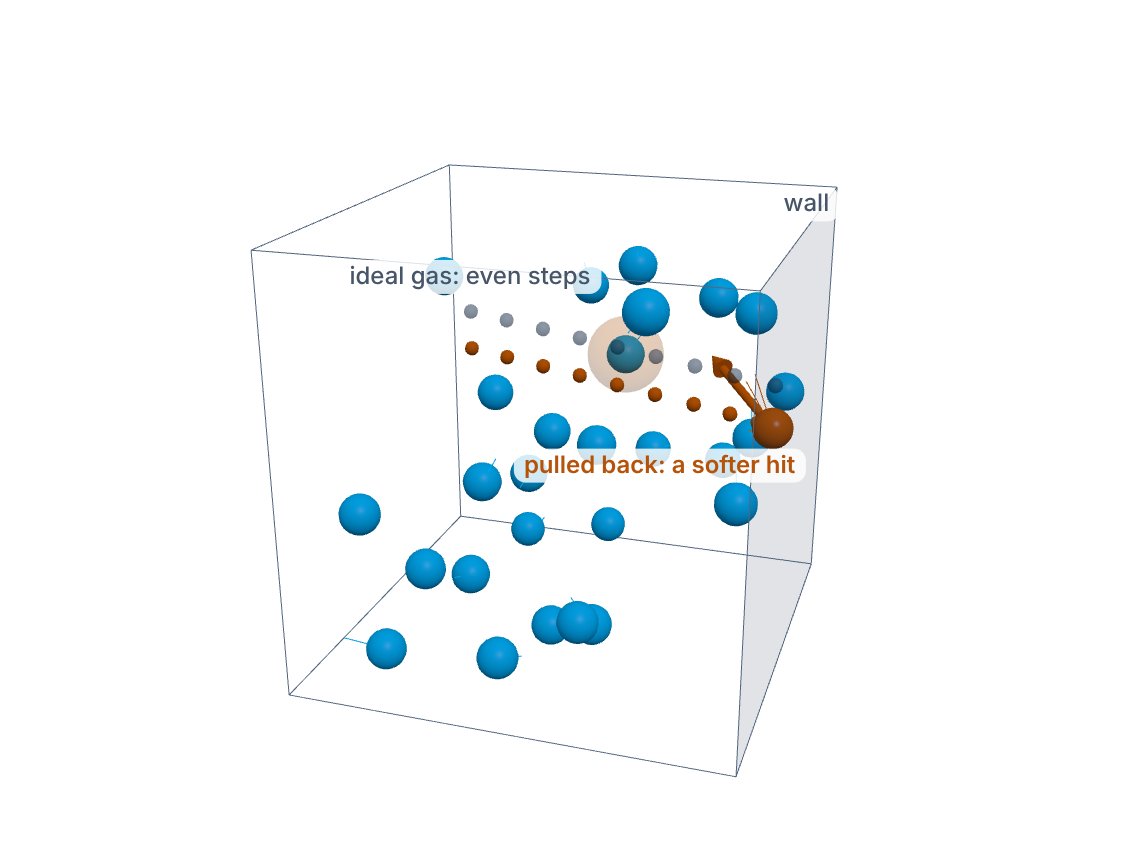
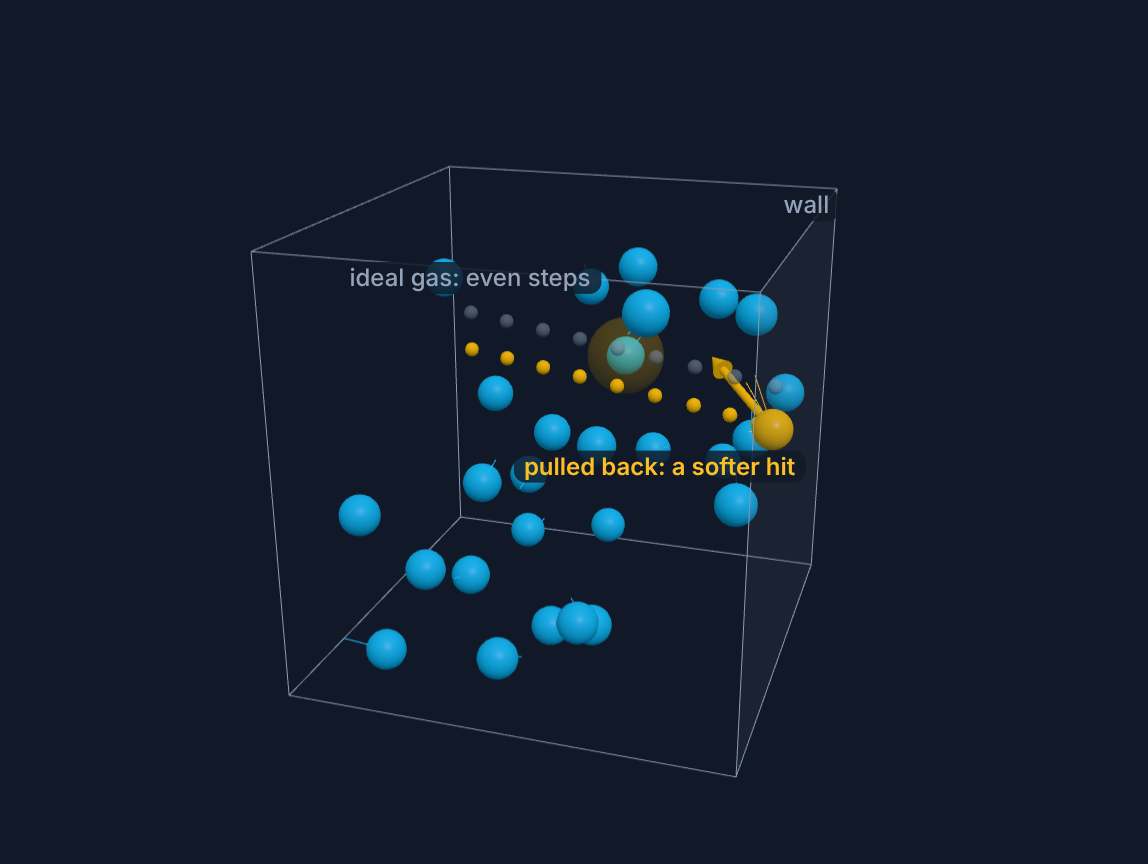
- Gas molecules are point masses (negligible volume)
- No intermolecular forces between molecules
- Collisions are perfectly elastic
- Average KE ∝ absolute temperature: KE = (3/2)RT per mole
u_rms = \(\sqrt{\dfrac{3RT}{M}}\) (root mean square)
ū = \(\sqrt{\dfrac{8RT}{\pi M}}\) (mean/average)
u_mp = \(\sqrt{\dfrac{2RT}{M}}\) (most probable)
Ratio: \(u_{mp} : \bar{u} : u_{rms} = \sqrt2 : \sqrt{\dfrac{8}{\pi}} : \sqrt3 = 1 : 1.128 : 1.225\)
All \(\propto \sqrt T\) and \(\propto \dfrac{1}{\sqrt M}\)
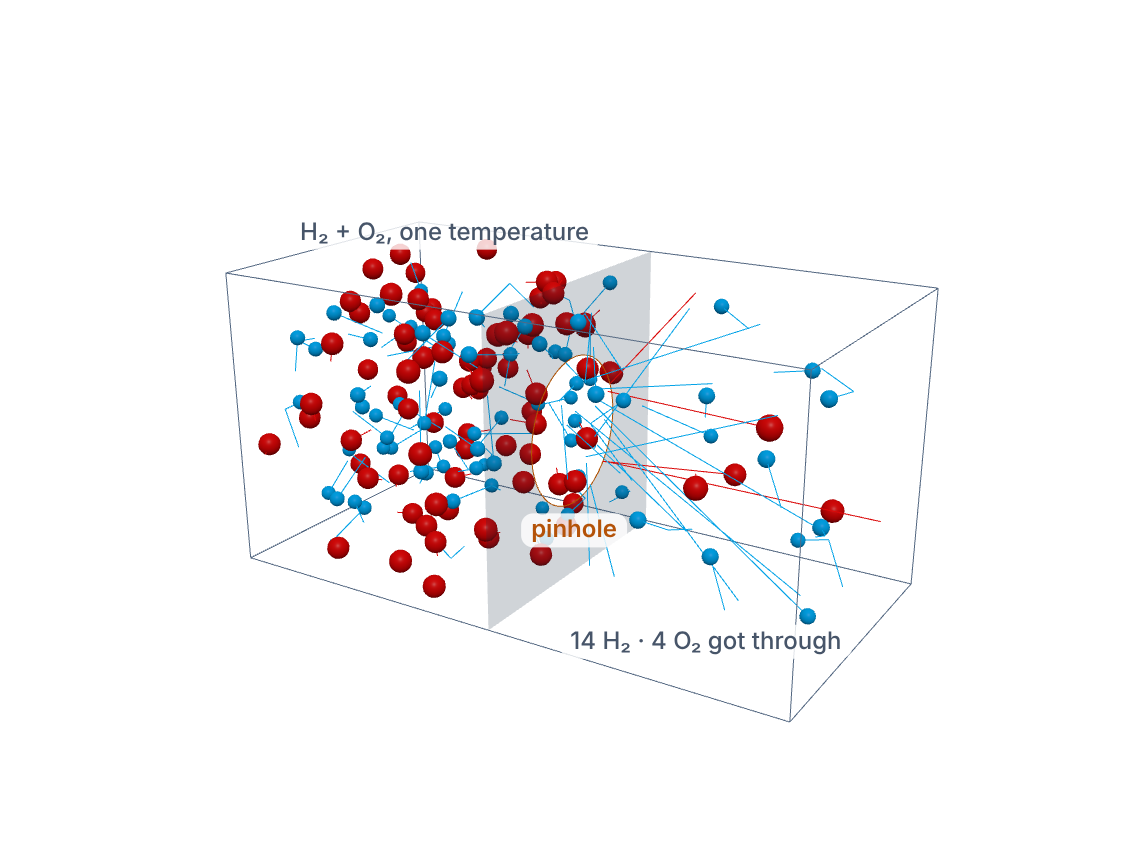
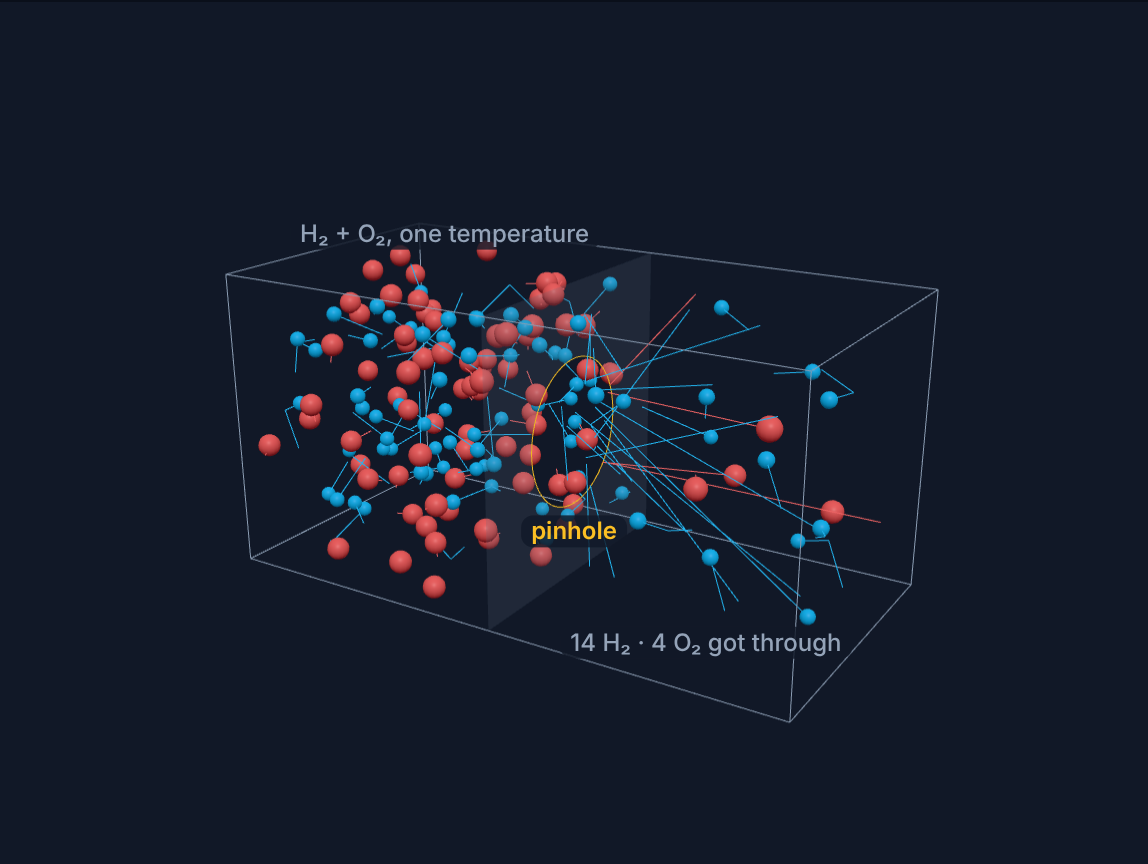
Rate of diffusion \(\propto \dfrac{1}{\sqrt M}\) (at same T and P)
$$ \frac{r_{1}}{r_{2}} = \sqrt{\frac{M_{2}}{M_{1}}} = \sqrt{\frac{d_{2}}{d_{1}}} $$
Used to compare diffusion rates of gases and to identify unknown gases by rate comparison.
$$ \lambda = RT / (\sqrt2 \cdot \pi d^{2} \cdot N_{a} \cdot P) $$
λ ↑ as P ↓ (fewer collisions) and T ↑
λ ↓ as molecular size (d) ↑
Collision frequency \(Z \propto \dfrac{P^2}{\sqrt T}\)
Real Gases and Van der Waals Equation
Ideal gas deviates at high P and low T. Two corrections:
$$ (P + \frac{an^{2}}{V^{2}})(V - nb) = nRT $$
| Constant | Corrects for | Effect |
|---|---|---|
| a (pressure correction) | Intermolecular attractions | Observed P < ideal; add a/V² to correct |
| b (volume correction) | Finite volume of molecules | Observed V > free space; subtract nb |
Compressibility factor Z = PV/nRT
| Z value | Behaviour | Dominant effect |
|---|---|---|
| Z = 1 | Ideal gas | — |
| Z < 1 (low P) | More compressible than ideal | Intermolecular attractions (a dominates) |
| Z > 1 (high P) | Less compressible than ideal | Finite volume of molecules (b dominates) |
Boyle temperature T_B = a/(Rb) — temperature at which a real gas behaves ideally over a wide pressure range (Z ≈ 1).
M = ρRT/P | P_total = Σpᵢ | pᵢ = χᵢ·P_total
Ratio u_mp : ū : u_rms = 1 : 1.128 : 1.225
a: intermolecular attractions | b: finite molecular volume
Boyle temperature T_B = a/(Rb)
H₂ and He: Z > 1 at all pressures (a ≈ 0)
- P₁V₁/T₁ = P₂V₂/T₂; \(T_{1} = 300 K, T_{2} = 400 K\)
- \(V_{2} = P_{1}V_{1}T_{2} / (T_{1}P_{2}) = (1 \times 5 \times 400) / (300 \times 2) = \dfrac{2000}{600} =\) 10/3 ≈ 3.33 L
- T = 300 K, M = 0.028 kg/mol, R = 8.314 J/mol·K
- $$ u_{rms} = \sqrt{\frac{3RT}{M}} = \sqrt{3 \times 8.314 \times 300 / 0.028} $$
- \(= \sqrt{7482.6 / 0.028} = \sqrt{267,236} =\) 517 m/s
- n(H₂) = 4/2 = 2 mol; n(O₂) = 32/32 = 1 mol; n_total = 3 mol
- χ(H₂) = 2/3; χ(O₂) = 1/3
- p(H₂) = (2/3) × 3 = 2 atm; p(O₂) = (1/3) × 3 = 1 atm
- \(u_{rms} \propto \sqrt{\dfrac{T}{M}}\). Set equal: \(\sqrt{\dfrac{T_{SO_2}}{64}} = \sqrt{\dfrac{298}{32}}\)
- T_SO₂/64 = 298/32
- T_SO₂ = 298 × 64/32 = 298 × 2 = 596 K = 323°C
- SO₂ (M=64) needs twice the temperature of O₂ (M=32) for the same rms speed, since M_SO₂ = 2 × M_O₂.
Surface Chemistry
Surface chemistry deals with phenomena occurring at interfaces — solid-gas, solid-liquid, and liquid-liquid — including adsorption, catalysis, colloids, and emulsions.
Adsorption
Adsorption vs Absorption
Adsorption: accumulation of a substance (adsorbate) on the surface of another (adsorbent). Surface phenomenon.
Absorption: uniform distribution throughout the bulk of the absorbing material.
Sorption: both adsorption and absorption occurring simultaneously.
Physisorption vs Chemisorption
| Property | Physisorption | Chemisorption |
|---|---|---|
| Force | van der Waals | Chemical bonds |
| ΔH | 20–40 kJ/mol | 40–400 kJ/mol |
| Reversibility | Reversible | Irreversible |
| Specificity | Non-specific | Highly specific |
| Layers | Multilayer | Monolayer only |
| Temp effect | Decreases with T | Initially increases, then decreases |
Factors Affecting Adsorption
- Nature of adsorbent: porous materials (charcoal, silica gel) have high surface area → greater adsorption
- Surface area: more surface area → more adsorption (finely divided > coarse)
- Nature of adsorbate: easily liquefiable gases (high \(T_{c}\)) are better adsorbed
- Temperature: physisorption decreases; chemisorption peaks then decreases
- Pressure: adsorption increases with pressure until saturation
Adsorption Isotherms
Freundlich isotherm: x/m = k·\(P^{1/n}\) (empirical; n > 1)
log(x/m) = log k + (1/n) log P — straight line graph; 1/n = slope
Langmuir isotherm: P/(x/m) = 1/(ab) + P/a — monolayer, homogeneous surface
At low P: x/m ∝ P (linear); At high P: x/m → constant (saturation)
Catalysis
Homogeneous Catalysis
Catalyst and reactants in the same phase.
Example: SO₂ oxidation — 2SO₂ + O₂ → 2SO₃ (catalyst: NO in gas phase)
Mechanism: catalyst forms intermediate compound with reactant; intermediate decomposes to give product and regenerate catalyst
Ea is lowered → rate increases without changing thermodynamics.
Heterogeneous Catalysis
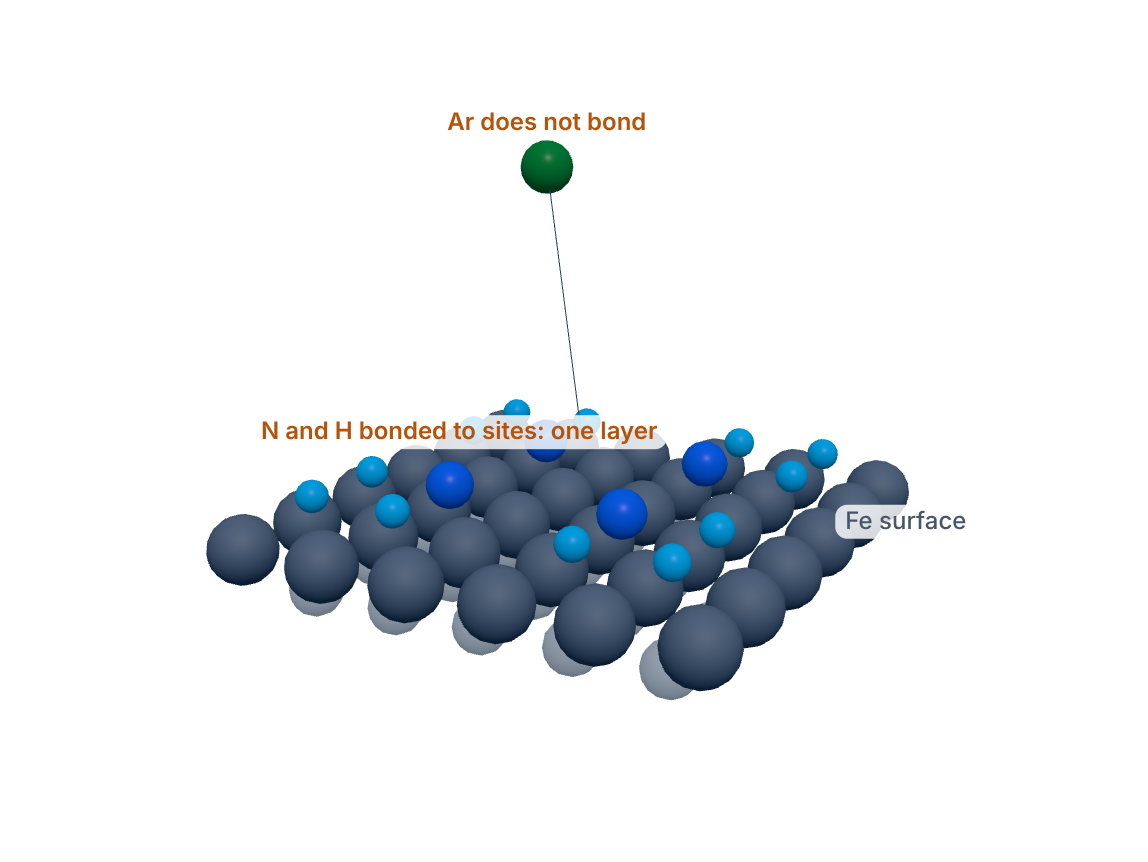
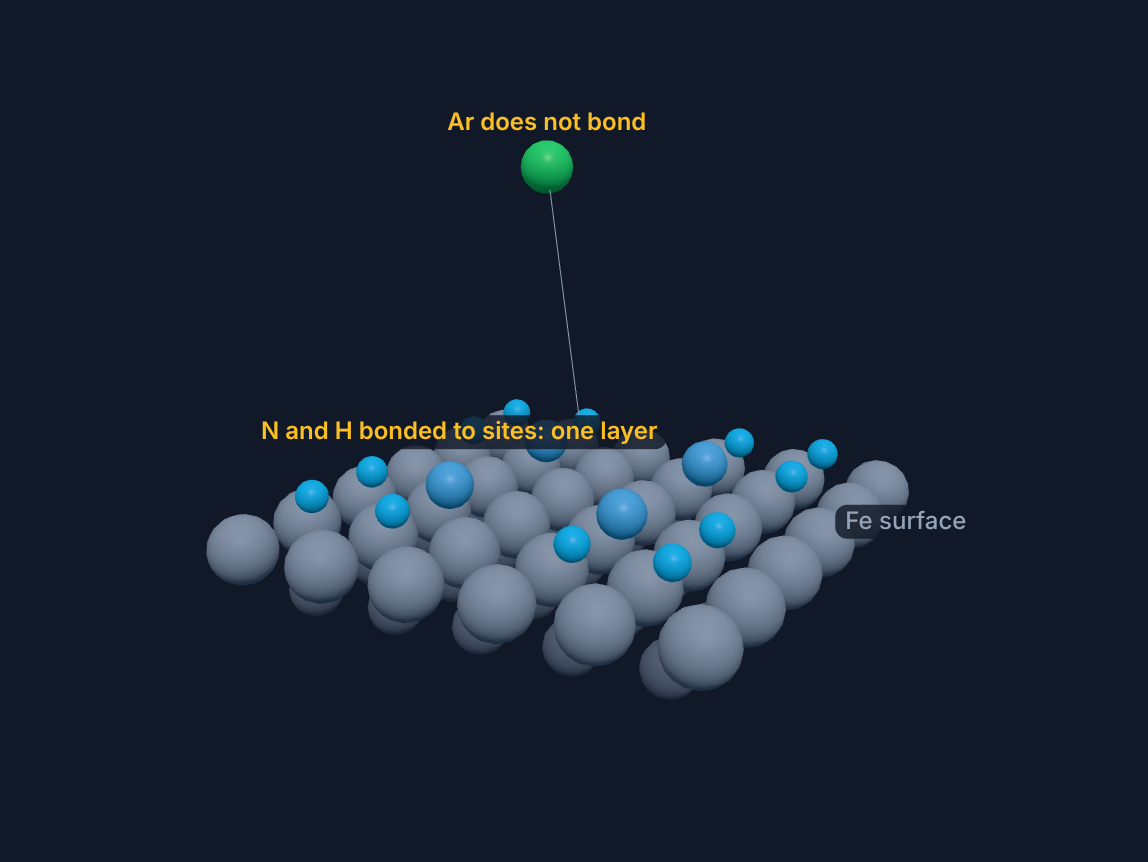
Catalyst and reactants in different phases. Reaction occurs on catalyst surface.
Steps: (1) Diffusion to surface → (2) Adsorption → (3) Reaction → (4) Desorption → (5) Diffusion away
Examples: Haber process (Fe catalyst); Contact process (V₂O₅); Hydrogenation of oils (Ni)
Promoters: enhance catalyst activity (e.g., Mo in Haber process)
Poisons: reduce activity (e.g., CO poisons Fe in Haber process)
Enzyme Catalysis
Biological catalysts; highly specific (lock-and-key model).
Properties: colloidal in nature; specific; greatly accelerate reaction; optimum temperature and pH; destroyed by high T or pH extremes
Michaelis-Menten kinetics: rate = \(V_{max}\)[S] / (\(K_{m}\) + [S])
At [S] << \(K_{m}\): first order; At [S] >> \(K_{m}\): zero order (saturation)
Colloids
Colloidal State
Particle size: 1–1000 nm (intermediate between true solution and suspension)
| Type | Particle size | Visibility |
|---|---|---|
| True solution | <1 nm | Not visible |
| Colloidal sol | 1–1000 nm | Ultramicroscope |
| Suspension | >1000 nm | Naked eye |
Classification of Colloids
By interaction with medium:
- Lyophilic: attracted to solvent (gelatin, starch, gum) — stable, reversible
- Lyophobic: repelled by solvent (metal sols, sulfur sol) — unstable, irreversible
Dispersed phase / Dispersion medium combinations:
- Sol: solid in liquid (Fe(OH)₃ sol)
- Gel: liquid in solid (cheese, butter)
- Emulsion: liquid in liquid (milk, mayonnaise)
- Aerosol: solid/liquid in gas (fog, smoke)
- Foam: gas in liquid (shaving cream)
Properties of Colloids
- Tyndall effect: scattering of light by colloidal particles — cone of light visible (true solutions don't show this)
- Brownian motion: zigzag random motion of colloidal particles; caused by unequal bombardment by dispersion medium molecules
- Electrophoresis: migration of colloidal particles toward oppositely charged electrode under electric field
- Coagulation: aggregation and settling of colloidal particles. Hardy-Schulze rule: higher the valence of coagulating ion → greater the coagulating power
Preparation and Purification
Dispersion methods: Bredig's arc (metals), peptization (adding electrolyte to precipitate)
Condensation methods: double decomposition (As₂S₃ from H₃AsO₃ + H₂S), reduction (Au/Ag sol), oxidation
Purification:
- Dialysis: removal of small ions/molecules through semipermeable membrane
- Electrodialysis: same but speeded by electric field
- Ultrafiltration: use of ultrafilter paper (very fine pores)
Emulsions
Types of Emulsions
O/W (oil in water): oil droplets dispersed in water — milk, cold cream. Emulsifier: soap, protein
W/O (water in oil): water droplets dispersed in oil — butter, cream. Emulsifier: heavy metal soaps
Emulsifiers: stabilise emulsions by adsorbing at interface and reducing surface tension
Demulsification: breaking emulsion by heating, centrifugation, adding demulsifier, or electric field
Surface Chemistry — Key Formulas
Solved Examples
- Solution:
- Freundlich: \(\dfrac{x}{m} = k\cdot P^{1/n}\)
- When P → 2P: \(new \frac{x}{m} = k\cdot(2P)^{1/n} = 2^{1/n} \cdot \frac{x}{m}\)
- Given factor = \(2^{0.4}\)
- \(∴ 2^{1/n} = 2^{0.4} \to\) 1/n = 0.4
- This means n = 2.5. The adsorption increases sub-linearly with pressure.
- Solution:
- Fe(OH)₃ sol is positively charged (Fe³⁺ ions on surface).
- Coagulation is done by the oppositely charged (negative) ions.
- By Hardy-Schulze rule: coagulating power ∝ valence of ion
- PO₄³⁻ (valence 3) > SO₄²⁻ (valence 2) > Cl⁻ (valence 1)
- ∴ Coagulating power: Na₃PO₄ > Na₂SO₄ > NaCl
- Solution:
- Arrhenius equation: k = A·\(e^{-Ea/RT}\)
- Rate factor = \(\dfrac{k_{cat}}{k_{uncat}}\) = \(e^{-(Ea,cat - Ea,uncat)/RT}\)
- ΔEa = 80 − 50 = 30 kJ/mol = 30,000 J/mol
- $$ \Delta \frac{Ea}{RT} = 30000 / (8.314 \times 300) = 12.03 $$
- Rate factor = \(e^{12.03}\) ≈ 1.67 × 10⁵
- Rate increases by about 167,000 times — dramatic effect of catalysis.
- Solution:
- Lyophilic colloids (e.g., gelatin, starch):
- Have high affinity for the dispersion medium
- Surrounded by a solvation (hydration) shell that prevents aggregation
- Charge is not essential for stability
- Reversible — can be reconstituted after drying
- Lyophobic colloids (e.g., metal sols):
- Low affinity for dispersion medium
- Stability depends entirely on charge (electrostatic repulsion between particles)
- Adding electrolytes neutralises charge → coagulation occurs
- Irreversible — cannot be reconstituted easily
- Addition of lyophilic colloid to lyophobic protects it (protective colloid action — Gold Number concept).